Collier Sigrid, Semeere Aggrey, Byakwaga Helen, Laker-Oketta Miriam, Chemtai Linda, Wagner Anjuli D, Bassett Ingrid V, Wools-Kaloustian Kara, Maurer Toby, Martin Jeffrey, Kiprono Samson, Freeman Esther E
University of Washington, Seattle, WA, USA.
Infectious Disease Institute, Kampala, Uganda.
Implement Sci Commun. 2022 May 13;3(1):50. doi: 10.1186/s43058-022-00281-7.
For people with advanced-stage Kaposi's sarcoma (KS), a common HIV-associated malignancy in sub-Saharan Africa, mortality is estimated to be 45% within 2 years after KS diagnosis, despite increasingly wide-spread availability of antiretroviral therapy and chemotherapy. For advanced-stage KS, chemotherapy in addition to antiretroviral therapy improves outcomes and saves lives, but currently, only ~50% of people with KS in western Kenya who have an indication for chemotherapy actually receive it. This protocol describes the evaluation of a multicomponent patient navigation strategy that addresses common barriers to service penetration of and fidelity to evidence-based chemotherapy among people with advanced-stage KS in Kenya.
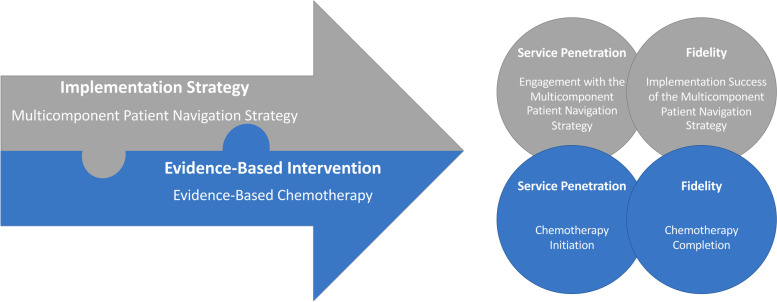
This is a hybrid type III effectiveness-implementation study using a non-randomized, pre- post-design nested within a longitudinal cohort. We will compare the delivery of evidence-based chemotherapy for advanced-stage KS during the period before (2016-2020) to the period after (2021-2024), the rollout of a multicomponent patient navigation strategy. The multicomponent patient navigation strategy was developed in a systematic process to address key determinants of service penetration of and fidelity to chemotherapy in western Kenya and includes (1) physical navigation and care coordination, (2) video-based education, (3) travel stipend, (4) health insurance enrollment assistance, (5) health insurance stipend, and (6) peer mentorship. We will compare the pre-navigation period to the post-navigation period to assess the impact of this multicomponent patient navigation strategy on (1) implementation outcomes: service penetration (chemotherapy initiation) and fidelity (chemotherapy completion) and (2) service and client outcomes: timeliness of cancer care, mortality, quality of life, stigma, and social support. We will also describe the implementation process and the determinants of implementation success for the multicomponent patient navigation strategy.
This study addresses an urgent need for effective implementation strategies to improve the initiation and completion of evidence-based chemotherapy in advanced-stage KS. By using a clearly specified, theory-based implementation strategy and validated frameworks, this study will contribute to a more comprehensive understanding of how to improve cancer treatment in advanced-stage KS.
对于患有晚期卡波西肉瘤(KS)的患者而言,这是撒哈拉以南非洲地区一种常见的与艾滋病相关的恶性肿瘤,尽管抗逆转录病毒疗法和化疗的可及性日益广泛,但据估计,在KS诊断后的2年内死亡率为45%。对于晚期KS,除抗逆转录病毒疗法外进行化疗可改善治疗效果并挽救生命,但目前,在肯尼亚西部,只有约50%有化疗指征的KS患者实际接受了化疗。本方案描述了对一种多组分患者导航策略的评估,该策略旨在解决肯尼亚晚期KS患者在基于证据的化疗服务普及和依从性方面的常见障碍。
这是一项III型混合有效性-实施研究,采用非随机、前后设计,并嵌套在一个纵向队列中。我们将比较在多组分患者导航策略推出之前(2016 - 2020年)和之后(2021 - 2024年)晚期KS基于证据的化疗的提供情况。多组分患者导航策略是通过一个系统过程制定的,以解决肯尼亚西部化疗服务普及和依从性的关键决定因素,包括(1)实体导航和护理协调,(2)基于视频的教育,(3)差旅补贴,(4)医疗保险参保协助,(5)医疗保险补贴,以及(6)同伴指导。我们将比较导航前时期和导航后时期,以评估这种多组分患者导航策略对(1)实施结果:服务普及(化疗开始)和依从性(化疗完成),以及(2)服务和患者结果:癌症护理的及时性、死亡率、生活质量、耻辱感和社会支持的影响。我们还将描述多组分患者导航策略的实施过程以及实施成功的决定因素。
本研究满足了对有效实施策略的迫切需求,以改善晚期KS中基于证据的化疗的启动和完成情况。通过使用明确规定的、基于理论的实施策略和经过验证的框架,本研究将有助于更全面地理解如何改善晚期KS的癌症治疗。