Division of Dermatology, University of Washington, Seattle, Washington, USA.
Virginia Commonwealth University School of Medicine, Richmond, Virginia, USA.
J Int AIDS Soc. 2022 Jul;25 Suppl 1(Suppl 1):e25918. doi: 10.1002/jia2.25918.
The experience of stigma can be multifaceted for people with HIV and cancer. Kaposi's sarcoma (KS), one of the most common HIV-associated cancers in sub-Saharan Africa, often presents with visible skin lesions that may put people at risk for stigmatization. In this way, HIV-associated KS is unique, as people with KS can experience stigma associated with HIV, cancer, and skin disease simultaneously. The aim of this study is to characterize the intersectionality of HIV-related, cancer-related and skin disease-related stigma in people living with HIV and KS.
We used a convergent mixed-methods approach nested within a longitudinal study of people with HIV-associated KS in western Kenya. Between February 2019 and December 2020, we collected quantitative surveys among all participants and conducted semi-structured interviews among a purposive sample of participants. Quantitative surveys were adapted from the abridged Berger HIV Stigma Scale to assess overall stigma, HIV-related stigma, cancer-related stigma, and skin disease-related stigma. Qualitative data were coded using stigma constructs from the Health Stigma and Discrimination Framework.
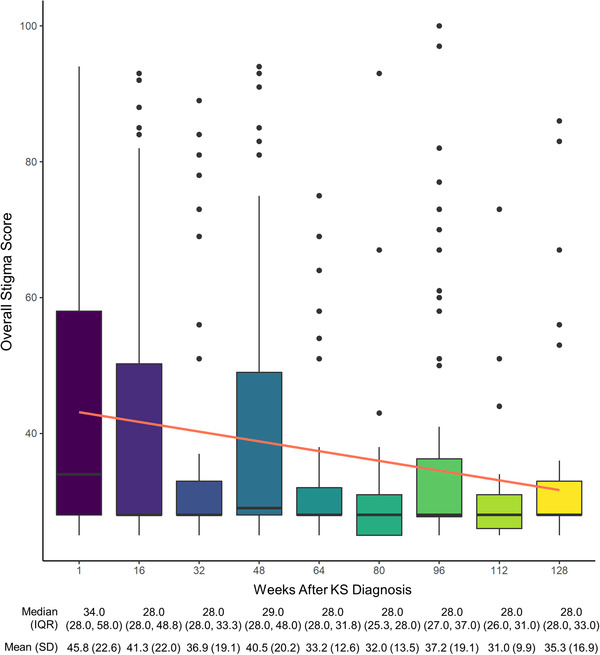
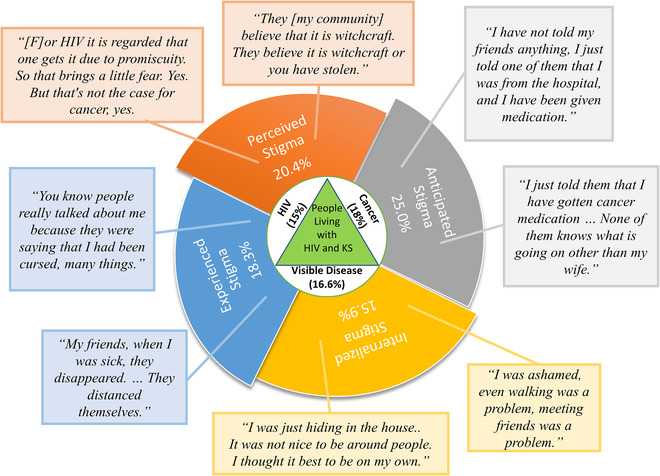
In 88 semi-structured interviews, stigma was a major barrier to KS diagnosis and treatment among people with HIV-associated KS. Participant's stories of stigma were dominated by HIV-related stigma, more than cancer-related or skin disease-related stigma. However, quantitative stigma scores among the 117 participants were similar for HIV-related (Median: 28.00; IQR: 28.0, 34.0), cancer-related (Median: 28.0; IQR: 28.0, 34.8), and skin disease-related stigma (Median: 28.0; IQR: 27.0, 34.0). In semi-structured interviews, cancer-related and skin disease-related stigma were more subtle contributors; cancer-related stigma was linked to fatalism and skin-related stigma was linked to visible disease. Participants reported resolution of skin lesions contributed to lessening stigma over time; there was a significant decline in quantitative scores of overall stigma in time since KS diagnosis (adjusted β = -0.15, p <0.001).
This study highlights the role mixed-method approaches can play in better understanding stigma in people living with both HIV and cancer. While HIV-related stigma may dominate perceptions of stigma among people with KS in Kenya, intersectional experiences of stigma may be subtle, and quantitative evaluation alone may be insufficient to understand intersectional stigma in certain contexts.
艾滋病毒感染者和癌症患者可能会经历多方面的污名化。卡波西肉瘤(KS)是撒哈拉以南非洲地区最常见的艾滋病毒相关癌症之一,其常见的皮肤损伤可能会使人们面临污名化的风险。在这种情况下,艾滋病毒相关的 KS 是独特的,因为 KS 患者可能同时经历与艾滋病毒、癌症和皮肤病相关的污名化。本研究旨在描述在肯尼亚西部艾滋病毒相关 KS 患者中,与艾滋病毒相关、与癌症相关和与皮肤病相关的污名之间的交叉情况。
我们采用了纵向研究中嵌套的收敛混合方法,该研究针对的是肯尼亚西部艾滋病毒相关 KS 患者。在 2019 年 2 月至 2020 年 12 月期间,我们在所有参与者中收集了定量调查,并在有目的的参与者样本中进行了半结构访谈。定量调查改编自缩短版的 Berger HIV 污名量表,用于评估整体污名、与艾滋病毒相关的污名、与癌症相关的污名和与皮肤病相关的污名。定性数据使用健康污名和歧视框架中的污名结构进行编码。
在 88 次半结构访谈中,KS 患者的 KS 诊断和治疗面临严重的污名障碍。参与者的污名故事主要是与艾滋病毒相关的污名,而不是与癌症相关或与皮肤病相关的污名。然而,117 名参与者的定量污名评分在与艾滋病毒相关的污名(中位数:28.00;IQR:28.0,34.0)、与癌症相关的污名(中位数:28.00;IQR:28.0,34.8)和与皮肤病相关的污名(中位数:28.00;IQR:27.0,34.0)方面相似。在半结构访谈中,与癌症相关和与皮肤病相关的污名是更微妙的因素;与癌症相关的污名与宿命论有关,与皮肤病相关的污名与可见的疾病有关。参与者报告说,皮肤损伤的缓解有助于随着时间的推移减轻污名;自 KS 诊断以来,整体污名的定量评分显著下降(调整β=-0.15,p<0.001)。
本研究强调了混合方法在更好地理解肯尼亚艾滋病毒和癌症共存患者的污名方面可以发挥的作用。虽然与艾滋病毒相关的污名可能主导了 KS 患者对污名的看法,但交叉的污名经历可能是微妙的,在某些情况下,仅进行定量评估可能不足以理解交叉污名。