HIV and AIDS Malignancy Branch, Center for Cancer Research, National Cancer Institute, Building 10, Rm. 6N106, MSC 1868, 10 Center Drive, Bethesda, MD, 20892-1868, USA.
J Transl Med. 2022 May 13;20(1):217. doi: 10.1186/s12967-022-03400-z.
The two oncogenic human gammaherpesviruses, Kaposi sarcoma-associated herpesvirus (KSHV) and Epstein-Barr virus (EBV), both downregulate immune surface molecules, such as MHC-I, ICAM-1, and B7-2, enabling them to evade T-cell and natural killer cell immunity. Both also either encode for human cyclin homologues or promote cellular cyclin activity, and this has been shown to be important for proliferation and survival of gammaherpesvirus-induced tumors. CDK4/6 inhibitors, which are approved for certain breast cancers, have been shown to enhance expression of MHC-I in cell lines and murine models of breast cancer, and this was attributed to activation of interferons by endogenous retrovirus elements. However, it was not known if this would occur in gammaherpesvirus-induced tumors in which interferons are already activated.
Multiple KSHV/EBV-infected cell lines were treated with CDK4/6 inhibitors. The growth of viable cells and expression of surface markers was assessed. T cell activation stimulated by the treated cells was assayed by a T-cell activation bioassay. Both viral and host gene expression was surveyed using RT-qPCR.
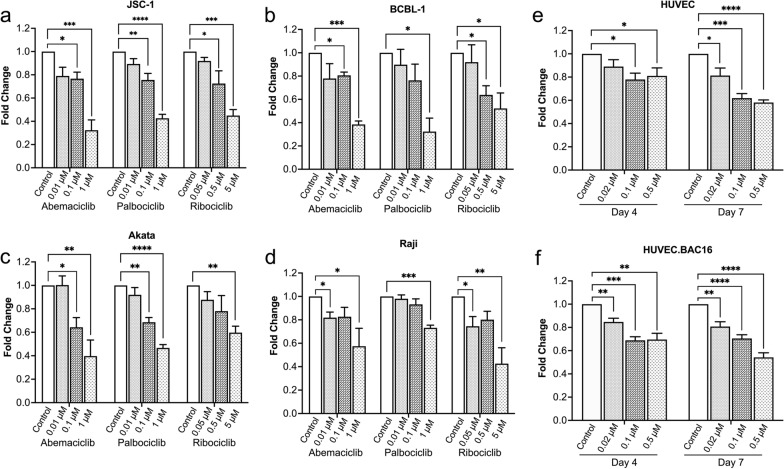
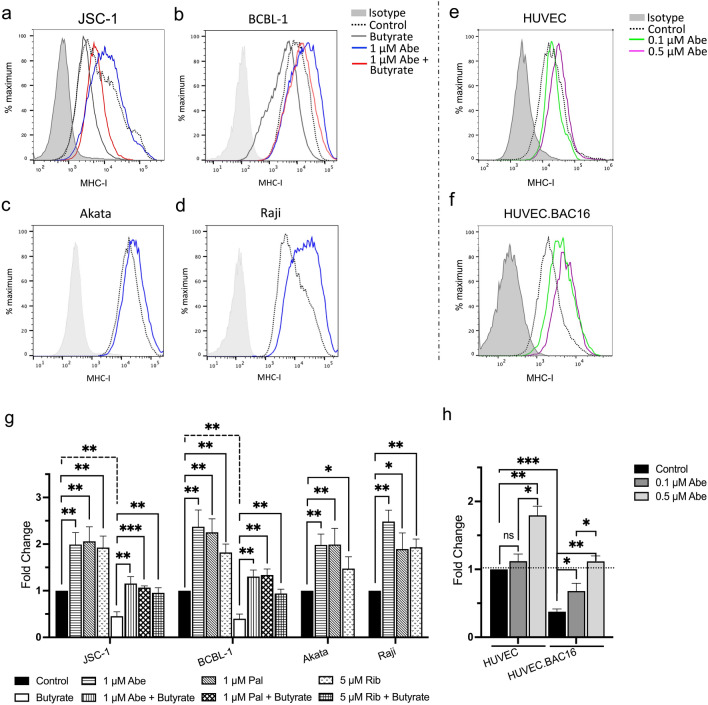
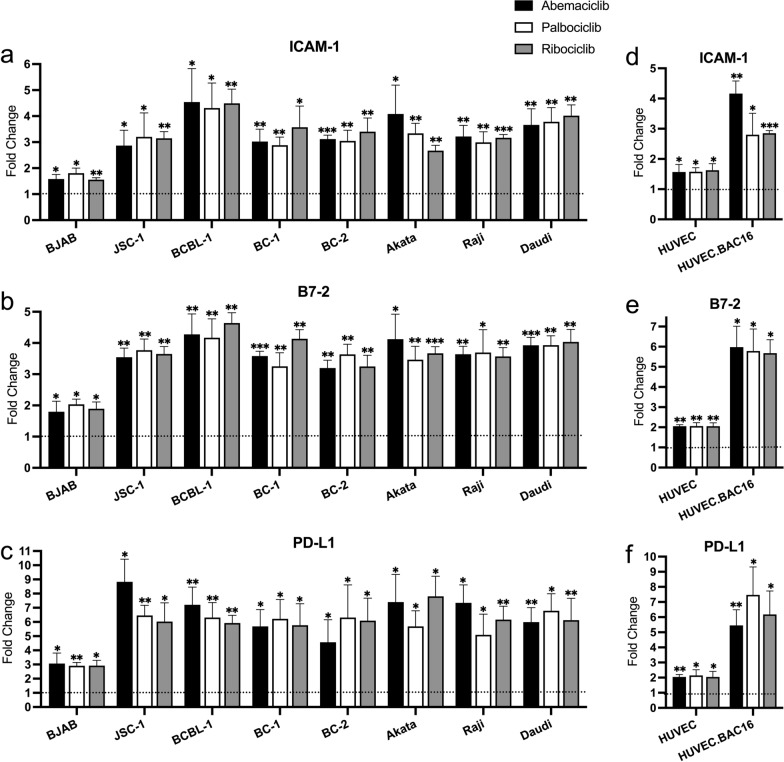
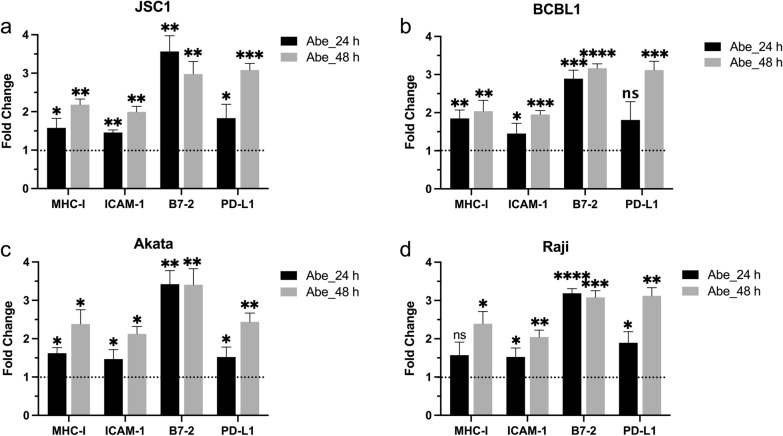
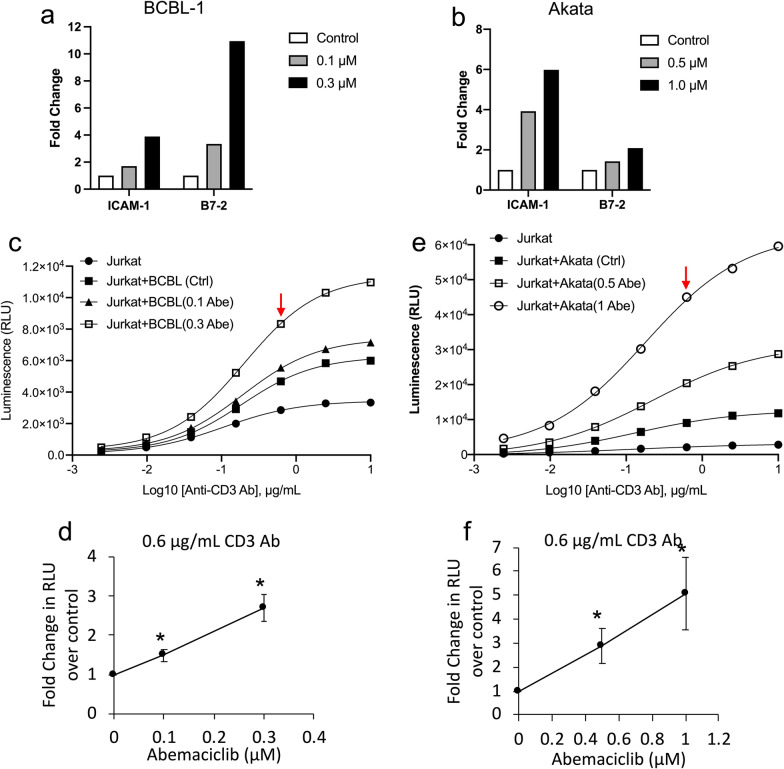
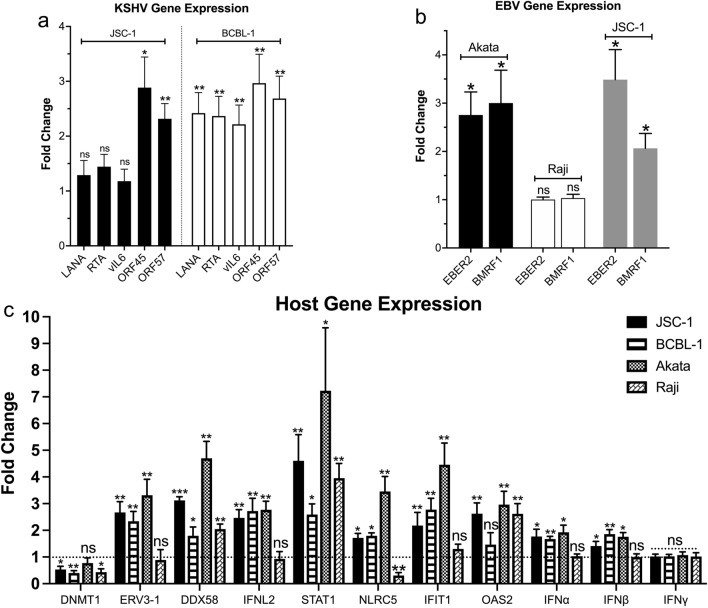
Three CDK4/6 inhibitors, abemaciclib, palbociclib, and ribociclib, inhibited cell growth in KSHV-induced primary effusion lymphoma (PEL) and EBV positive Burkitt's lymphoma (BL) cell lines, and KSHV-infected human umbilical vein endothelial cells (HUVECs). Moreover, CDK4/6 inhibitors increased mRNA and surface expression of MHC-I in all three and prevented downregulation of MHC-I surface expression during lytic replication in KSHV-infected cells. CDK4/6 inhibitors also variably increased mRNA and surface expression of ICAM-1 and B7-2 in the tested lines. Abemaciclib also significantly enhanced T-cell activation induced by treated PEL and BL cells. Certain gammaherpesvirus genes as well as endogenous retrovirus (ERV) 3-1 genes were enhanced by CDK4/6 inhibitors in most PEL and BL lines and this enhancement was associated with expression of gamma interferon-induced genes including MHC-I.
These observations provide evidence that CDK4/6 inhibitors can induce expression of surface immune markers MHC-I, B7-2, and ICAM-1 in gammaherpesvirus-infected cell lines and induce virus-specific immunity. They can thus thwart virus-induced immune evasion. These effects, along with their direct effects on KSHV- or EBV-induced tumors, provide a rational for the clinical testing of these drugs in these tumors.
两种致癌的人类γ疱疹病毒,卡波西肉瘤相关疱疹病毒(KSHV)和 EBV,都下调免疫表面分子,如 MHC-I、ICAM-1 和 B7-2,使它们能够逃避 T 细胞和自然杀伤细胞的免疫。两者都编码人类细胞周期蛋白同源物或促进细胞周期蛋白活性,这对于 γ疱疹病毒诱导的肿瘤的增殖和存活很重要。CDK4/6 抑制剂已被批准用于某些乳腺癌,已被证明可增强乳腺癌细胞系和小鼠模型中 MHC-I 的表达,这归因于内源性逆转录病毒元件激活干扰素。然而,尚不清楚这是否会发生在干扰素已被激活的 γ疱疹病毒诱导的肿瘤中。
用 CDK4/6 抑制剂处理多种 KSHV/EBV 感染的细胞系。评估活细胞的生长和表面标记物的表达。通过 T 细胞激活生物测定检测经处理的细胞刺激的 T 细胞激活。使用 RT-qPCR 调查病毒和宿主基因的表达。
三种 CDK4/6 抑制剂,阿贝西利、哌柏西利和瑞波西利,抑制 KSHV 诱导的原发性渗出性淋巴瘤(PEL)和 EBV 阳性伯基特淋巴瘤(BL)细胞系以及 KSHV 感染的人脐静脉内皮细胞(HUVEC)的细胞生长。此外,CDK4/6 抑制剂增加了所有三种细胞系中 MHC-I 的 mRNA 和表面表达,并防止了 KSHV 感染细胞中的裂解复制过程中 MHC-I 表面表达的下调。CDK4/6 抑制剂还可不同程度地增加所测试细胞系中 ICAM-1 和 B7-2 的 mRNA 和表面表达。阿贝西利还显著增强了经处理的 PEL 和 BL 细胞诱导的 T 细胞激活。在大多数 PEL 和 BL 细胞系中,CDK4/6 抑制剂增强了某些 γ 疱疹病毒基因和内源性逆转录病毒(ERV)3-1 基因,这种增强与 γ 干扰素诱导基因的表达相关,包括 MHC-I。
这些观察结果提供了证据,表明 CDK4/6 抑制剂可诱导 γ 疱疹病毒感染细胞系中表面免疫标志物 MHC-I、B7-2 和 ICAM-1 的表达,并诱导病毒特异性免疫。因此,它们可以挫败病毒诱导的免疫逃逸。这些作用以及它们对 KSHV 或 EBV 诱导的肿瘤的直接作用,为这些药物在这些肿瘤中的临床测试提供了依据。