Institute of Agrobiological Sciences, National Agriculture and Food Research Organization (NIAS), Tsukuba 305-8602, Japan.
Institute of Vegetable and Floriculture Science, National Agriculture and Food Research Organization (NIVFS), Tsukuba 305-0852, Japan.
Int J Mol Sci. 2022 Apr 25;23(9):4735. doi: 10.3390/ijms23094735.
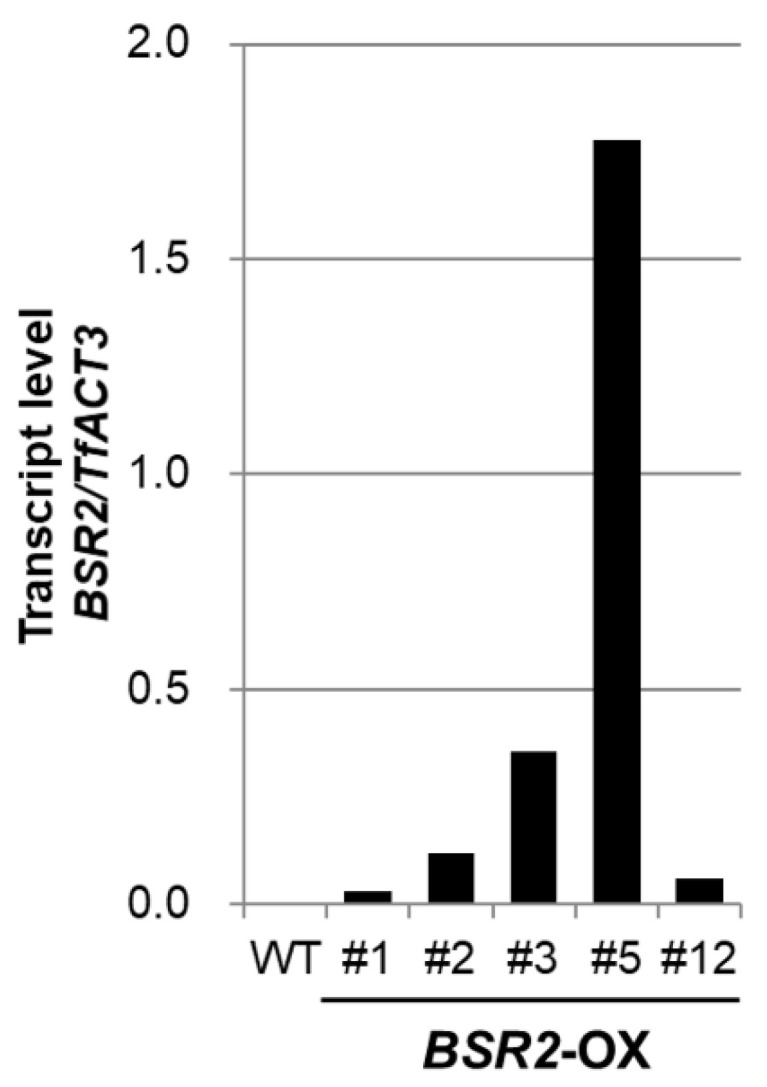
Plant pathogens evade basal defense systems and attack different organs and tissues of plants. Genetic engineering of plants with genes that confer resistance against pathogens is very effective in pathogen control. Conventional breeding for disease resistance in ornamental crops is difficult and lagging relative to that in non-ornamental crops due to an inadequate number of disease-resistant genes. Therefore, genetic engineering of these plants with defense-conferring genes is a practical approach. We used rice encoding CYP78A15 for developing transgenic Lind. lines. The overexpression of conferred resistance against two devastating fungal pathogens, and . In addition, overexpression resulted in enlarged flowers with enlarged floral organs. Histological observation of the petal cells suggested that the enlargement in the floral organs could be due to the elongation and expansion of the cells. Therefore, the overexpression of confers broad-spectrum disease resistance and induces the production of enlarged flowers simultaneously. Therefore, this could be an effective strategy for developing ornamental crops that are disease-resistant and economically more valuable.
植物病原体逃避基础防御系统,并攻击植物的不同器官和组织。利用赋予植物对病原体抗性的基因对植物进行基因工程改造在病原体控制方面非常有效。由于抗病基因数量不足,观赏作物的常规抗病性育种相对于非观赏作物来说较为困难且滞后。因此,利用赋予防御能力的基因对这些植物进行基因工程改造是一种切实可行的方法。我们使用编码 CYP78A15 的水稻来开发转基因 Lind. 品系。过表达 赋予了对两种毁灭性真菌病原体 和 的抗性。此外,过表达导致花朵增大,花器官增大。对花瓣细胞的组织学观察表明,花器官的增大可能是由于细胞的伸长和扩张。因此,过表达 赋予广谱抗病性,并同时诱导产生增大的花朵。因此,这可能是开发具有抗病性和更具经济价值的观赏作物的有效策略。