Institute of Basic Medical Sciences, College of Medicine, National Cheng Kung University, Tainan 701401, Taiwan.
Institute of Oral Medicine, College of Medicine, National Cheng Kung University, Tainan 701401, Taiwan.
Int J Mol Sci. 2022 Apr 27;23(9):4833. doi: 10.3390/ijms23094833.
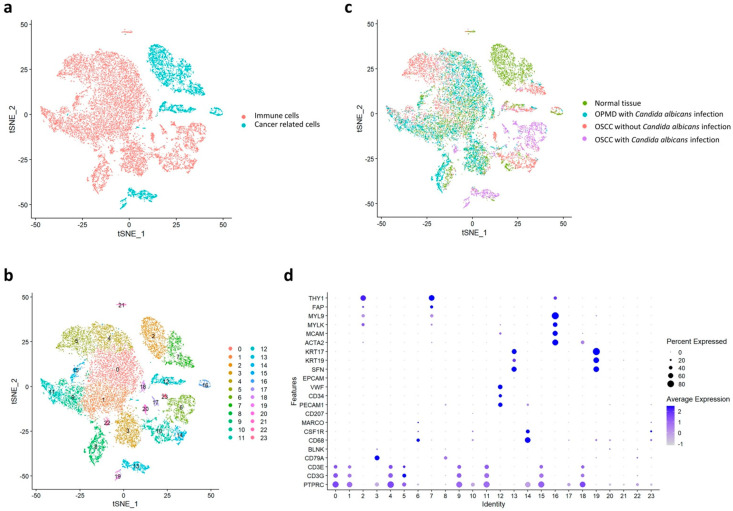
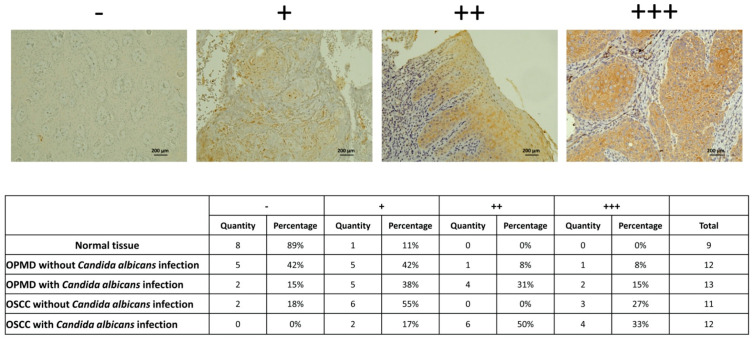
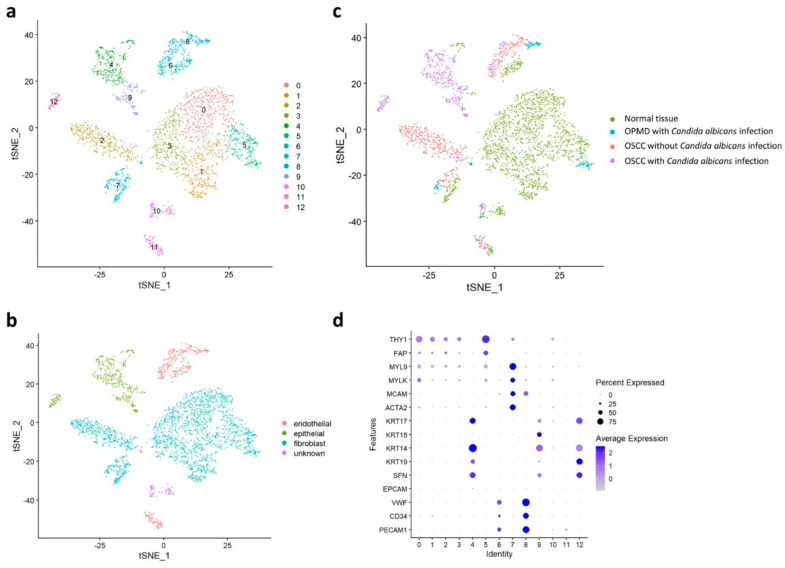
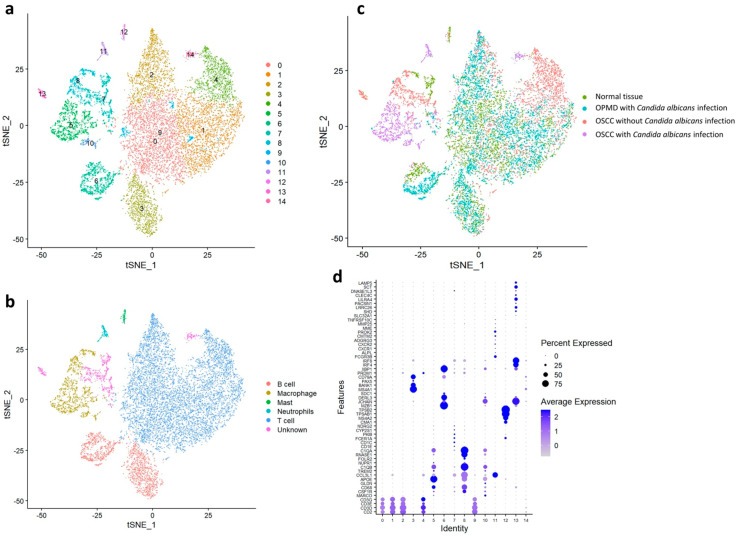
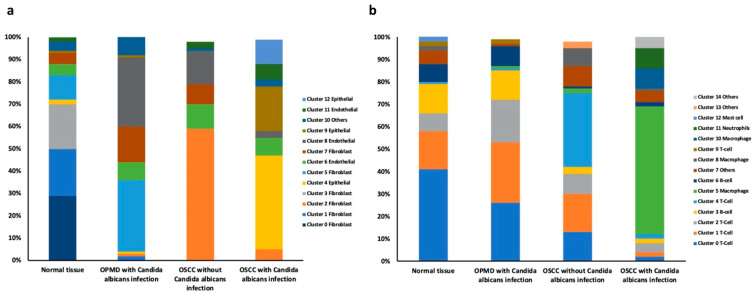
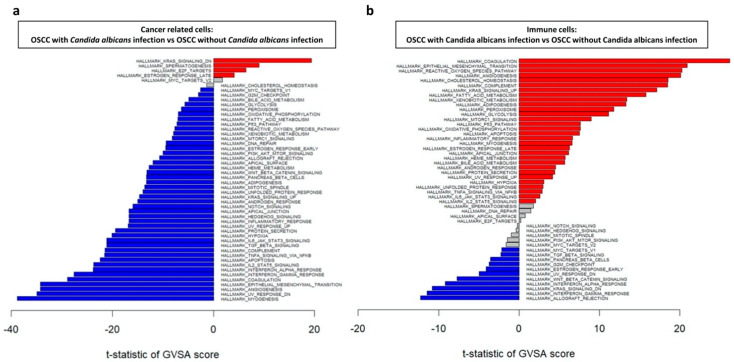
Oral squamous cell carcinoma (OSCC) carcinogenesis involves heterogeneous tumor cells, and the tumor microenvironment (TME) is highly complex with many different cell types. Cancer cell-TME interactions are crucial in OSCC progression. ()-frequently pre-sent in the oral potentially malignant disorder (OPMD) lesions and OSCC tissues-promotes malignant transformation. The aim of the study is to verify the mechanisms underlying OSCC car-cinogenesis with infection and identify the biomarker for the early detection of OSCC and as the treatment target. The single-cell RNA sequencing analysis (scRNA-seq) was performed to explore the cell subtypes in normal oral mucosa, OPMD, and OSCC tissues. The cell composi-tion changes and oncogenic mechanisms underlying OSCC carcinogenesis with infec-tion were investigated. Gene Set Variation Analysis (GSVA) was used to survey the mechanisms underlying OSCC carcinogenesis with and without infection. The results revealed spe-cific cell clusters contributing to OSCC carcinogenesis with and without infection. The major mechanisms involved in OSCC carcinogenesis without infection are the IL2/STAT5, TNFα/NFκB, and TGFβ signaling pathways, whereas those involved in OSCC carcinogenesis with infection are the KRAS signaling pathway and E2F target down-stream genes. Finally, stratifin (SFN) was validated to be a specific biomarker of OSCC with infection. Thus, the detailed mechanism underlying OSCC carcinogenesis with infection was determined and identified the treatment biomarker with potential precision medicine applications.
口腔鳞状细胞癌 (OSCC) 的发生涉及异质肿瘤细胞,肿瘤微环境 (TME) 高度复杂,包含多种不同的细胞类型。癌细胞与 TME 的相互作用在 OSCC 的进展中至关重要。()-在口腔潜在恶性疾病 (OPMD) 病变和 OSCC 组织中经常存在-促进恶性转化。本研究旨在验证 HPV 感染与 OSCC 发生的机制,并确定用于 OSCC 早期检测和作为治疗靶点的生物标志物。进行了单细胞 RNA 测序分析 (scRNA-seq) 以探索正常口腔黏膜、OPMD 和 OSCC 组织中的细胞亚型。研究了 HPV 感染与 OSCC 发生的致癌机制。采用基因集变异分析 (GSVA) 来研究 HPV 感染与不感染情况下 OSCC 发生的机制。结果揭示了特定的细胞簇有助于 HPV 感染与不感染情况下的 OSCC 发生。与 HPV 感染不相关的 OSCC 发生的主要机制是 IL2/STAT5、TNFα/NFκB 和 TGFβ 信号通路,而与 HPV 感染相关的 OSCC 发生的主要机制是 KRAS 信号通路和 E2F 下游靶基因。最后,证实层粘连蛋白 (SFN) 是 HPV 感染相关 OSCC 的特异性生物标志物。因此,确定了 HPV 感染与 OSCC 发生的详细机制,并确定了具有潜在精准医学应用的治疗生物标志物。