Department of Oral Biology and Diagnostic Sciences, The Dental College of Georgia, Augusta University, Augusta, GA 30912, USA.
Cells. 2022 Apr 27;11(9):1470. doi: 10.3390/cells11091470.
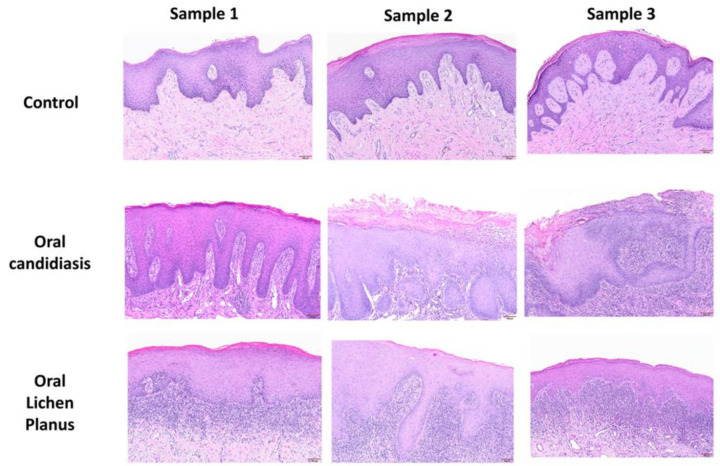
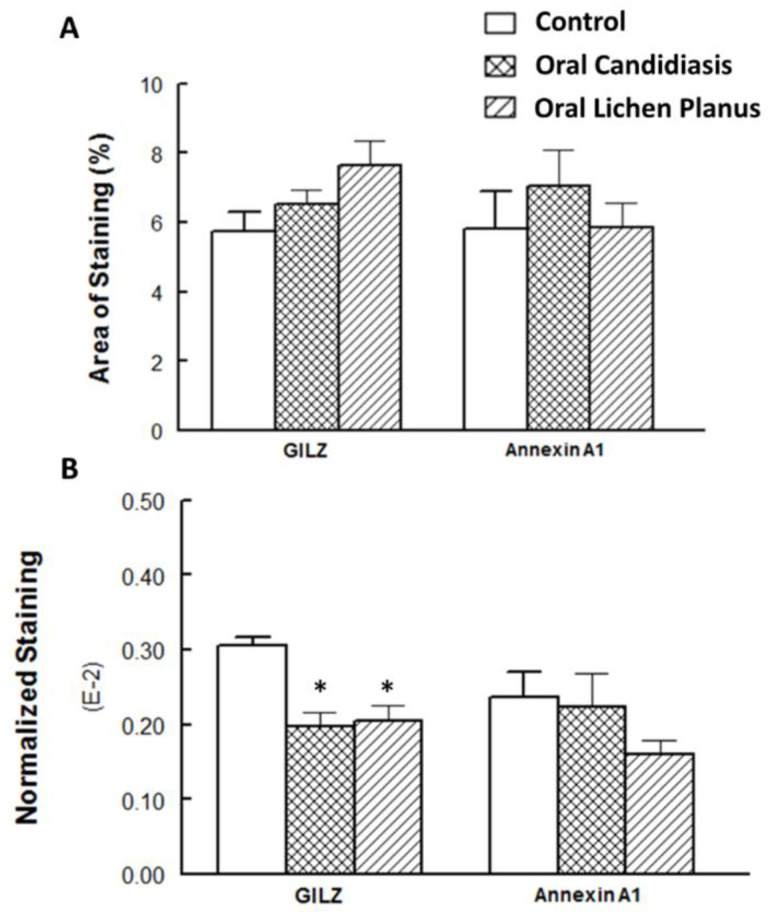
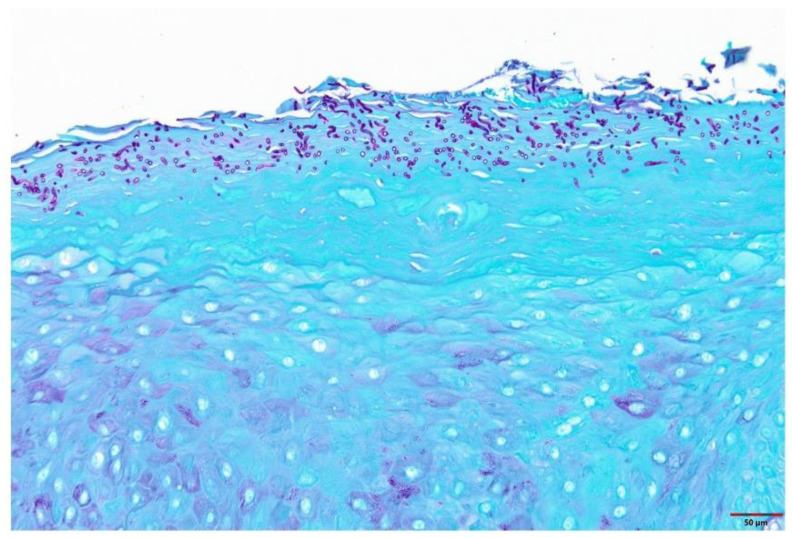
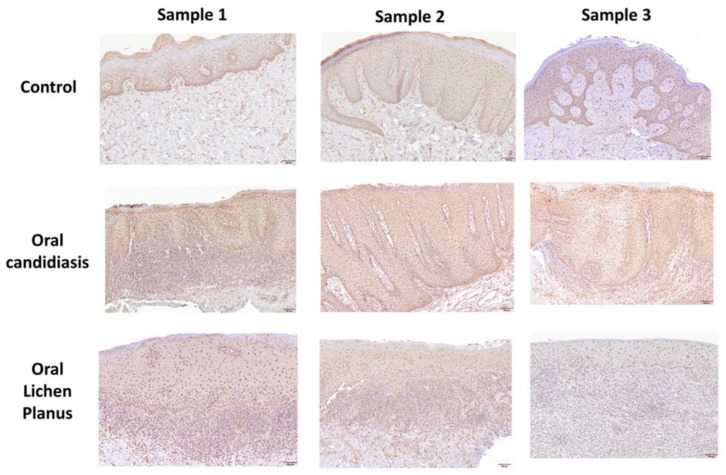
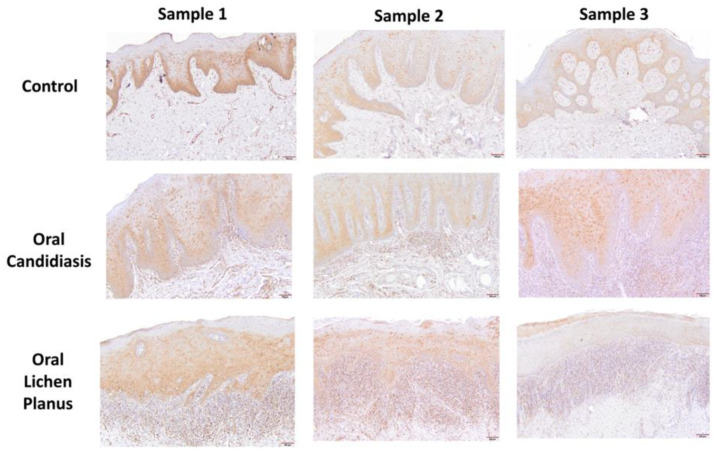
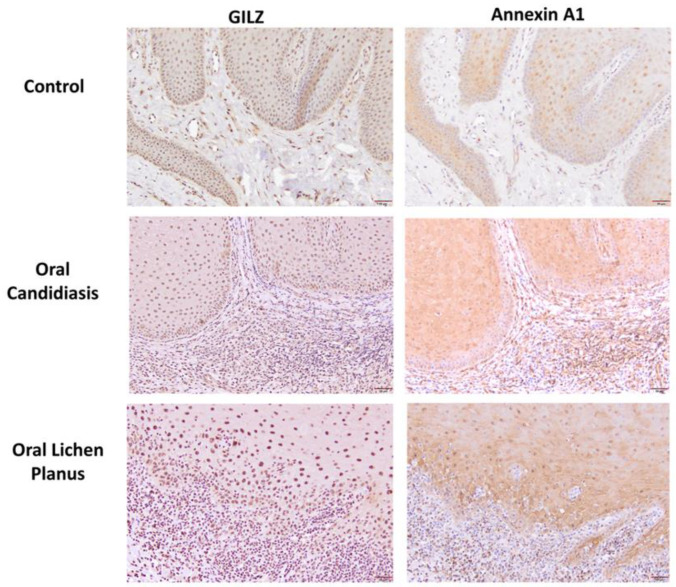
Adrenal glands are the major source of glucocorticoids, but recent studies indicate tissue-specific production of cortisol, including that in the oral mucosa. Both endogenous and exogenous glucocorticoids regulate the production of several proteins, including the glucocorticoid-induced leucine zipper (GILZ) and Annexin A1, which play important roles in the regulation of immune and inflammatory responses. Common inflammation-associated oral conditions include lichen planus and candidiasis, but the status of GILZ and Annexin A1 in these human conditions remains to be established. Accordingly, archived paraffin-embedded biopsy samples were subjected to immunohistochemistry to establish tissue localization and profile of GILZ and Annexin A1 coupled with the use of hematoxylin-eosin stain for histopathological assessment; for comparison, fibroma specimens served as controls. Histopathological examination confirmed the presence of spores and pseudohyphae for oral candidiasis (OC) specimens and marked inflammatory cell infiltrates for both OC and oral lichen planus (OLP) specimens compared to control specimens. All specimens displayed consistent and prominent nuclear staining for GILZ throughout the full thickness of the epithelium and, to varying extent, for inflammatory infiltrates and stromal cells. On the other hand, a heterogeneous pattern of nuclear, cytoplasmic, and cell membrane staining was observed for Annexin A1 for all specimens in the suprabasal layers of epithelium and, to varying extent, for inflammatory and stromal cells. Semi-quantitative analyses indicated generally similar fractional areas of staining for both GILZ and Annexin A1 among the groups, but normalized staining for GILZ, but not Annexin A1, was reduced for OC and OLP compared to the control specimens. Thus, while the cellular expression pattern of GILZ and Annexin A1 does not differentiate among these conditions, differential cellular profiles for GILZ vs. Annexin A1 are suggestive of their distinct physiological functions in the oral mucosa.
肾上腺是糖皮质激素的主要来源,但最近的研究表明,皮质醇也可以在组织中特异性产生,包括口腔黏膜。内源性和外源性糖皮质激素调节多种蛋白质的产生,包括糖皮质激素诱导的亮氨酸拉链(GILZ)和膜联蛋白 A1,它们在调节免疫和炎症反应中发挥重要作用。常见的与炎症相关的口腔疾病包括扁平苔藓和念珠菌病,但这些人类疾病中 GILZ 和膜联蛋白 A1 的状况仍有待确定。因此,对存档的石蜡包埋活检样本进行免疫组织化学染色,以确定 GILZ 和膜联蛋白 A1 的组织定位和特征,并结合苏木精-伊红染色进行组织病理学评估;纤维瘤标本作为对照。组织病理学检查证实,口腔念珠菌病(OC)标本中存在孢子和假菌丝,OC 和口腔扁平苔藓(OLP)标本中存在明显的炎症细胞浸润,与对照标本相比。所有标本的上皮全层以及炎症浸润和基质细胞均显示出 GILZ 的一致且明显的核染色。另一方面,所有标本的上皮基底层以及炎症和基质细胞均观察到膜联蛋白 A1 的核、细胞质和细胞膜染色的异质性模式。半定量分析表明,各组 GILZ 和膜联蛋白 A1 的染色面积大致相似,但与对照标本相比,OC 和 OLP 中 GILZ 的标准化染色减少,而膜联蛋白 A1 的标准化染色没有减少。因此,尽管 GILZ 和膜联蛋白 A1 的细胞表达模式在这些疾病中没有差异,但 GILZ 与膜联蛋白 A1 的细胞谱差异表明它们在口腔黏膜中具有不同的生理功能。