Central American Institute for Studies on Toxic Substances (IRET), Universidad Nacional, Heredia 40101, Costa Rica.
Centro de Investigación y Diagnóstico en Salud y Deporte (CIDISAD), Escuela de Ciencias del Movimiento Humano y Calidad de Vida (CIEMHCAVI), Universidad Nacional, Heredia 40101, Costa Rica.
Int J Environ Res Public Health. 2022 Apr 19;19(9):4962. doi: 10.3390/ijerph19094962.
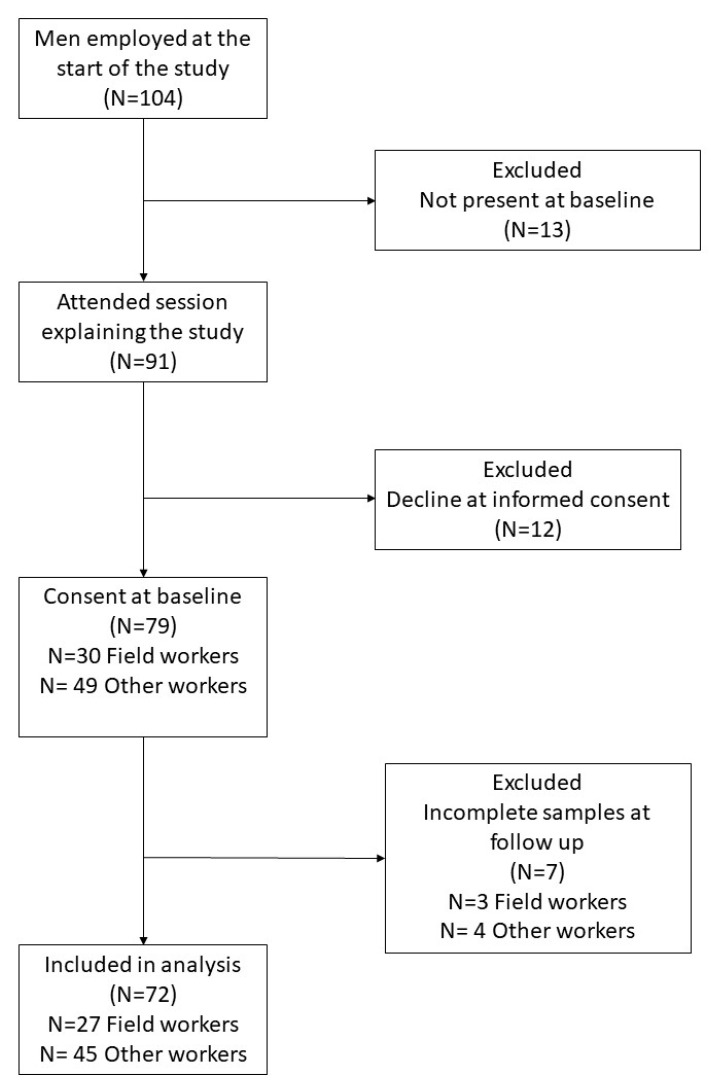
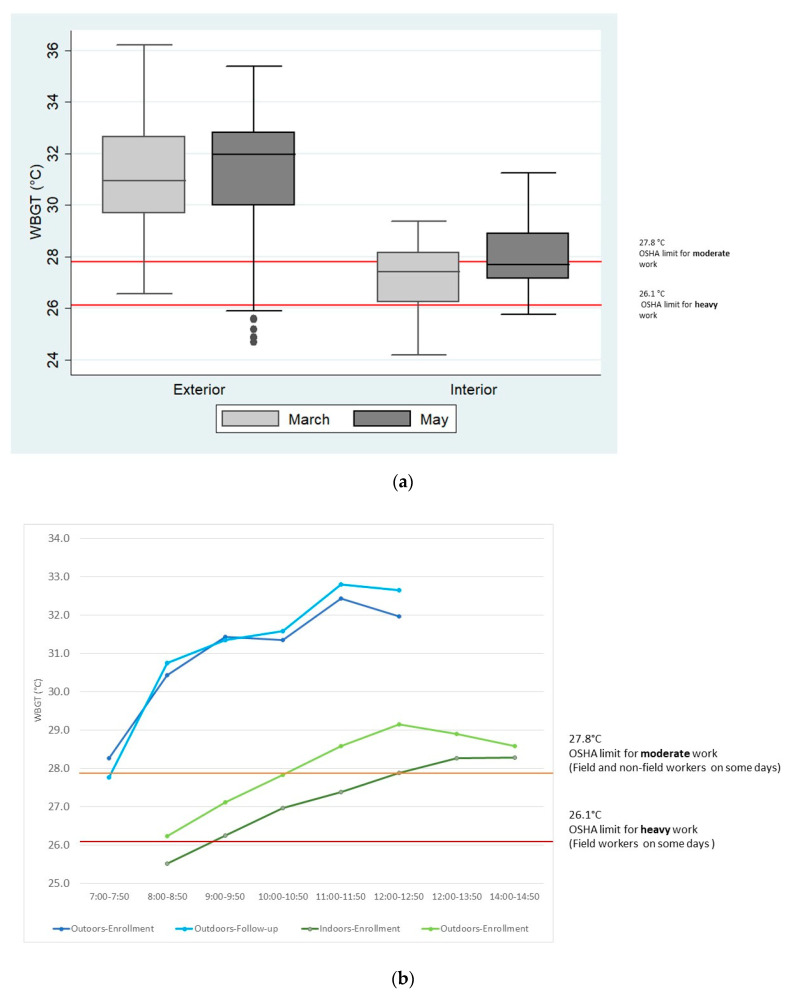
The aim of this study was to evaluate heat exposure, dehydration, and kidney function in rice workers over the course of three months, in Guanacaste, Costa Rica. We collected biological and questionnaire data across a three-month-period in male field (n = 27) and other (n = 45) workers from a rice company where chronic kidney disease of unknown origin (CKDu) is endemic. We used stepwise forward regression to determine variables associated with estimated glomerular filtration rate eGFR at enrollment and/or change in eGFR, and Poisson regression to assess associations with incident kidney injury (IKI) over the course of three months. Participants were 20−62 years old (median = 40 in both groups). Dehydration was common (≥37%) in both groups, particularly among other workers at enrollment, but field workers were more exposed to heat and had higher workloads. Low eGFR (<60 mL/min/1.73 m2) was more prevalent in field workers at enrollment (19% vs. 4%) and follow-up (26% vs. 7%). Field workers experienced incident kidney injury (IKI) more frequently than other workers: 26% versus 2%, respectively. Age (β = −0.71, 95%CI: −1.1, −0.4), current position as a field worker (β = −2.75, 95%CI: −6.49, 0.99) and past work in construction (β = 3.8, 95%CI: −0.1, 7.6) were included in the multivariate regression model to explain eGFR at enrollment. The multivariate regression model for decreased in eGFR over three month included current field worker (β = −3.9, 95%CI: −8.2, 0.4), current smoking (β= −6.2, 95%CI: −13.7−1.3), dehydration (USG ≥ 1.025) at both visits (β= −3.19, 95%CI: −7.6, 1.2) and pain medication at follow-up (β= −3.2, 95%CI: −8.2, 1.95). Current fieldwork [IR (incidence rate) = 2.2, 95%CI 1.1, 5.8) and being diabetic (IR = 1.8, 95%CI 0.9, 3.6) were associated with IKI. Low eGFR was common in field workers from a rice company in Guanacaste, and being a field worker was a risk factor for IKI, consistent with the hypothesis that occupational heat exposure is a critical risk factor for CKDu in Mesoamerica.
本研究旨在评估哥斯达黎加瓜纳卡斯特的水稻种植工人在三个月内的热暴露、脱水和肾功能情况。我们在一家慢性病因不明的肾病(CKDu)流行的水稻种植公司收集了三个月期间田间(n=27)和其他(n=45)工人的生物和问卷调查数据。我们使用逐步向前回归来确定与入组时估计肾小球滤过率(eGFR)和/或 eGFR 变化相关的变量,并使用泊松回归来评估与三个月内新发肾脏损伤(IKI)的相关性。参与者年龄在 20-62 岁之间(两组的中位数均为 40 岁)。两组均有较高的脱水率(≥37%),尤其是其他工人在入组时,但田间工人暴露于更多的热且工作负荷更高。低 eGFR(<60mL/min/1.73m2)在入组时(19%对 4%)和随访时(26%对 7%)在田间工人中更为常见。与其他工人相比,田间工人更常发生新发肾脏损伤(IKI):分别为 26%和 2%。年龄(β=-0.71,95%CI:-1.1,-0.4)、当前田间工人身份(β=-2.75,95%CI:-6.49,0.99)和过去建筑工作(β=3.8,95%CI:-0.1,7.6)被纳入解释入组时 eGFR 的多变量回归模型。三个月内 eGFR 下降的多变量回归模型包括当前田间工人(β=-3.9,95%CI:-8.2,0.4)、当前吸烟(β=-6.2,95%CI:-13.7-1.3)、两次就诊时的脱水(尿比重≥1.025)(β=-3.19,95%CI:-7.6,1.2)和随访时的止痛药物(β=-3.2,95%CI:-8.2,1.95)。当前田间工作(IR=2.2,95%CI 1.1,5.8)和糖尿病(IR=1.8,95%CI 0.9,3.6)与 IKI 相关。瓜纳卡斯特一家水稻种植公司的田间工人中常见低 eGFR,且田间工人身份是 IKI 的危险因素,这与职业性热暴露是中美洲 CKDu 的关键危险因素的假设一致。