Sperling Florian, Misiak Danny, Hüttelmaier Stefan, Michl Patrick, Griesmann Heidi
Department of Internal Medicine I, Martin Luther University Halle-Wittenberg, 06120 Halle, Germany.
Department for Molecular Cell Biology, Institute for Molecular Medicine, Martin Luther University Halle-Wittenberg, Charles Tanford Protein Center, 06120 Halle, Germany.
Cancers (Basel). 2022 Apr 24;14(9):2121. doi: 10.3390/cancers14092121.
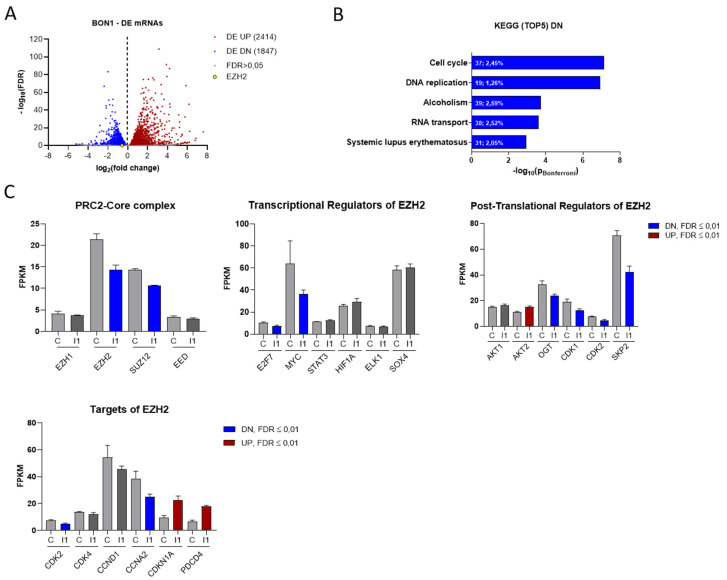
Neuroendocrine neoplasms (NENs) represent a heterogenous class of highly vascularized neoplasms that are increasing in prevalence and are predominantly diagnosed at a metastatic state. The molecular mechanisms leading to tumor initiation, metastasis, and chemoresistance are still under investigation. Hence, identification of novel therapeutic targets is of great interest. Here, we demonstrate that the RNA-binding Protein IGF2BP1 is a post-transcriptional regulator of components of the Polycomb repressive complex 2 (PRC2), an epigenic modifier affecting transcriptional regulation and proliferation: Comprehensive in silico analyses along with in vitro experiments showed that IGF2BP1 promotes neuroendocrine tumor cell proliferation by stabilizing the mRNA of Enhancer of Zeste 2 (EZH2), the catalytic subunit of PRC2, which represses gene expression by tri-methylation of histone H3 at lysine 27 (H3K27me3). The IGF2BP1-driven stabilization and protection of EZH2 mRNA is m6A-dependent and enhances EZH2 protein levels which stimulates cell cycle progression by silencing cell cycle arrest genes through enhanced H3K27 tri-methylation. Therapeutic inhibition of IGF2BP1 destabilizes EZH2 mRNA and results in a reduced cell proliferation, paralleled by an increase in G1 and sub-G1 phases. Combined targeting of IGF2BP1, EZH2, and Myc, a transcriptional activator of EZH2 and well-known target of IGF2BP1 cooperatively induces tumor cell apoptosis. Our data identify IGF2BP1 as an important driver of tumor progression in NEN, and indicate that disruption of the IGF2BP1-Myc-EZH2 axis represents a promising approach for targeted therapy of neuroendocrine neoplasms.
神经内分泌肿瘤(NENs)是一类异质性的高度血管化肿瘤,其患病率正在上升,并且主要在转移状态下被诊断出来。导致肿瘤起始、转移和化疗耐药的分子机制仍在研究中。因此,识别新的治疗靶点备受关注。在此,我们证明RNA结合蛋白IGF2BP1是多梳抑制复合物2(PRC2)组分的转录后调节因子,PRC2是一种影响转录调控和增殖的表观遗传修饰因子:全面的计算机分析以及体外实验表明,IGF2BP1通过稳定PRC2的催化亚基增强子结合蛋白2(EZH2)的mRNA来促进神经内分泌肿瘤细胞增殖,EZH2通过组蛋白H3赖氨酸27位点的三甲基化(H3K27me3)来抑制基因表达。IGF2BP1驱动的EZH2 mRNA的稳定和保护是m6A依赖性的,并提高EZH2蛋白水平,通过增强H3K27三甲基化沉默细胞周期阻滞基因来刺激细胞周期进程。对IGF2BP1的治疗性抑制使EZH2 mRNA不稳定,并导致细胞增殖减少,同时G1期和亚G1期增加。联合靶向IGF2BP1、EZH2和Myc(EZH2的转录激活因子以及IGF2BP1的著名靶点)可协同诱导肿瘤细胞凋亡。我们的数据确定IGF2BP1是NEN中肿瘤进展的重要驱动因素,并表明破坏IGF2BP1-Myc-EZH2轴是神经内分泌肿瘤靶向治疗的一种有前景的方法。