Scheibel Jessica, Garcia-Porta Joan, Quezada Galo, Ibáñez Alejandro
Zoological Institute, Technische Universität Braunschweig, 38106 Braunschweig, Germany.
Department of Biology, Washington University in St. Louis, St. Louis, MO 63130, USA.
Animals (Basel). 2022 Apr 28;12(9):1142. doi: 10.3390/ani12091142.
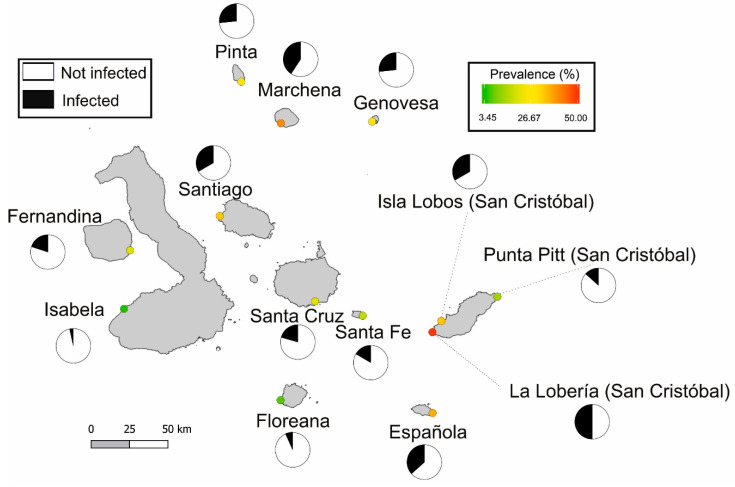
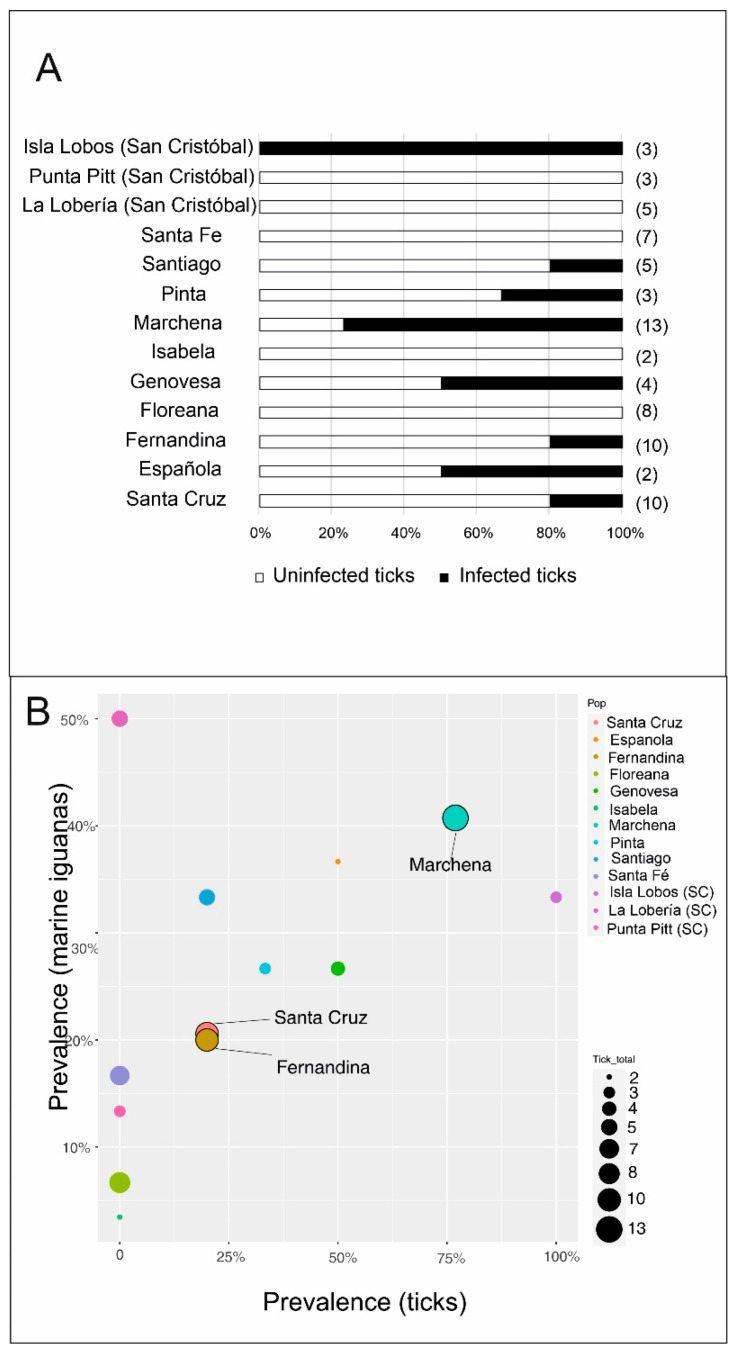
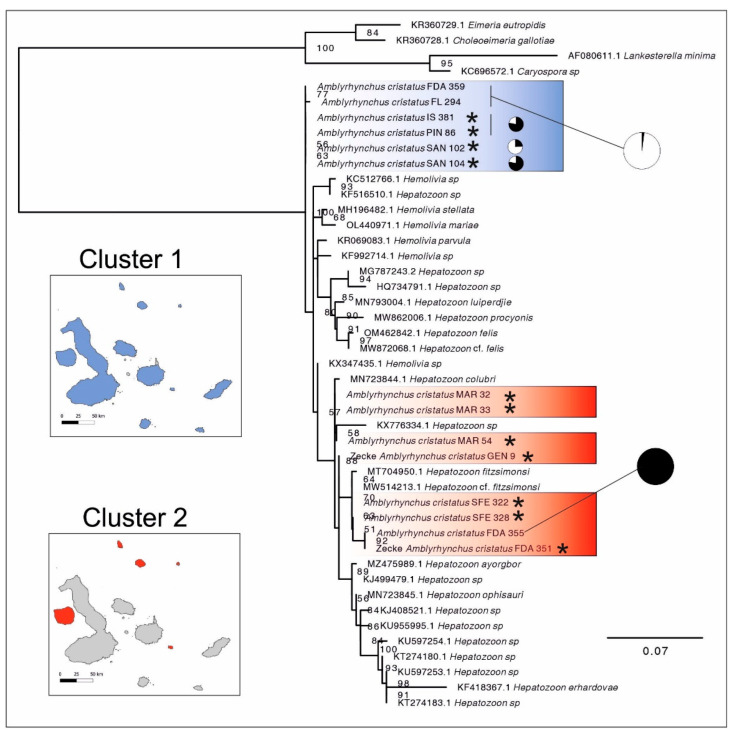
Parasitism is among the most common forms of coexistence of organisms of different species. Hemoparasites live in the bloodstream of the host where they complete different life-cycle stages. Members of the phylum Apicomplexa constitute a large portion of all hemoparasites infecting reptiles and their parasite transmitting vectors, including arthropods. In this study, we carried out a survey and molecular identification of hemoparasites in blood samples of the iconic Galápagos marine iguana (). Major island populations of marine iguanas were sampled to examine large-scale biogeographic patterns of parasite diversity and prevalence. Nested PCRs were used to amplify segments of the 18S rRNA-gene of hemoparasites. Furthermore, ticks attached to marine iguanas were collected and analyzed in the same way to assess their potential use as a non-invasive method for the detection of hemoparasites in vertebrate host species. PCR products were sequenced and a phylogenetic analysis was carried out showing the presence of two genetically distinct clusters of hemoparasites, one more commonly distributed than the other one, belonging to the genera and/or (Apicomplexa: Eucoccidiorida). Overall, 25% of marine iguanas were infected by hemoparasites. However, infection rates varied strongly among particular island populations (from 3.45% to 50%). Although marine iguanas are an extremely mobile species that has colonized all islands in the Galápagos archipelago, parasite occurrence was not related to geographical distance, suggesting that dispersal behavior has a minor role in parasite transmission. On most islands, females tended to have higher infection rates than males, but this relationship was only significant on one island. Overall, ticks and marine iguanas had similar prevalence and diversity of parasites. However, the infection profiles of ticks and their corresponding hosts (marine iguanas) did not mirror one another, indicating that this method cannot be used reliably to assess marine iguana infection status. Interestingly, we found that hemoparasite prevalence in marine iguanas and ticks tended to be positively correlated across islands. Our results indicate that certain populations of marine iguanas may have special mechanisms and adaptations to cope with parasite infection. In addition, other factors such as vector density, anthropogenic-related activities or the immunological state of marine iguanas could potentially affect the striking variation in hemoparasite prevalence across island populations.
寄生是不同物种生物共存的最常见形式之一。血液寄生虫生活在宿主的血液中,并在其中完成不同的生命周期阶段。顶复门的成员构成了感染爬行动物及其寄生虫传播媒介(包括节肢动物)的所有血液寄生虫的很大一部分。在本研究中,我们对标志性的加拉帕戈斯海鬣蜥的血液样本中的血液寄生虫进行了调查和分子鉴定。对海鬣蜥的主要岛屿种群进行了采样,以研究寄生虫多样性和流行率的大规模生物地理模式。采用巢式PCR扩增血液寄生虫18S rRNA基因片段。此外,以同样的方式收集并分析附着在海鬣蜥身上的蜱虫,以评估其作为检测脊椎动物宿主物种血液寄生虫的非侵入性方法的潜在用途。对PCR产物进行测序,并进行系统发育分析,结果显示存在两个基因不同的血液寄生虫簇,其中一个比另一个分布更普遍,属于 属和/或 属(顶复门:真球虫目)。总体而言,25%的海鬣蜥感染了血液寄生虫。然而,特定岛屿种群中的感染率差异很大(从3.45%到50%)。尽管海鬣蜥是一种极具移动性的物种,已在加拉帕戈斯群岛的所有岛屿上定居,但寄生虫的出现与地理距离无关,这表明扩散行为在寄生虫传播中作用较小。在大多数岛屿上,雌性的感染率往往高于雄性,但这种关系仅在一个岛屿上显著。总体而言,蜱虫和海鬣蜥的寄生虫流行率和多样性相似。然而,蜱虫及其相应宿主(海鬣蜥)的感染情况并不相互反映,这表明该方法不能可靠地用于评估海鬣蜥的感染状况。有趣的是,我们发现各岛屿上海鬣蜥和蜱虫的血液寄生虫流行率往往呈正相关。我们的结果表明,某些海鬣蜥种群可能具有特殊的机制和适应性来应对寄生虫感染。此外,其他因素,如媒介密度、人为相关活动或海鬣蜥的免疫状态,可能会潜在地影响各岛屿种群中血液寄生虫流行率的显著差异。