Medical University Department of Medicine, Kantonsspital Aarau, 5001 Aarau, Switzerland.
Faculty of Medicine, University of Basel, 4056 Basel, Switzerland.
Nutrients. 2022 Apr 29;14(9):1862. doi: 10.3390/nu14091862.
A higher risk for severe clinical courses of coronavirus disease 2019 (COVID-19) has been linked to deficiencies of several micronutrients. We therefore studied the prevalence of deficiencies of eight different micronutrients in a cohort of hospitalized COVID-19-patients.
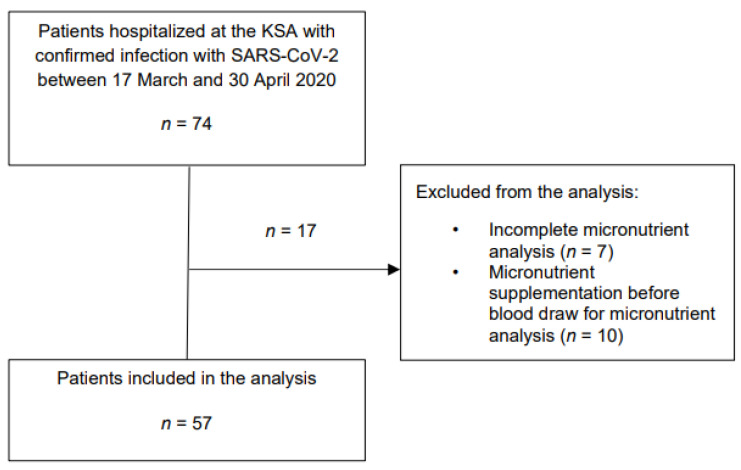
We measured admission serum/plasma levels of vitamins A, B12, D, and E, as well as folic acid, zinc, selenium, and copper in 57 consecutively admitted adult patients with confirmed COVID-19 and analyzed prevalence of micronutrient deficiencies and correlations among micronutrient levels. Further, we studied associations of micronutrient levels with severe disease progression, a composite endpoint consisting of in-hospital mortality and/or need for intensive care unit (ICU) treatment with logistic regression.
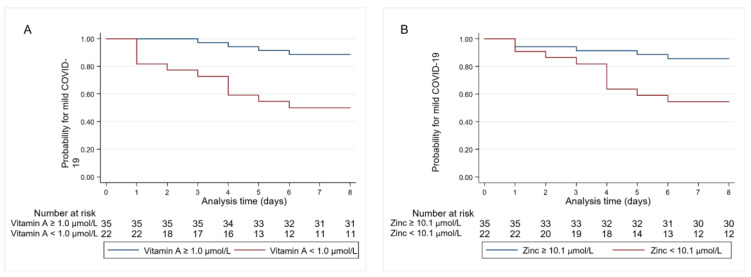
Median age was 67.0 years (IQR 60.0, 74.2) and 60% ( = 34) were male. Overall, 79% ( = 45) of patients had at least one deficient micronutrient level and 33% ( = 19) had ≥3 deficiencies. Most prevalent deficiencies were found for selenium, vitamin D, vitamin A, and zinc (51%, 40%, 39%, and 39%, respectively). We found several correlations among micronutrients with correlation coefficients ranging from r = 0.27 to r = 0.42. The strongest associations with lower risk for severe COVID-19 disease progression (adjusted odds ratios) were found for higher levels of vitamin A (0.18, 95% CI 0.05-0.69, = 0.01), zinc (0.73, 95% CI 0.55-0.98, = 0.03), and folic acid (0.88, 95% CI 0.78-0.98, = 0.02).
We found a high prevalence of micronutrient deficiencies in mostly older patients hospitalized for COVID-19, particularly regarding selenium, vitamin D, vitamin A, and zinc. Several deficiencies were associated with a higher risk for more severe COVID-19 courses. Whether supplementation of micronutrients is useful for prevention of severe clinical courses or treatment of COVID-19 warrants further research.
有研究表明,多种微量营养素的缺乏与 2019 年冠状病毒病(COVID-19)的严重临床病程有关。因此,我们研究了住院 COVID-19 患者队列中 8 种不同微量营养素缺乏的发生率。
我们测量了 57 名连续入院的确诊 COVID-19 成年患者入院时血清/血浆中维生素 A、B12、D、E、叶酸、锌、硒和铜的水平,并分析了微量营养素缺乏的发生率以及微量营养素水平之间的相关性。此外,我们通过逻辑回归研究了微量营养素水平与严重疾病进展(包括住院死亡率和/或需要重症监护病房(ICU)治疗的复合终点)之间的关联。
中位年龄为 67.0 岁(IQR 60.0,74.2),60%(=34)为男性。总体而言,79%(=45)的患者至少有一种微量营养素缺乏,33%(=19)有≥3 种缺乏。最常见的缺乏是硒、维生素 D、维生素 A 和锌(分别为 51%、40%、39%和 39%)。我们发现微量营养素之间存在几种相关性,相关系数范围为 r = 0.27 至 r = 0.42。与 COVID-19 疾病严重程度进展风险降低相关的最强关联(调整后的优势比)是维生素 A 水平较高(0.18,95%CI 0.05-0.69,=0.01)、锌水平较高(0.73,95%CI 0.55-0.98,=0.03)和叶酸水平较高(0.88,95%CI 0.78-0.98,=0.02)。
我们发现住院 COVID-19 的患者中微量营养素缺乏的发生率很高,尤其是硒、维生素 D、维生素 A 和锌。几种缺乏与 COVID-19 更严重的病程相关。微量营养素补充是否对预防严重临床病程或治疗 COVID-19 有用,还需要进一步研究。