Beetz Nick Lasse, Geisel Dominik, Maier Christoph, Auer Timo Alexander, Shnayien Seyd, Malinka Thomas, Neumann Christopher Claudius Maximilian, Pelzer Uwe, Fehrenbach Uli
Department of Radiology, Charité-Universitätsmedizin Berlin, Corporate Member of Freie Universität Berlin and Humboldt-Universität zu Berlin, 13353 Berlin, Germany.
Berlin Institute of Health, 10178 Berlin, Germany.
J Clin Med. 2022 Apr 22;11(9):2356. doi: 10.3390/jcm11092356.
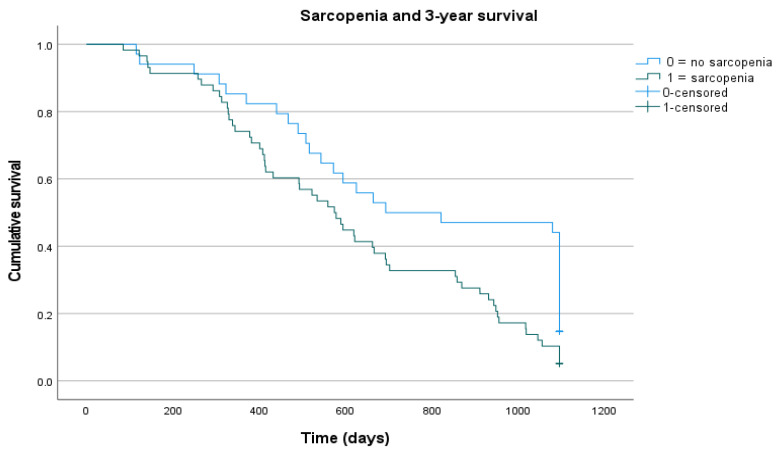
Pancreatic cancer is the seventh leading cause of cancer death in both sexes. The aim of this study is to analyze baseline CT body composition using artificial intelligence to identify possible imaging predictors of survival. We retrospectively included 103 patients. First, the presence of surgical treatment and cut-off values for sarcopenia and obesity served as independent variates. Second, the presence of surgery, subcutaneous adipose tissue (SAT), visceral adipose tissue (VAT), and skeletal muscle index (SMI) served as independent variates. Cox regression analysis was performed for 1-year, 2-year, and 3-year survival. Possible differences between patients undergoing surgical versus nonsurgical treatment were analyzed. Presence of surgery significantly predicted 1-year, 2-year, and 3-year survival (p = 0.01, <0.001, and <0.001, respectively). Across the follow-up periods of 1-year, 2-year, and 3-year survival, the presence of sarcopenia became an equally important predictor of survival (p = 0.25, 0.07, and <0.001, respectively). Additionally, increased VAT predicted 2-year and 3-year survival (p = 0.02 and 0.04, respectively). The impact of sarcopenia on 3-year survival was higher in the surgical treatment group (p = 0.02 and odds ratio = 2.57) compared with the nonsurgical treatment group (p = 0.04 and odds ratio = 1.92). Fittingly, a lower SMI significantly affected 3-year survival only in patients who underwent surgery (p = 0.02). Especially if surgery is performed, AI-derived sarcopenia and reduced muscle mass are unfavorable imaging predictors.
胰腺癌是男女癌症死亡的第七大主要原因。本研究的目的是使用人工智能分析基线CT身体成分,以识别可能的生存影像预测指标。我们回顾性纳入了103例患者。首先,手术治疗的存在以及肌肉减少症和肥胖的临界值作为独立变量。其次,手术的存在、皮下脂肪组织(SAT)、内脏脂肪组织(VAT)和骨骼肌指数(SMI)作为独立变量。对1年、2年和3年生存率进行Cox回归分析。分析了接受手术治疗与非手术治疗患者之间可能存在的差异。手术的存在显著预测了1年、2年和3年生存率(p分别为0.01、<0.001和<0.001)。在1年、2年和3年生存率的随访期内,肌肉减少症的存在成为同样重要的生存预测指标(p分别为0.25、0.07和<0.001)。此外,VAT增加预测了2年和3年生存率(p分别为0.02和0.04)。与非手术治疗组相比,手术治疗组中肌肉减少症对3年生存率的影响更高(p = 0.02,比值比 = 2.57)(非手术治疗组p = 0.04,比值比 = 1.92)。相应地,较低的SMI仅在接受手术的患者中显著影响3年生存率(p = 0.02)。特别是如果进行了手术,人工智能衍生的肌肉减少症和肌肉量减少是不利的影像预测指标。