Caracciolo Alessandro, Scalise Renato Francesco Maria, Ceresa Fabrizio, Bagnato Gianluca, Versace Antonio Giovanni, Licordari Roberto, Perfetti Silvia, Lofrumento Francesca, Irrera Natasha, Santoro Domenico, Patanè Francesco, Di Bella Gianluca, Costa Francesco, Micari Antonio
Department of Clinical and Experimental Medicine, Policlinic "Gaetano Martino", University of Messina, 98100 Messina, Italy.
Department of Cardio-Thoraco-Vascular Surgery, Division of Cardiac Surgery, Papardo Hospital, 98158 Messina, Italy.
J Clin Med. 2022 Apr 23;11(9):2380. doi: 10.3390/jcm11092380.
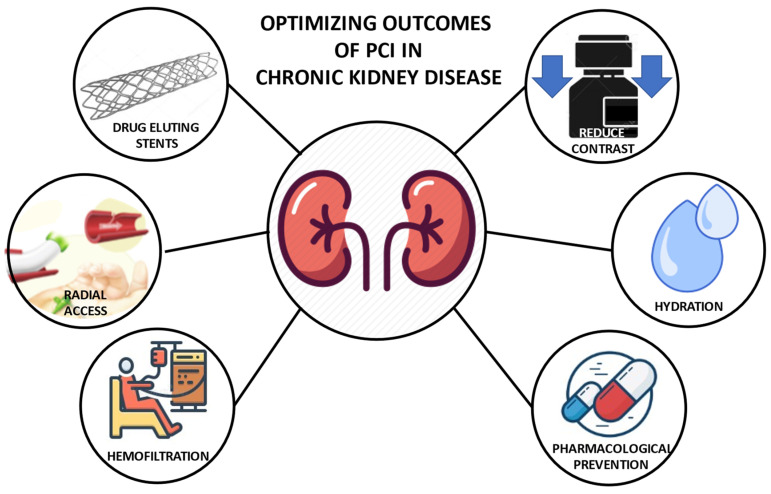
Percutaneous coronary intervention (PCI) is one of the most common procedures performed in medicine. However, its net benefit among patients with chronic kidney disease (CKD) is less well established than in the general population. The prevalence of patients suffering from both CAD and CKD is high, and is likely to increase in the coming years. Planning the adequate management of this group of patients is crucial to improve their outcome after PCI. This starts with proper preparation before the procedure, the use of all available means to reduce contrast during the procedure, and the implementation of modern strategies such as radial access and drug-eluting stents. At the end of the procedure, personalized antithrombotic therapy for the patient's specific characteristics is advisable to account for the elevated ischemic and bleeding risk of these patients.
经皮冠状动脉介入治疗(PCI)是医学中最常见的手术之一。然而,与普通人群相比,其在慢性肾脏病(CKD)患者中的净效益尚未得到充分证实。同时患有冠心病(CAD)和CKD的患者患病率很高,且在未来几年可能会增加。规划对这组患者的适当管理对于改善他们PCI后的预后至关重要。这始于手术前的适当准备,术中使用所有可用方法减少造影剂用量,以及实施诸如桡动脉入路和药物洗脱支架等现代策略。在手术结束时,根据患者的具体特征进行个性化抗栓治疗,以应对这些患者缺血和出血风险升高的情况。