Lee Seungwon, Pyo Dae Hee, Sim Woo Seog, Lee Woo Young, Park MiHye
Department of Anesthesiology and Pain Medicine, Samsung Medical Center, Sungkyunkwan University School of Medicine, 81 Irwon-ro, Gangnam-gu, Seoul 06351, Korea.
Department of Surgery, Samsung Medical Center, Sungkyunkwan University School of Medicine, Seoul 06351, Korea.
J Clin Med. 2022 May 8;11(9):2648. doi: 10.3390/jcm11092648.
Propofol is considered to protect against immunosuppression and has lower inflammatory responses in the perioperative period than volatile agents. We evaluated whether the anesthetic agent is associated with cancer outcomes.
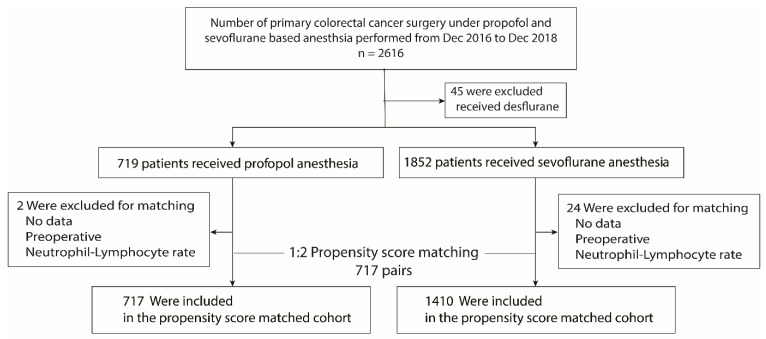
We retrospectively reviewed 2616 patients who underwent colorectal cancer surgery under general anesthesia between 2016 and 2018 (follow-up closure: July 2021) at a single institution. Patients received propofol-based total intravenous anesthesia or sevoflurane-based inhalational anesthesia. After propensity score matching, the postoperative neutrophil-lymphocyte ratio (NLR) was compared as primary outcome, and clinical outcomes were evaluated.
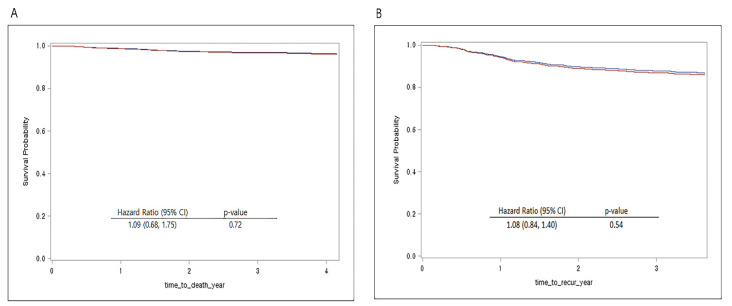
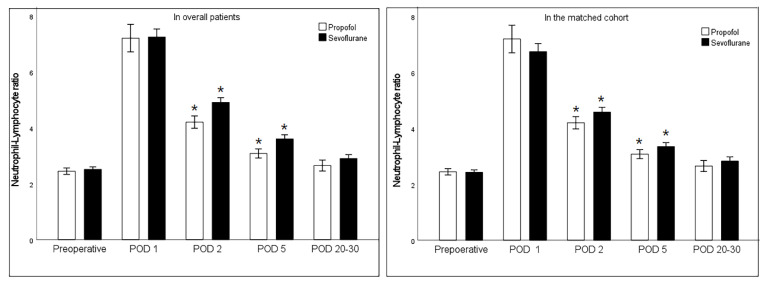
After 1:2 propensity matching, 717 patients were given propofol anesthesia and 1410 patients were given sevoflurane anesthesia. In the matched cohort, preoperative NLR was not significantly different between propofol and sevoflurane anesthesia (mean (95% CI)2.3 (1.8 to 2.8) and 2.2 (1.9 to 3.2); = 0.72). NLR was significantly lower in propofol anesthesia at postoperative day two and five (mean difference (95% CI) 0.71 (0.43 to 0.98); = 0.000 and 0.52 (0.30 to 0.74); = 0.000). Urinary retention showed a higher incidence after propofol anesthesia (4.9% vs. 2.6%; = 0.008). Other postoperative complications and overall/recurrence-free survival were not different in the two groups.
Although propofol anesthesia showed lower postoperative NLR than sevoflurane anesthesia, there was no association with clinical outcomes.
丙泊酚被认为可预防免疫抑制,且在围手术期比挥发性麻醉剂具有更低的炎症反应。我们评估了这种麻醉剂是否与癌症预后相关。
我们回顾性分析了2016年至2018年在一家机构接受全身麻醉下结直肠癌手术的2616例患者(随访截止时间:2021年7月)。患者接受丙泊酚全静脉麻醉或七氟醚吸入麻醉。在进行倾向评分匹配后,比较术后中性粒细胞与淋巴细胞比值(NLR)作为主要结局,并评估临床结局。
经过1:2倾向匹配后,717例患者接受丙泊酚麻醉,1410例患者接受七氟醚麻醉。在匹配队列中,丙泊酚麻醉和七氟醚麻醉术前NLR无显著差异(均值(95%CI)分别为2.3(1.8至2.8)和2.2(1.9至3.2);P = 0.72)。丙泊酚麻醉术后第2天和第5天NLR显著更低(平均差值(95%CI)分别为0.71(0.43至0.98);P = 0.000和0.52(0.30至0.74);P = 0.000)。丙泊酚麻醉后尿潴留发生率更高(4.9%对2.6%;P = 0.008)。两组其他术后并发症及总生存期/无复发生存期无差异。
尽管丙泊酚麻醉术后NLR低于七氟醚麻醉,但与临床结局无关。