Department of Medicine, School of Medicine, The University of Auckland, Auckland, New Zealand.
Analytics and Intelligence Section, Health Workforce, Ministry of Health, Wellington, New Zealand.
Aust J Rural Health. 2022 Oct;30(5):666-675. doi: 10.1111/ajr.12876. Epub 2022 May 14.
It is well established that rural workforce outcomes are more likely among medical graduates who spend time training in non-urban areas; however, fewer studies have assessed whether graduates are more likely to return to the specific area where they undertook rural training.
This study aimed to determine whether graduates who had undertaken a regional-rural immersion program in Northland, NZ, were more likely to have returned to work in Northland as of mid-2021, relative to peers who did not participate.
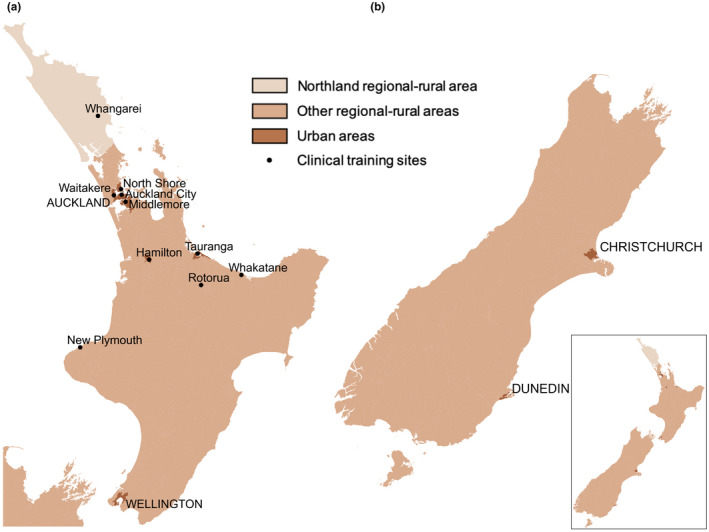
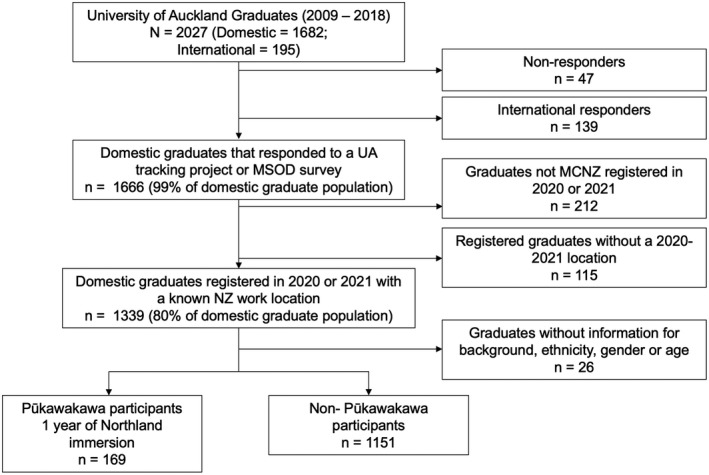
This prospective cohort study used longitudinal tracking survey responses, medical school administrative data and workforce outcome information. A multinomial model, accounting for other covariates, was built to determine the association between graduates practising in Northland (population ⟨ 100 000), which encompasses both rural (population ⟨ 25 000) and regional (25 000 ⟩ population ⟨ 100 000) areas, and having participated in a Northland-based immersion program during medical school. The study population was University of Auckland domestic medical students graduating between 2009 and 2018, inclusive. Immersion program participants who responded to longitudinal career tracking surveys were included in the study sample.
The final sample size was 1320 students (80% of population of interest). Graduates who undertook the Northland immersion program (n = 169) were more likely than non-participants (n = 1151) to be working in Northland as of 2020-2021 (relative risk: 3.2).
Regional-rural immersion programs might preferentially build workforces in that specific region; however, further research is required to understand whether these findings are generalizable, and the main reasons for this effect.
已有大量研究证实,在非城市地区接受培训的医学毕业生更有可能从事农村工作;然而,较少有研究评估毕业生是否更有可能回到他们接受农村培训的特定地区。
本研究旨在确定在新西兰北地完成区域农村沉浸项目的毕业生是否更有可能在 2021 年年中回到北地工作,与未参加该项目的同龄人相比。
这是一项前瞻性队列研究,使用纵向跟踪调查应答、医学院行政数据和劳动力结果信息。建立了一个多变量模型,考虑了其他协变量,以确定在北地(人口 ⟨ 100000)工作的毕业生(包括农村(人口 ⟨ 25000)和区域(25000 ⟩人口 ⟨ 100000)地区)与在医学院期间参加北地沉浸项目之间的关联。研究人群为奥克兰大学在 2009 年至 2018 年期间毕业的国内医学生,包括在内。参加过纵向职业跟踪调查的沉浸项目参与者被纳入研究样本。
最终样本量为 1320 名学生(感兴趣人群的 80%)。与未参加者(n=1151)相比,参加北地沉浸项目的毕业生(n=169)更有可能在 2020-2021 年在北地工作(相对风险:3.2)。
区域农村沉浸项目可能优先在该特定地区建立劳动力;然而,需要进一步研究以了解这些发现是否具有普遍性,以及产生这种效果的主要原因。