School of Life Sciences, Anhui University, Hefei, P. R. China; Key Laboratory of Human Microenvironment and Precision Medicine of Anhui Higher Education Institutes, Anhui University, Hefei, Anhui, P. R. China.
School of Life Sciences, Anhui University, Hefei, P. R. China; Information Materials and Intelligent Sensing Laboratory of Anhui Province, Institutes of Material Science and Information Technology, Anhui University, Hefei, Anhui, P. R. China.
J Biol Chem. 2022 Jun;298(6):102027. doi: 10.1016/j.jbc.2022.102027. Epub 2022 May 11.
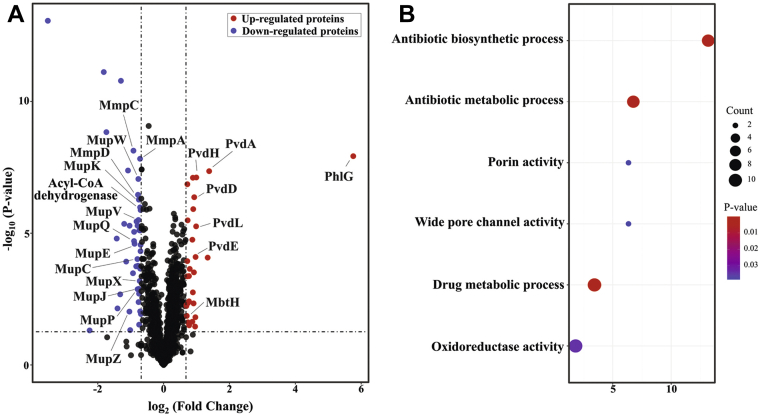
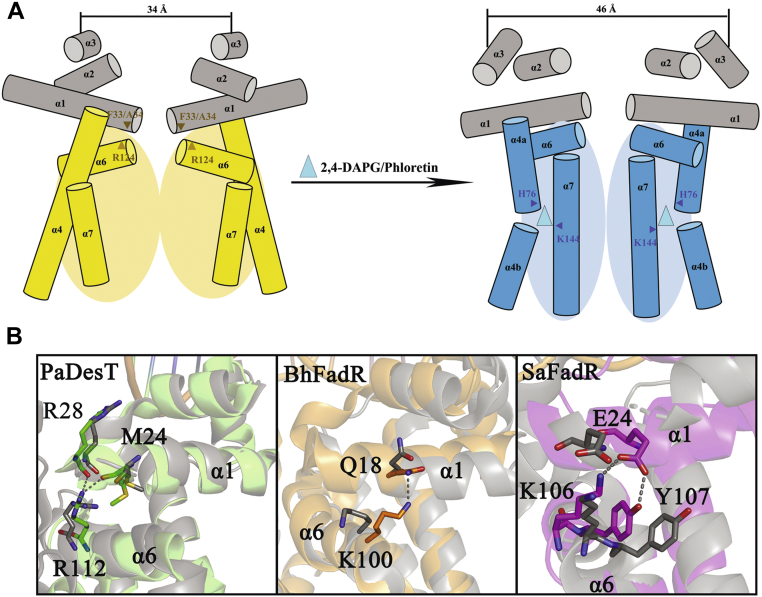
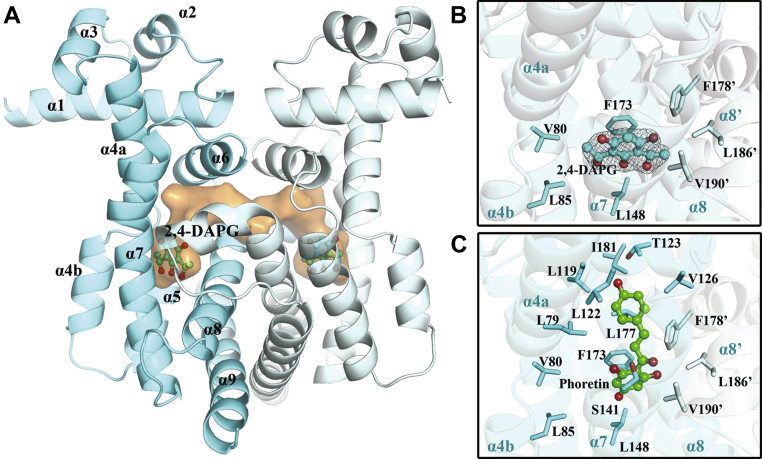
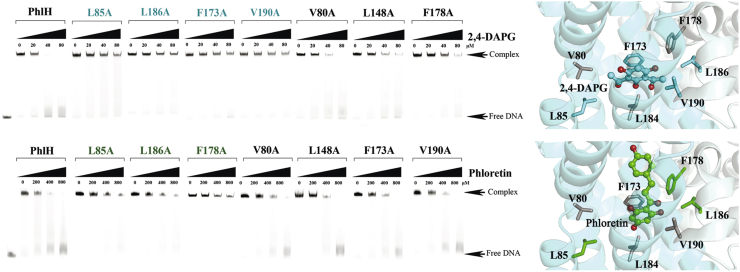
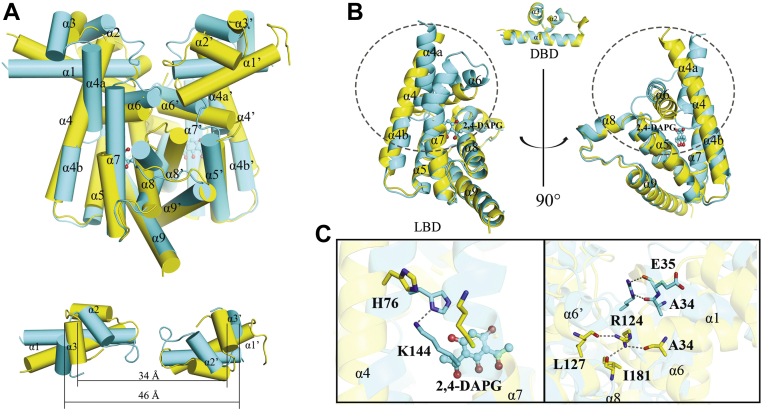
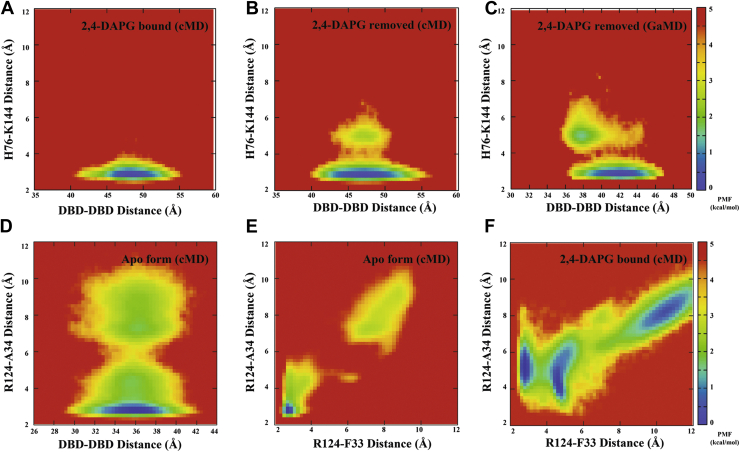
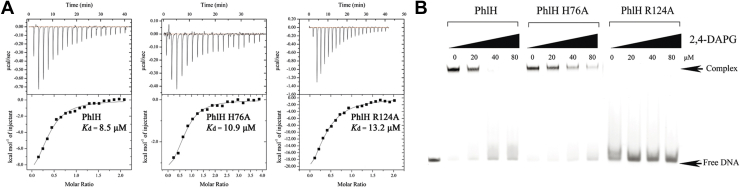
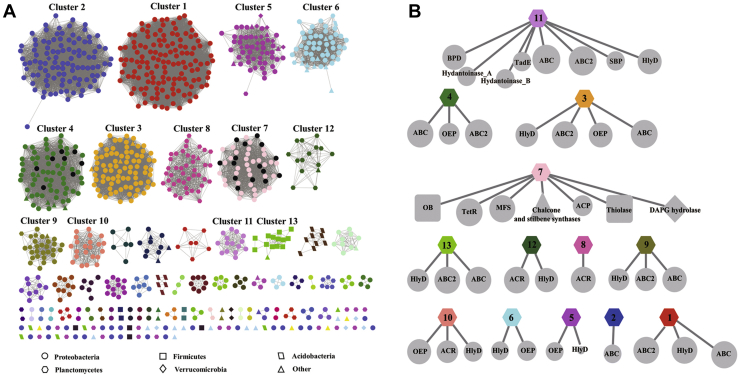
The production of secondary metabolites is a major mechanism used by beneficial rhizobacteria to antagonize plant pathogens. These bacteria have evolved to coordinate the production of different secondary metabolites due to the heavy metabolic burden imposed by secondary metabolism. However, for most secondary metabolites produced by bacteria, it is not known how their biosynthesis is coordinated. Here, we showed that PhlH from the rhizobacterium Pseudomonas fluorescens is a TetR-family regulator coordinating the expression of enzymes related to the biosynthesis of several secondary metabolites, including 2,4-diacetylphloroglucinol (2,4-DAPG), mupirocin, and pyoverdine. We present structures of PhlH in both its apo form and 2,4-DAPG-bound form and elucidate its ligand-recognizing and allosteric switching mechanisms. Moreover, we found that dissociation of 2,4-DAPG from the ligand-binding domain of PhlH was sufficient to allosterically trigger a pendulum-like movement of the DNA-binding domains within the PhlH dimer, leading to a closed-to-open conformational transition. Finally, molecular dynamics simulations confirmed that two distinct conformational states were stabilized by specific hydrogen bonding interactions and that disruption of these hydrogen bonds had profound effects on the conformational transition. Our findings not only reveal a well-conserved route of allosteric signal transduction in TetR-family regulators but also provide novel mechanistic insights into bacterial metabolic coregulation.
次生代谢产物的产生是有益根际细菌拮抗植物病原体的主要机制。由于次生代谢产生的代谢负担很重,这些细菌已经进化到可以协调不同次生代谢产物的产生。然而,对于大多数细菌产生的次生代谢产物,其生物合成如何协调尚不清楚。在这里,我们表明,荧光假单胞菌中的 PhlH 是一种 TetR 家族调节剂,协调与几种次生代谢物生物合成相关的酶的表达,包括 2,4-二乙酰基间苯三酚(2,4-DAPG)、莫匹罗星和吡咯并喹啉。我们展示了 PhlH 在apo 形式和 2,4-DAPG 结合形式下的结构,并阐明了其配体识别和变构开关机制。此外,我们发现 2,4-DAPG 从 PhlH 的配体结合域解离足以变构触发 PhlH 二聚体中 DNA 结合域的钟摆样运动,导致从闭合到开放的构象转变。最后,分子动力学模拟证实了两种不同的构象状态由特定的氢键相互作用稳定,并且破坏这些氢键对构象转变有深远的影响。我们的研究结果不仅揭示了 TetR 家族调节剂中变构信号转导的一种保守途径,还为细菌代谢的核心调控提供了新的机制见解。