Lucke Miriam, Correa Mario Gabriel, Levy Asaf
Department of Plant Pathology and Microbiology, The Robert H. Smith Faculty of Agriculture, Food and Environment, The Hebrew University of Jerusalem, Rehovot, Israel.
Front Plant Sci. 2020 Nov 9;11:589416. doi: 10.3389/fpls.2020.589416. eCollection 2020.
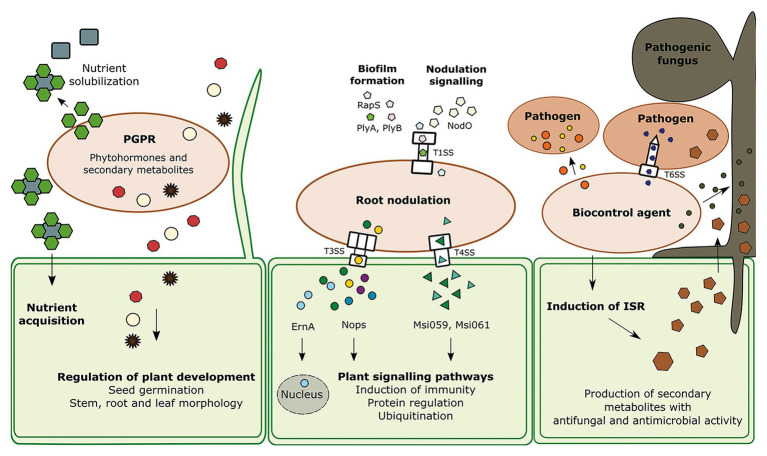
Beneficial rhizobacteria dwell in plant roots and promote plant growth, development, and resistance to various stress types. In recent years there have been large-scale efforts to culture root-associated bacteria and sequence their genomes to uncover novel beneficial microbes. However, only a few strains of rhizobacteria from the large pool of soil microbes have been studied at the molecular level. This review focuses on the molecular basis underlying the phenotypes of three beneficial microbe groups; (1) plant-growth promoting rhizobacteria (PGPR), (2) root nodulating bacteria (RNB), and (3) biocontrol agents (BCAs). We focus on bacterial proteins and secondary metabolites that mediate known phenotypes within and around plants, and the mechanisms used to secrete these. We highlight the necessity for a better understanding of bacterial genes responsible for beneficial plant traits, which can be used for targeted gene-centered and molecule-centered discovery and deployment of novel beneficial rhizobacteria.
有益根际细菌栖息于植物根系,促进植物生长、发育,并增强植物对各种胁迫的抗性。近年来,人们开展了大规模工作来培养与根系相关的细菌并对其基因组进行测序,以发现新的有益微生物。然而,在大量土壤微生物中,只有少数根际细菌菌株在分子水平上得到了研究。本综述聚焦于三类有益微生物群体表型的分子基础:(1)植物促生根际细菌(PGPR),(2)根瘤菌(RNB),以及(3)生物防治剂(BCA)。我们关注介导植物体内外已知表型的细菌蛋白和次生代谢产物,以及分泌这些物质的机制。我们强调,有必要更好地了解负责植物有益性状的细菌基因,这些基因可用于以基因为中心和以分子为中心的靶向发现和应用新型有益根际细菌。