Department of Medical Imaging, The First Affiliated Hospital of Hebei North University, No. 12, Changqing Road, Qiaoxi District, Zhangjiakou, 075000, Hebei, China.
Graduate School of Hebei North University, Hebei, China.
BMC Cardiovasc Disord. 2022 May 14;22(1):220. doi: 10.1186/s12872-022-02655-0.
Coronary distensibility index (CDI), as an early predictor of cardiovascular diseases, has the potential to complement coronary computed tomography angiography (cCTA)-derived fractional flow reserve (CT-FFR) for predicting major adverse cardiac events (MACEs). Thus, the prognostic value of CT-FFR combined with CDI for MACEs is worth exploring.
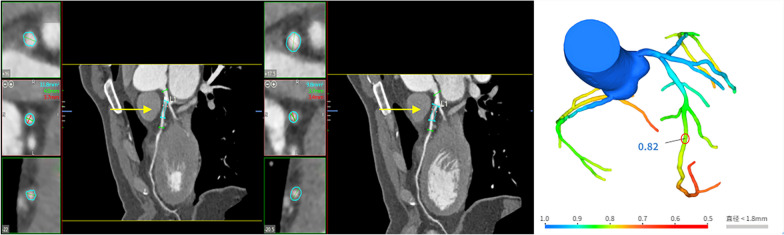
Patients with a moderate or severe single left anterior descending coronary artery stenosis were included and underwent FFR and CDI analysis based on cCTA, followed up at least 1 year, and recorded MACEs. Multivariate logistic regression analysis was performed to determine independent predictors of MACEs. The area under of receiver operating characteristic (ROC) curve was used to evaluated evaluate the diagnostic performance of CT-FFR, CDI, and a combination of the two.
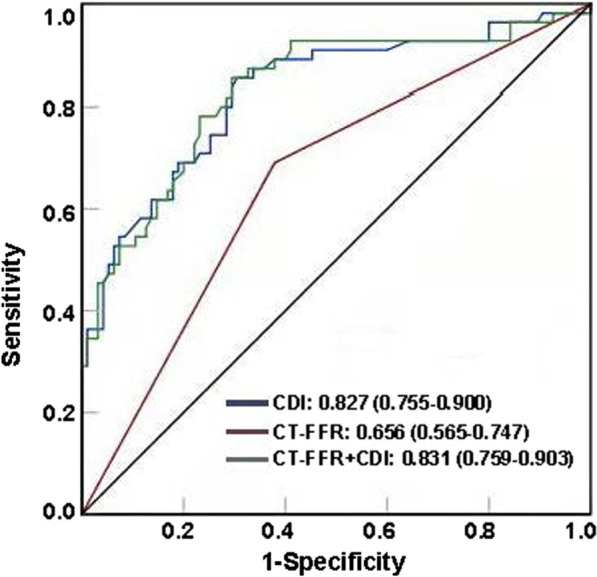
All the vessel-specific data were from LAD. 150 patients were analysed. 55 (37%) patients experienced MACEs during follow-up. Patients with CT-FFR ≤ 0.8 had higher percentage of MACEs compared with CT-FFR > 0.8 (56.3% vs.7.3%, p < 0.05). Patients' CDI was significantly decreased in MACEs group compared with non-MACEs group (p < 0.05). Multivariate analysis revealed that diabetes (p = 0.025), triglyceride (p = 0.015), CT-FFR ≤ 0.80 (p = 0.038), and CDI (p < 0.001) are independent predictors of MACEs. According to ROC curve analysis, CT-FFR combined CDI showed incremental diagnostic performance over CT-FFR alone for prediction of MACEs (AUC = 0.831 vs. 0.656, p = 0.0002).
Our study provides initial evidence that combining CDI with CT-FFR shows incremental discriminatory power for MACEs over CT-FFR alone, independent of clinical risk factors. Diabetes and triglyceride are also associated with MACEs.
作为心血管疾病的早期预测指标,冠状动脉扩张指数(CDI)有可能补充基于冠状动脉计算机断层扫描血管造影(cCTA)的血流储备分数(FFR-CT),用于预测主要不良心脏事件(MACE)。因此,CT-FFR 联合 CDI 对 MACE 的预后价值值得探索。
纳入有中重度单一左前降支冠状动脉狭窄的患者,基于 cCTA 进行 FFR 和 CDI 分析,至少随访 1 年,记录 MACE 事件。采用多变量 logistic 回归分析确定 MACE 的独立预测因素。通过受试者工作特征(ROC)曲线下面积评价 CT-FFR、CDI 及其两者联合的诊断性能。
所有血管特异性数据均来自 LAD。共分析了 150 例患者。在随访期间,55 例(37%)患者发生 MACE。CT-FFR≤0.8 的患者 MACE 发生率明显高于 CT-FFR>0.8 的患者(56.3%比 7.3%,p<0.05)。MACE 组患者的 CDI 明显低于非 MACE 组(p<0.05)。多变量分析显示,糖尿病(p=0.025)、甘油三酯(p=0.015)、CT-FFR≤0.80(p=0.038)和 CDI(p<0.001)是 MACE 的独立预测因素。根据 ROC 曲线分析,CT-FFR 联合 CDI 对 MACE 的预测显示出比 CT-FFR 单独预测更高的诊断效能(AUC=0.831 比 0.656,p=0.0002)。
本研究初步表明,CDI 与 CT-FFR 联合使用可提供比 CT-FFR 单独使用更高的鉴别力,用于预测 MACE,独立于临床危险因素。糖尿病和甘油三酯也与 MACE 相关。