Department of Anaesthesiology, The Third Affiliated Hospital of Anhui Medical University, The First People's Hospital of Hefei), 390 Huaihe Road, Hefei, 230061, Anhui, China.
Wannan Medical College, 22 West Wenchang Road, Wuhu, 241002, Anhui, China.
BMC Anesthesiol. 2022 May 14;22(1):144. doi: 10.1186/s12871-022-01694-6.
The present study aimed to investigate whether intratracheal dexmedetomidine combined with ropivacaine reduces the severity and incidence of postoperative sore throat after tracheal intubation under general anaesthesia.
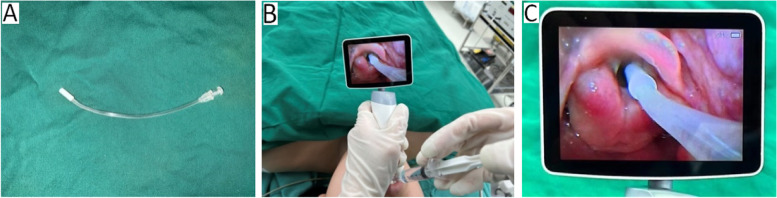
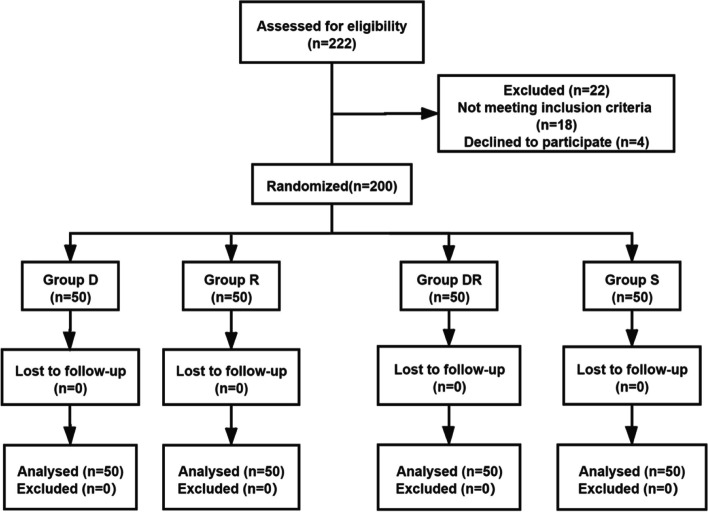
Two hundred patients with American Society of Anaesthesiologists physical status I-II who were subjected to general anaesthesia were randomly divided into four groups, namely, Group D, Group R, Group DR and Group S; these groups received intratracheal dexmedetomidine (1 µg/kg), 0.8% ropivacaine (40 mg), dexmedetomidine (1 µg/kg) combined with 0.8% ropivacaine (40 mg) and normal saline before endotracheal intubation, respectively. The primary outcomes were the incidence and grade of sore throat and hoarseness at 2 h and 24 h after surgery. Moreover, the modified Observer's Assessment of Alertness/Sedation Scale results were recorded at each time point. The secondary outcomes were intraoperative haemodynamic fluctuations, intraoperative anaesthetic drug requirements, and adverse reactions during and after surgery. The patients' vital signs before induction, before superficial anaesthesia, after superficial anaesthesia, before intubation, after intubation, and 1 min after intubation were recorded. The use of anaesthetic drugs and occurrence of adverse effects were also recorded.
The incidence and severity of sore throat were significantly lower in Group DR than in the other three groups 2 h after the operation, but they were only significantly lower in Group DR than in the control group 24 h after the operation. Moreover, compared with Group S and Group D, Group DR exhibited more stable haemodynamics during intubation. The doses of remifentanil and propofol were significantly lower in Group DR than in the other groups.
The combined use of dexmedetomidine and ropivacaine for surface anaesthesia before intubation significantly reduced the incidence and severity of postoperative sore throat. This treatment also decreased anaesthetic drug requirements and intraoperative haemodynamic fluctuations and caused no adverse effects.
This clinical research was registered at the Chinese Clinical Trial Registry (ChiCTR1900022907, Registration date 30/04/2019).
本研究旨在探讨经气管内给予右美托咪定联合罗哌卡因是否能降低全身麻醉下气管插管后咽痛的严重程度和发生率。
选择 200 例 ASA Ⅰ-Ⅱ级全身麻醉下行气管插管的患者,随机分为 4 组,即 D 组、R 组、DR 组和 S 组,分别于气管插管前经气管内给予右美托咪定(1μg/kg)、0.8%罗哌卡因(40mg)、右美托咪定(1μg/kg)联合 0.8%罗哌卡因(40mg)和生理盐水。主要观察术后 2h 和 24h 咽痛和声音嘶哑的发生率和严重程度,同时记录改良的警觉/镇静评分(OAA/S)结果。次要观察指标为术中血流动力学波动、术中麻醉药物用量及围术期不良反应。记录患者诱导前、浅麻醉前、浅麻醉后、插管前、插管后、插管后 1min 的生命体征,记录麻醉药物的使用情况及不良反应的发生情况。
与其他三组相比,DR 组术后 2h 时咽痛的发生率和严重程度显著降低,但仅与对照组相比,DR 组术后 24h 时咽痛的发生率和严重程度显著降低。而且,与 S 组和 D 组相比,DR 组在插管过程中血流动力学更稳定。DR 组瑞芬太尼和丙泊酚的剂量明显低于其他组。
在气管插管前进行表面麻醉时联合使用右美托咪定和罗哌卡因可显著降低术后咽痛的发生率和严重程度,同时还可降低麻醉药物的需求量和术中血流动力学波动,且无不良反应。
本临床研究在中国临床试验注册中心注册(ChiCTR1900022907,注册日期:2019 年 4 月 30 日)。