Nephrology Center, Toranomon Hospital Kajigaya, Japan.
Okinaka Memorial Institute for Medical Research, Toranomon Hospital, Japan.
Intern Med. 2022 Dec 1;61(23):3547-3552. doi: 10.2169/internalmedicine.9185-21. Epub 2022 May 14.
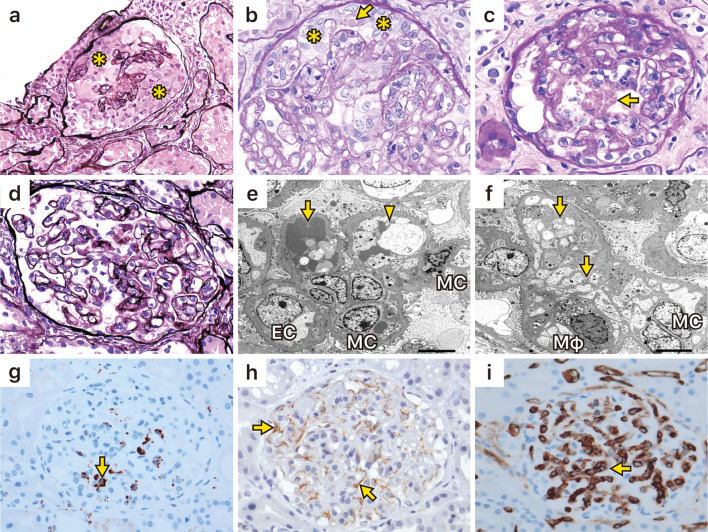
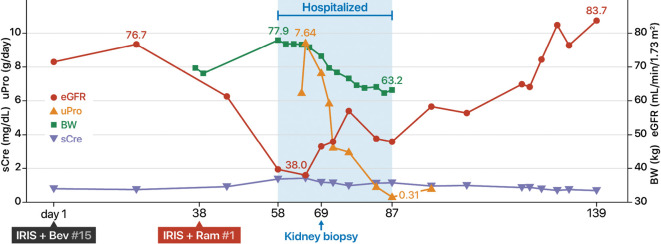
We encountered a 77-year-old Japanese man who presented with nephrotic-range proteinuria 20 days after receiving ramucirumab treatment for metastatic sigmoid colon cancer. A kidney biopsy showed two characteristic histological findings. The first finding was podocyte injury with cellular crescent-like formation, although focal segmental glomerulosclerosis (FSGS) (collapsing variant) according to the Columbia classification may have been a more appropriate name for this injury, as hypertrophy and hyperplasia of epithelial cells, presumably resulting from podocyte injury, were seen between Bowman's capsule and the glomerular basement membrane (GBM); these changes appeared to be due to the collapse of the GBM rather than to GBM destruction with fibrinoid necrosis. The second finding was endotheliopathy characterized by prominent mesangial interposition via enlargement of the mesangial matrix with mesangiolysis. Proteinuria and renal dysfunction subsided after discontinuation of ramucirumab. Bevacizumab has been reported to induce glomerular microangiopathy with endothelial damage and swelling six months after treatment, but in this case, ramucirumab may have induced focal segmental glomerulosclerosis (FSGS) collapsing variant and glomerular microangiopathy with endotheliopathy via mesangial damage within 1 month. We believe that the damage to the glomerular podocyte and endothelial cells via mesangial damage secondary to ramucirumab in our patient was a different type of glomerular microangiopathy than the endothelial cell damage with enlargement of the subendothelial space caused by bevacizumab.
我们遇到一位 77 岁的日本男性,在接受雷莫芦单抗治疗转移性乙状结肠癌 20 天后出现肾病范围蛋白尿。肾脏活检显示出两个特征性的组织学发现。第一个发现是足细胞损伤伴有细胞新月体样形成,尽管根据哥伦比亚分类,局灶节段性肾小球硬化症(FSGS)(塌陷型)可能是这种损伤更恰当的名称,因为在鲍曼囊和肾小球基底膜(GBM)之间可见上皮细胞的肥大和增生,推测是由于足细胞损伤所致;这些变化似乎是由于 GBM 的塌陷而不是由于 GBM 破坏伴纤维蛋白样坏死。第二个发现是内皮病变,表现为系膜基质扩张导致系膜插入明显,伴有系膜溶解。停用雷莫芦单抗后蛋白尿和肾功能不全消退。贝伐珠单抗治疗 6 个月后已报道会引起肾小球微血管病伴内皮损伤和肿胀,但在本例中,雷莫芦单抗可能在 1 个月内通过系膜损伤引起局灶节段性肾小球硬化症(FSGS)塌陷型和伴内皮病变的肾小球微血管病。我们认为,与贝伐珠单抗引起的肾小球内皮细胞损伤导致的副内皮空间扩大不同,我们患者的肾小球足细胞和内皮细胞损伤是由雷莫芦单抗引起的另一种类型的肾小球微血管病。