Division of Pneumology, II. Department of Medicine, University Medical Center Hamburg-Eppendorf, Martinistrasse 52, 20246, Hamburg, Germany.
Division of Infectious Diseases, I. Department of Medicine, University Medical Center Hamburg-Eppendorf, 20246, Hamburg, Germany.
Infection. 2022 Oct;50(5):1391-1397. doi: 10.1007/s15010-022-01840-9. Epub 2022 May 16.
Symptoms often persistent for more than 4 weeks after COVID-19-now commonly referred to as 'Long COVID'. Independent of initial disease severity or pathological pulmonary functions tests, fatigue, exertional intolerance and dyspnea are among the most common COVID-19 sequelae. We hypothesized that respiratory muscle dysfunction might be prevalent in persistently symptomatic patients after COVID-19 with self-reported exercise intolerance.
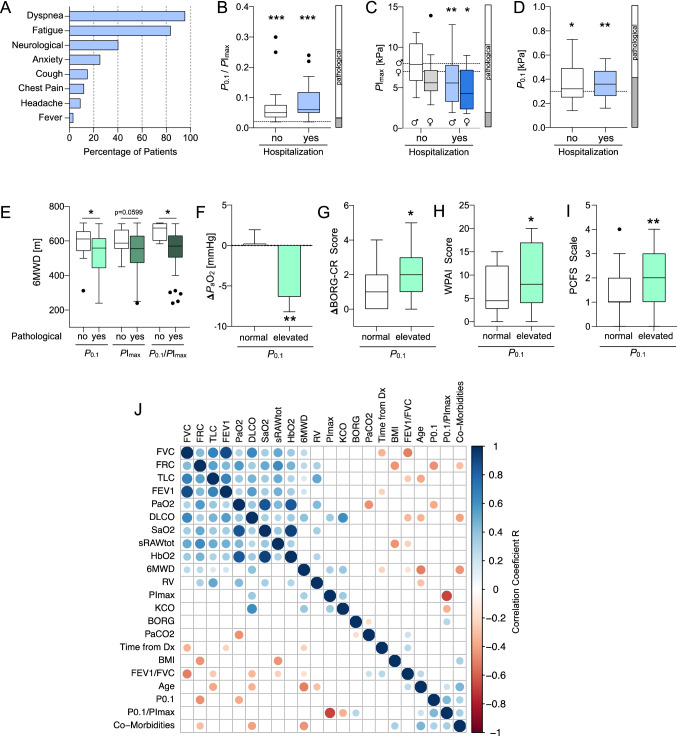
In a small cross-sectional pilot study (n = 67) of mild-to-moderate (nonhospitalized) and moderate-to-critical convalescent (formerly hospitalized) patients presenting to our outpatient clinic approx. 5 months after acute infection, we measured neuroventilatory activity P, inspiratory muscle strength (PI) and total respiratory muscle strain (P/PI) in addition to standard pulmonary functions tests, capillary blood gas analysis, 6 min walking tests and functional questionnaires.
Pathological P/PI was found in 88% of symptomatic patients. Mean PI was reduced in hospitalized patients, but reduced PI was also found in 65% of nonhospitalized patients. Mean P was pathologically increased in both groups. Increased P was associated with exercise-induced deoxygenation, impaired exercise tolerance, decreased activity and productivity and worse Post-COVID-19 functional status scale. Pathological changes in P, PI or P/PI were not associated with pre-existing conditions.
Our findings point towards respiratory muscle dysfunction as a novel aspect of COVID-19 sequelae. Thus, we strongly advocate for systematic respiratory muscle testing during the diagnostic workup of persistently symptomatic, convalescent COVID-19 patients.
COVID-19 后症状常持续超过 4 周-现在通常称为“长新冠”。无论初始疾病严重程度或肺功能测试如何,疲劳、运动不耐受和呼吸困难都是 COVID-19 最常见的后遗症之一。我们假设,在有自我报告的运动不耐受的 COVID-19 后持续有症状的患者中,呼吸肌功能障碍可能很常见。
在一项针对轻度至中度(非住院)和中度至危重症(曾住院)康复期患者的小横断面试点研究(n=67)中,我们在急性感染后约 5 个月向我们的门诊就诊时,除了标准的肺功能测试、毛细血管血气分析、6 分钟步行测试和功能问卷外,还测量了神经通气活性 P、吸气肌力量(PI)和总呼吸肌应变(P/PI)。
有症状患者中 88%存在病理性 P/PI。住院患者的 PI 降低,但非住院患者中也有 65%的患者 PI 降低。两组的平均 P 均病理性升高。P 的增加与运动诱导的缺氧、运动耐量受损、活动和生产力下降以及 COVID-19 后功能状态量表评分较差有关。P、PI 或 P/PI 的病理性变化与既往疾病无关。
我们的发现表明,呼吸肌功能障碍是 COVID-19 后遗症的一个新方面。因此,我们强烈主张在持续有症状的 COVID-19 康复患者的诊断过程中进行系统的呼吸肌测试。