Centro Interdisciplinar de Estudo da Performance Humana, Faculdade de Motricidade Humana, Universidade de Lisboa, Lisbon, Portugal.
Departamento de Atividade Física e Saúde, Escola Superior de Desporto de Rio Maior, Instituto Politécnico de Santarém, Rio Maior, Portugal.
Front Public Health. 2022 Apr 28;10:861390. doi: 10.3389/fpubh.2022.861390. eCollection 2022.
Learning to cycle is an important milestone for children, but the popularity of cycling and the environmental factors that promote the development and practice of this foundational movement skill vary among cultures and across time. This present study aimed to investigate if country of residence and the generation in which a person was born influence the age at which people learn to cycle.
Data were collected through an online survey between November 2019 and December 2020. For this study, a total of 9,589 responses were obtained for adults (self-report) and children (parental report) living in 10 countries (Portugal, Italy, Brazil, Finland, Spain, Belgium, United Kingdom, Mexico, Croatia, and the Netherlands). Participants were grouped according to their year of birth with 20-year periods approximately corresponding to 3 generations: 1960-79 (generation X; = 2,214); 1980-99 (generation Y; = 3,994); 2000-2019 (generation Z; = 3,381).
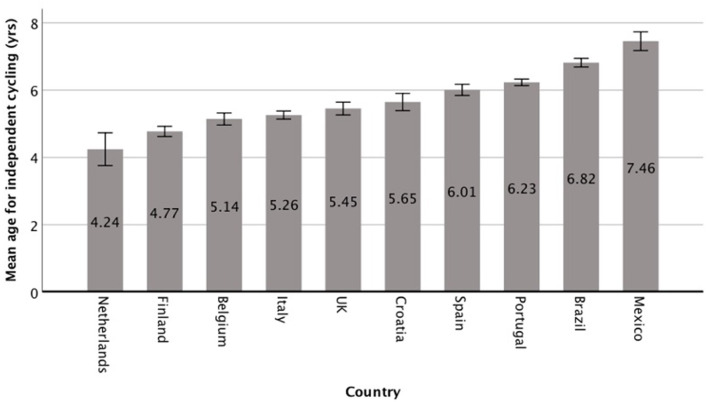
A two-way ANOVA showed a significant effect of country, = 90.17, < 0.001, = 0.086, and generation, = 47.21, < 0.001, = 0.122, on the age at which individuals learn to cycle. Countries with the lowest learning age were the Netherlands, Finland and Belgium and countries with the highest learning age were Brazil and Mexico. Furthermore, the age at which one learns to cycle has decreased across generations. There was also a significant country x generation interaction effect on learning age, = 2.90, < 0.001; however, this effect was negligible ( = 0.006).
These findings support the socio-ecological perspective that learning to cycle is a process affected by both proximal and distal influences, including individual, environment and time.
学习骑自行车对于儿童来说是一个重要的里程碑,但骑自行车的普及程度以及促进这一基本运动技能发展和实践的环境因素因文化和时间的不同而有所差异。本研究旨在调查一个人居住的国家和出生的年代是否会影响其学习骑自行车的年龄。
数据是通过 2019 年 11 月至 2020 年 12 月期间的在线调查收集的。本研究共获得了来自 10 个国家(葡萄牙、意大利、巴西、芬兰、西班牙、比利时、英国、墨西哥、克罗地亚和荷兰)的成年人(自我报告)和儿童(父母报告)的 9589 份回复。参与者根据他们的出生年份分组,20 年左右大致对应 3 个世代:1960-1979 年(X 世代; = 2214);1980-1999 年(Y 世代; = 3994);2000-2019 年(Z 世代; = 3381)。
双向方差分析显示,国家和世代对学习骑自行车的年龄有显著影响,国家的影响为 = 90.17,<0.001, = 0.086,世代的影响为 = 47.21,<0.001, = 0.122。学习骑自行车年龄最低的国家是荷兰、芬兰和比利时,学习年龄最高的国家是巴西和墨西哥。此外,随着世代的更迭,学习骑自行车的年龄也在逐渐降低。国家和世代之间也存在显著的交互作用, = 2.90,<0.001;然而,这种影响是微不足道的( = 0.006)。
这些发现支持了社会生态观点,即学习骑自行车是一个受到个体、环境和时间等近端和远端因素共同影响的过程。