Morioka Shinichiro, Tan Ban Hock, Kikuchi Hiroe, Asai Yusuke, Suzuki Tetsuya, Ashida Shinobu, Kutsuna Satoshi, Saito Sho, Hayakawa Kayoko, Tan Thuan Tong, Kodama Eiichi, Ohmagari Norio
Disease Control and Prevention Center, National Center for Global Health and Medicine Hospital, Tokyo, Japan.
Emerging and Reemerging Infectious Diseases, Graduate School of Medicine, Tohoku University, Sendai, Japan.
Front Psychiatry. 2022 Apr 28;13:781796. doi: 10.3389/fpsyt.2022.781796. eCollection 2022.
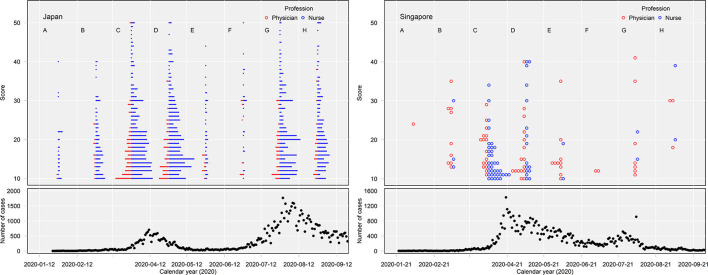
This study explores the factors contributing to the prolonged psychological distress of frontline nurses and physicians caring for COVID-19 patients in hospitals in Singapore and Japan. A cross-sectional survey between September and December 2020 yielded 1,644 responses (23.8%), from 62 nurses and 64 physicians in Singapore and 1,280 nurses and 238 physicians in Japan. Multivariate logistic regression analysis revealed that significant risk factors for prolonged psychological distress included being a frontline nurse [adjusted odds ratio (aOR) = 2.40, 95% confidence interval (CI): 1.24-4.66], having an underlying medical condition (aOR = 1.74, 95% CI: 1.22-2.46), experiencing prejudice because they undertook COVID-19 patient care (aOR = 3.05, 95% CI: 2.23-4.18), having trouble dealing with panicked or uncooperative patients (aOR = 2.36, 95% CI: 1.71-3.25), and experiencing an outbreak of COVID-19 in the hospital (aOR = 2.05, 95% CI: 1.38-3.04). Factors inversely associated with psychological distress included age (OR = 0.98, 95% CI: 0.97-1.00), number of beds in the hospital (aOR = 0.73, 95% CI: 0.57-0.94), clinical practice of carefully putting on and taking off personal protective equipment in daily COVID-19 patient care (aOR = 0.52, 95% CI: 0.37-0.73), and knowledge on COVID-19 (aOR = 0.82, 95% CI: 0.72-0.94). These results could help us identify vulnerable healthcare providers who need urgent mental care during the COVID-19 pandemic. Measures that may reduce psychological strain include adequate supply of medical resources, education on precautionary measures, and communication strategies to combat discrimination against frontline healthcare providers.
本研究探讨了导致新加坡和日本医院中照顾新冠肺炎患者的一线护士和医生长期心理困扰的因素。2020年9月至12月进行的一项横断面调查共收到1644份回复(回复率为23.8%),其中包括新加坡的62名护士和64名医生,以及日本的1280名护士和238名医生。多因素逻辑回归分析显示,导致长期心理困扰的显著风险因素包括身为一线护士[调整优势比(aOR)=2.40,95%置信区间(CI):1.24 - 4.66]、有基础疾病(aOR = 1.74,95% CI:1.22 - 2.46)、因照顾新冠肺炎患者而遭受偏见(aOR = 3.05,95% CI:2.23 - 4.18)、难以应对恐慌或不合作的患者(aOR = 2.36,95% CI:1.71 - 3.25)以及医院内出现新冠肺炎疫情(aOR = 2.05,95% CI:1.38 - 3.04)。与心理困扰呈负相关的因素包括年龄(优势比=0.98,95% CI:0.97 - 1.00)、医院床位数量(aOR = 0.73, 95% CI:0.57 - 0.94)、在日常照顾新冠肺炎患者时认真穿戴和摘除个人防护装备的临床实践(aOR = 0.52, 95% CI:0.37 - 0.73)以及对新冠肺炎的了解(aOR = 0.82, 95% CI:0.72 - 0.94)。这些结果有助于我们识别在新冠肺炎疫情期间需要紧急心理护理的弱势医护人员。可能减轻心理压力的措施包括充足的医疗资源供应、预防措施教育以及对抗对一线医护人员歧视的沟通策略。