Chalchat Emeric, Siracusa Julien, Bourrilhon Cyprien, Charlot Keyne, Martin Vincent, Garcia-Vicencio Sebastian
Institut de Recherche Biomédicale des Armées, Unité de Physiologie des Exercices et Activités en Conditions Extrêmes, Département Environnements Opérationnels, Bretigny-Sur-Orge, France.
AME2P, Université Clermont Auvergne, Clermont-Ferrand, France.
Front Physiol. 2022 Apr 29;13:877485. doi: 10.3389/fphys.2022.877485. eCollection 2022.
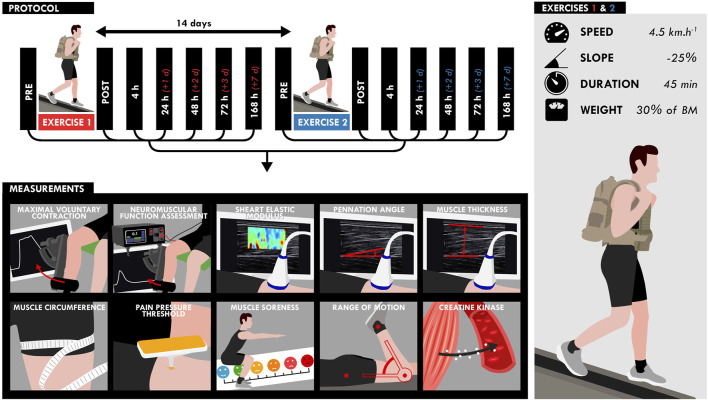
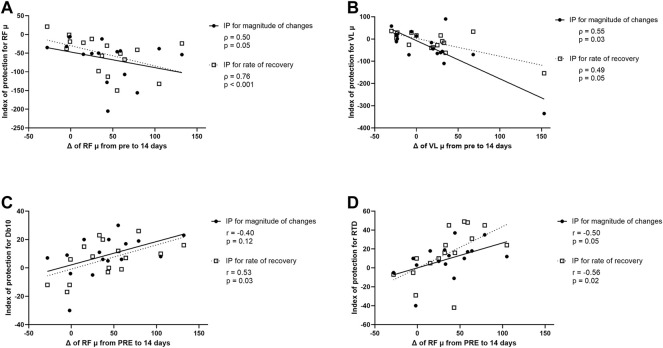
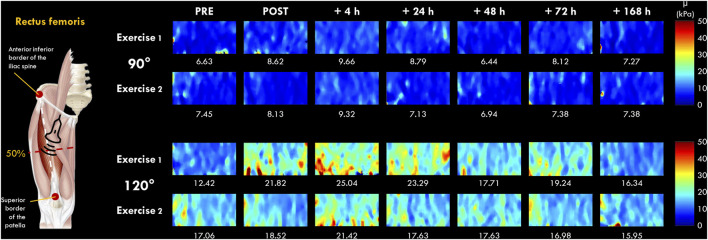
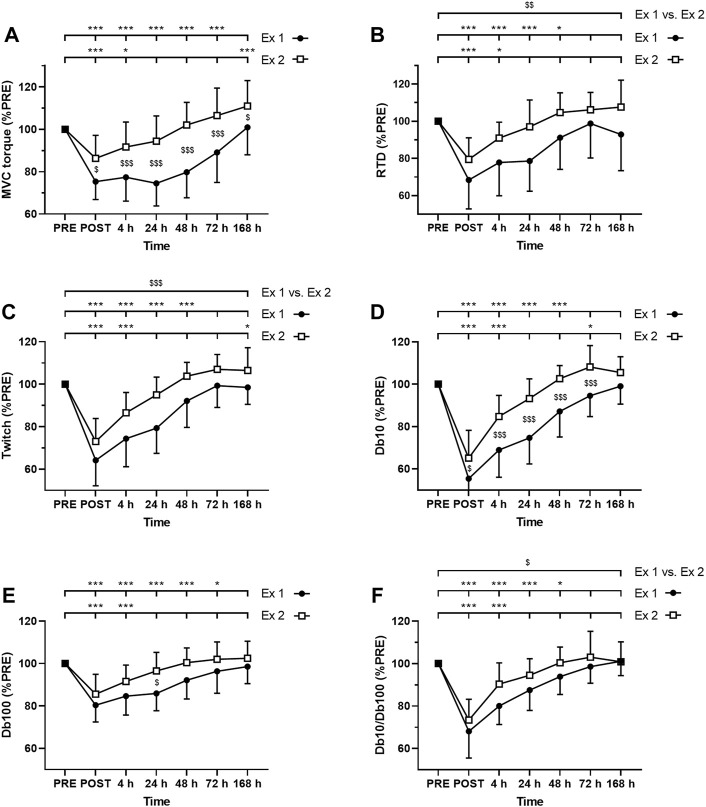
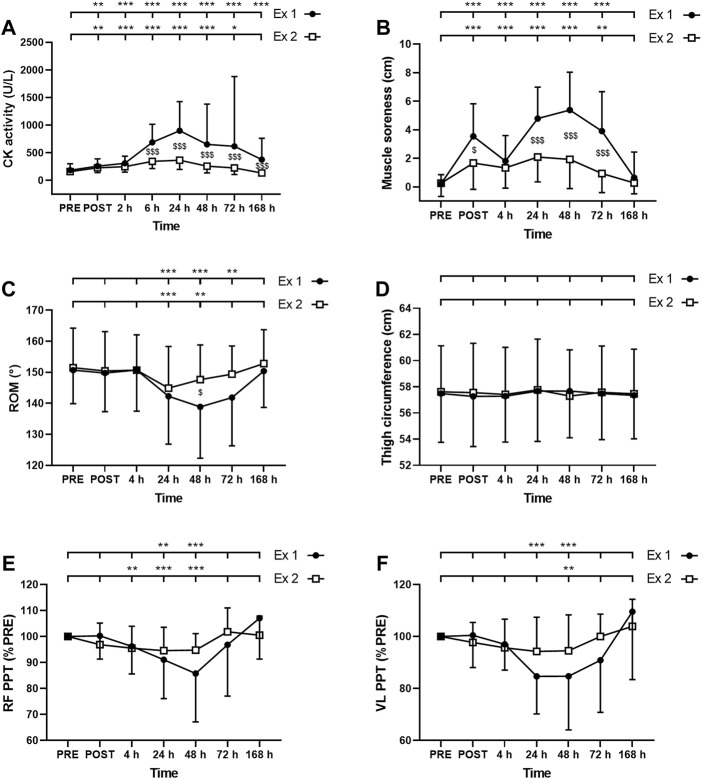
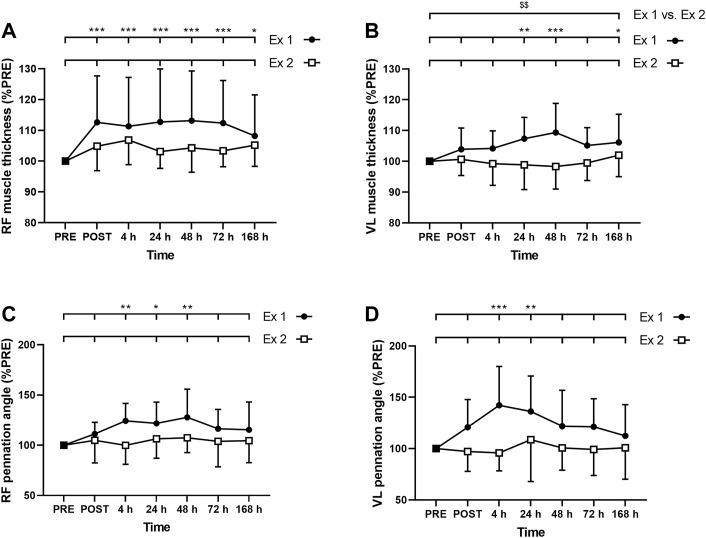
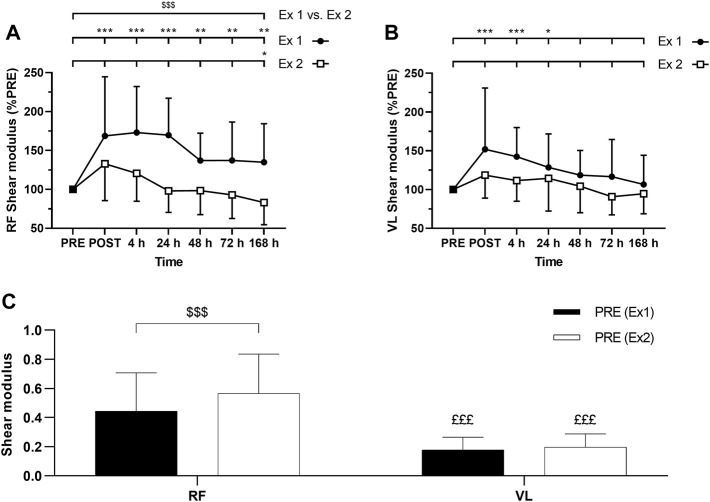
The neuromuscular system is able to quickly adapt to exercise-induced muscle damage (EIMD), such that it is less affected by subsequent damaging exercise, a phenomenon known as the repeated bout effect (RBE). The objective was to determine whether the mechanical properties of the quadriceps, as evaluated by shear wave elastography (SWE), were less affected when a second bout of eccentric-biased exercise was performed 2 weeks later. It was hypothesized that the first bout would confer protection against extensive muscle damage through an adaptation of the muscle stiffness before the second bout (i.e., higher muscle stiffness). Sixteen males performed two identical bouts of downhill walking separated by 2 weeks (45 min at 4.5 km.h; gradient: 25%; load: 30% of the body mass). (RF) and (VL) resting shear elastic modulus (µ) and EIMD symptoms were measured before and up to 7 days following the exercise bouts. Changes in neuromuscular function was evaluated by maximal voluntary contraction torque, voluntary activation level, evoked mechanical response to single and double (10 and 100 Hz doublets) electrical stimulation. An index of protection (IP) was calculated for EIMD symptoms to assess magnitude the RBE. EIMD symptoms were less affected after the second than the first exercise bout. RF and VL-µ increased ( < 0.001) only after the first exercise. RF µ was elevated up to 2 weeks after the end of the first exercise ( < 0.001) whereas VL µ was only increased up to 24 h. The increase in µ observed 2 weeks after the end of the first exercise was correlated with the IP; i.e., attenuation of alterations in muscle µ, 10 Hz-doublet amplitude and rate of torque development after the second exercise bout ( < 0.05). We showed that muscle µ assessed by SWE was sensitive to the RBE, with a differential effect between VL and RF. The persistent increase in µ was associated with the attenuation of neuromuscular impairments observed after the second bout, suggesting that the increased muscle stiffness could be a "protective" adaptation making muscles more resistant to the mechanical strain associated to eccentric contractions.
神经肌肉系统能够快速适应运动诱导的肌肉损伤(EIMD),从而在后续的损伤性运动中受影响较小,这一现象称为重复运动效应(RBE)。目的是确定在2周后进行第二轮偏心偏向运动时,通过剪切波弹性成像(SWE)评估的股四头肌机械性能是否受影响较小。假设第一轮运动会通过在第二轮运动前使肌肉僵硬度适应(即更高的肌肉僵硬度)来防止广泛的肌肉损伤。16名男性进行了两轮相同的下坡行走,间隔2周(以4.5公里/小时的速度行走45分钟;坡度:25%;负荷:体重的30%)。在运动前后直至7天测量股直肌(RF)和股外侧肌(VL)的静息剪切弹性模量(μ)以及EIMD症状。通过最大自主收缩扭矩、自主激活水平、对单次和双次(10和100Hz双脉冲)电刺激的诱发机械反应来评估神经肌肉功能的变化。计算EIMD症状的保护指数(IP)以评估RBE的程度。与第一轮运动相比,第二轮运动后EIMD症状受影响较小。仅在第一轮运动后,RF和VL-μ增加(P<0.001)。第一轮运动结束后,RF μ升高至2周(P<0.001),而VL μ仅在24小时内增加。在第一轮运动结束后2周观察到的μ增加与IP相关;即第二轮运动后肌肉μ、10Hz双脉冲幅度和扭矩发展速率变化的减弱(P<0.05)。我们表明,通过SWE评估的肌肉μ对RBE敏感,VL和RF之间存在差异效应。μ的持续增加与第二轮运动后观察到的神经肌肉损伤减弱相关,表明增加的肌肉僵硬度可能是一种“保护性”适应,使肌肉对与偏心收缩相关的机械应变更具抵抗力。