Molecular Biology Program, University of Colorado Anschutz Medical Campusgrid.430503.1, Aurora, Colorado, USA.
Mucosal Inflammation Program, University of Colorado Anschutz Medical Campusgrid.430503.1, Aurora, Colorado, USA.
mBio. 2022 Jun 28;13(3):e0048022. doi: 10.1128/mbio.00480-22. Epub 2022 May 16.
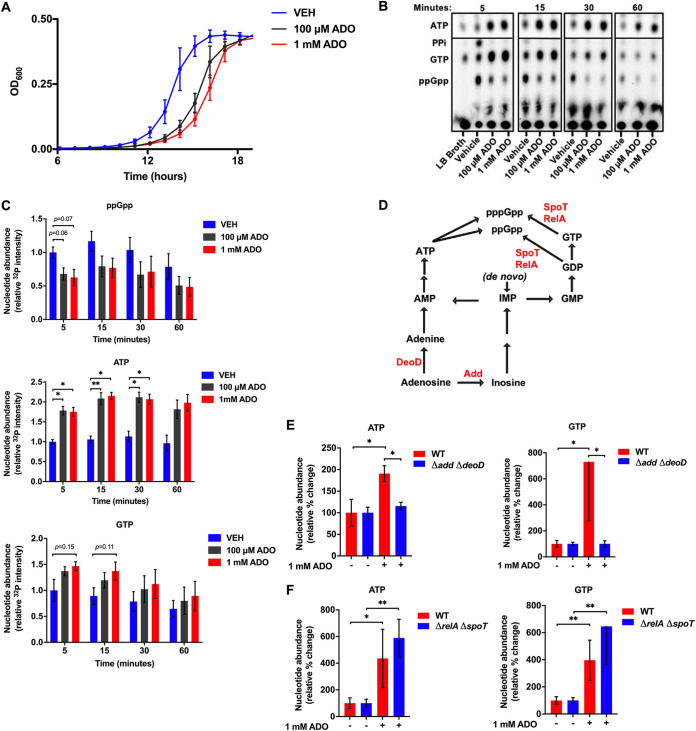
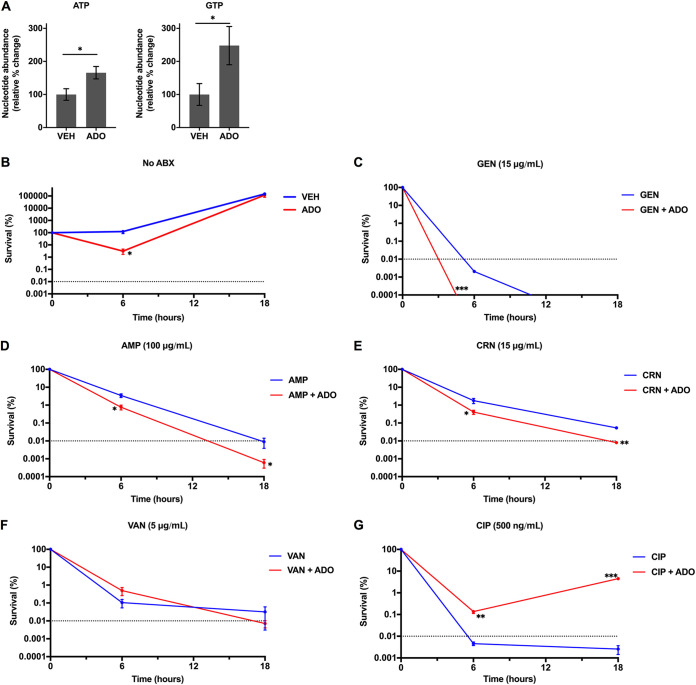
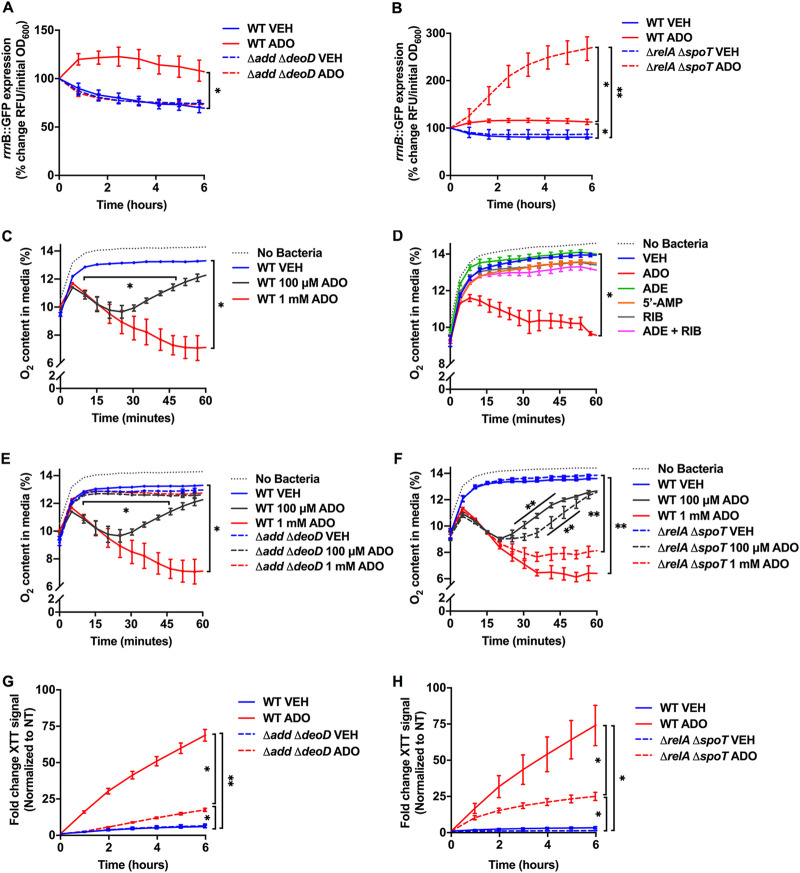
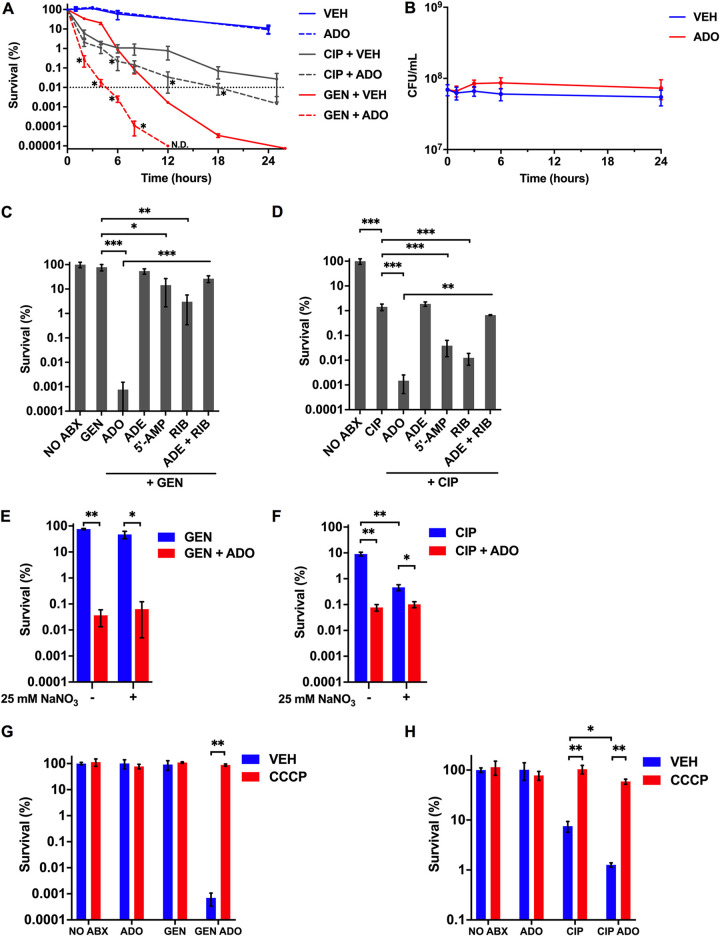
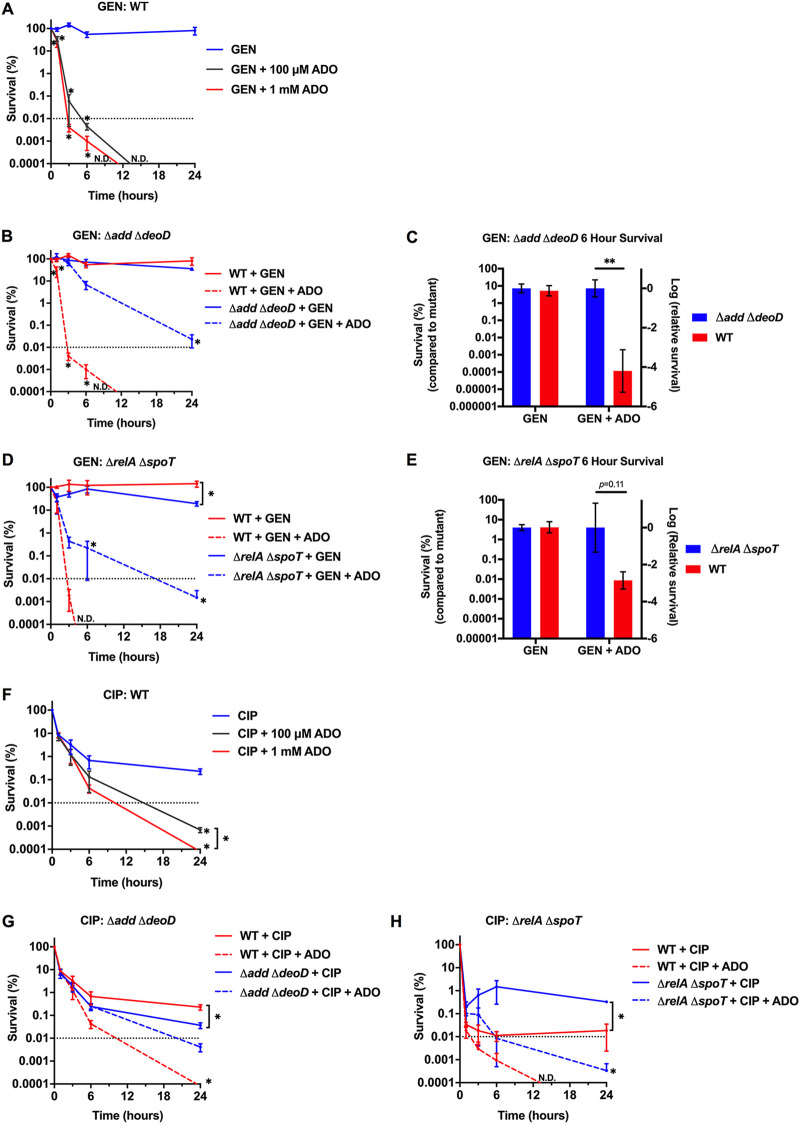
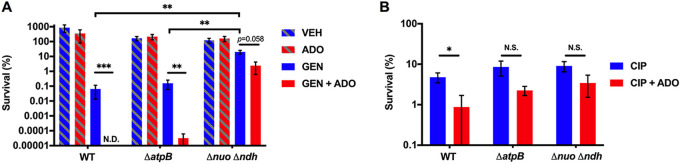
Metabolic and growth arrest are primary drivers of antibiotic tolerance and persistence in clinically diverse bacterial pathogens. We recently showed that adenosine (ADO) suppresses bacterial growth under nutrient-limiting conditions. In the current study, we show that despite the growth-suppressive effect of ADO, extracellular ADO enhances antibiotic killing in both Gram-negative and Gram-positive bacteria by up to 5 orders of magnitude. The ADO-potentiated antibiotic activity is dependent on purine salvage and is paralleled with a suppression of guanosine tetraphosphate synthesis and the massive accumulation of ATP and GTP. These changes in nucleoside phosphates coincide with transient increases in rRNA transcription and proton motive force. The potentiation of antibiotic killing by ADO is manifested against bacteria grown under both aerobic and anaerobic conditions, and it is exhibited even in the absence of alternative electron acceptors such as nitrate. ADO potentiates antibiotic killing by generating proton motive force and can occur independently of an ATP synthase. Bacteria treated with an uncoupler of oxidative phosphorylation and NADH dehydrogenase-deficient bacteria are refractory to the ADO-potentiated killing, suggesting that the metabolic awakening induced by this nucleoside is intrinsically dependent on an energized membrane. In conclusion, ADO represents a novel example of metabolite-driven but growth-independent means to reverse antibiotic tolerance. Our investigations identify the purine salvage pathway as a potential target for the development of therapeutics that may improve infection clearance while reducing the emergence of antibiotic resistance. Antibiotic tolerance, which is a hallmark of persister bacteria, contributes to treatment-refractory infections and the emergence of heritable antimicrobial resistance. Drugs that reverse tolerance and persistence may become part of the arsenal to combat antimicrobial resistance. Here, we demonstrate that salvage of extracellular ADO reduces antibiotic tolerance in nutritionally stressed Escherichia coli, Salmonella enterica, and Staphylococcus aureus. ADO potentiates bacterial killing under aerobic and anaerobic conditions and takes place in bacteria lacking the ATP synthase. However, the sensitization to antibiotic killing elicited by ADO requires an intact NADH dehydrogenase, suggesting a requirement for an energized electron transport chain. ADO antagonizes antibiotic tolerance by activating ATP and GTP synthesis, promoting proton motive force and cellular respiration while simultaneously suppressing the stringent response. These investigations reveal an unprecedented role for purine salvage stimulation as a countermeasure of antibiotic tolerance and the emergence of antimicrobial resistance.
代谢和生长停滞是抗生素耐药性和持久性在临床多种细菌病原体中的主要驱动因素。我们最近表明,腺嘌呤核苷(ADO)在营养受限的条件下抑制细菌生长。在当前的研究中,我们表明,尽管 ADO 具有生长抑制作用,但细胞外 ADO 仍能将抗生素对革兰氏阴性和革兰氏阳性细菌的杀灭作用提高多达 5 个数量级。ADO 增强抗生素活性依赖于嘌呤补救途径,并且与鸟苷四磷酸合成的抑制和 ATP 和 GTP 的大量积累相平行。这些核苷磷酸的变化与 rRNA 转录和质子动力的短暂增加相一致。ADO 对有氧和无氧条件下生长的细菌均能增强抗生素的杀菌作用,即使在缺乏硝酸盐等替代电子受体的情况下也能表现出来。ADO 通过产生质子动力来增强抗生素的杀菌作用,并且可以独立于 ATP 合酶发生。用氧化磷酸化解偶联剂处理的细菌和 NADH 脱氢酶缺陷的细菌对 ADO 增强的杀伤作用具有抗性,这表明这种核苷诱导的代谢觉醒本质上依赖于能量化的膜。总之,ADO 代表了一种新的代谢物驱动但与生长无关的逆转抗生素耐药性的范例。我们的研究确定嘌呤补救途径是开发治疗方法的潜在靶点,这些方法可能在减少抗生素耐药性的同时提高感染清除率。抗生素耐药性是持久细菌的标志,导致治疗难治性感染和遗传获得性抗菌耐药性的出现。逆转耐药性和持久性的药物可能成为对抗抗菌耐药性的武器的一部分。在这里,我们证明了细胞外 ADO 的补救可降低营养胁迫下大肠杆菌、沙门氏菌和金黄色葡萄球菌中的抗生素耐药性。ADO 在有氧和无氧条件下增强细菌的杀伤作用,并发生在缺乏 ATP 合酶的细菌中。然而,ADO 引发的对抗生素杀伤的敏感性需要完整的 NADH 脱氢酶,这表明需要一个能量化的电子传递链。ADO 通过激活 ATP 和 GTP 合成、促进质子动力和细胞呼吸,同时抑制严格反应,拮抗抗生素耐药性。这些研究揭示了嘌呤补救刺激作为抗生素耐药性和抗菌耐药性出现的对策的前所未有的作用。