Department of Chemical Engineering, Queen's University, Kingston, Ontario, Canada.
Centre for Health Innovation, Queen's University and Kingston Health Sciences Centre, Kingston, Ontario, Canada.
Transl Vis Sci Technol. 2022 May 2;11(5):14. doi: 10.1167/tvst.11.5.14.
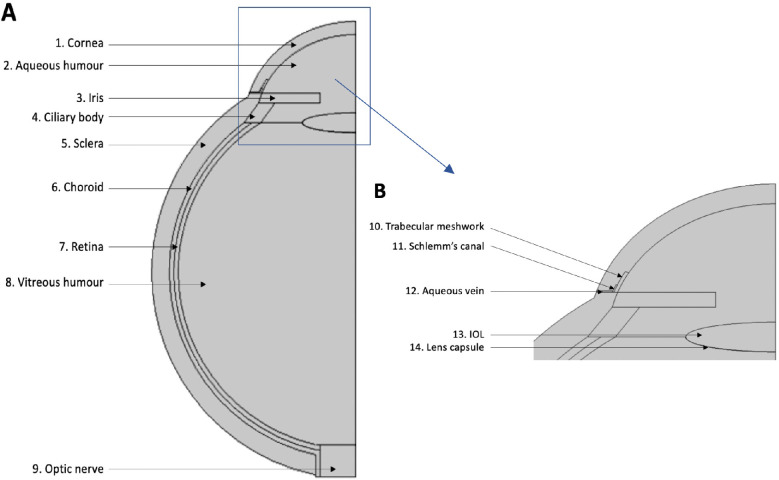
Surgically implanted intraocular lenses (IOLs) may be used as drug-delivery devices, but their effectiveness is not well defined. Computational fluid dynamics models were developed to investigate the capability of IOLs to release drugs at therapeutic concentrations.
Models were generated using COMSOL Multiphysics. Primary open-angle glaucoma (POAG) and wet age-related macular degeneration (AMD) were simulated by reducing aqueous vein and choroidal blood flow, respectively. Release of dexamethasone, ganciclovir, or dextran was studied using common IOL materials, polydimethylsiloxane (PDMS) and poly(2-hydroxyethyl methacrylate) (PHEMA).
Drug clearance proceeds mainly through choroidal blood flow. When fully constricted, maximum concentration at the choroid (Cmax) values increased by 32.4% to 39,800%. Compared to dexamethasone, Cmax in different tissues decreased by 6.07% to 96.0% for ganciclovir and dextran, and clearance rates decreased by 16% to 69% for ganciclovir and by 92% to 100% for dextran. Using PDMS as the IOL reduced clearance rates by 91.3% to 94.6% compared to PHEMA.
In diseased eyes, drugs accumulate mainly in posterior tissue; thus, choroidal drug toxicity must be assessed prior to IOL implantation in POAG and AMD patients. Moreover, drug properties modulated concentration profiles in all ocular segments. The hydrophobic small-molecule dexamethasone attained the highest concentrations and cleared the fastest, whereas hydrophilic macromolecular dextran attained the lowest concentrations and cleared the slowest. Furthermore, high concentrations were achieved quickly following release from PHEMA, whereas PDMS allowed for sustained release.
In silico results can guide scientists and clinicians regarding important physiological and chemical factors that modulate tissue drug concentrations from drug-eluting IOLs.
手术植入的人工晶状体(IOL)可用作药物输送装置,但它们的效果尚未明确。本文使用计算流体动力学模型来研究 IOL 以治疗浓度释放药物的能力。
使用 COMSOL Multiphysics 生成模型。通过分别减少房水静脉和脉络膜血流来模拟原发性开角型青光眼(POAG)和湿性年龄相关性黄斑变性(AMD)。使用常见的 IOL 材料聚二甲基硅氧烷(PDMS)和聚(2-羟乙基甲基丙烯酸酯)(PHEMA)研究了地塞米松、更昔洛韦和葡聚糖的释放。
药物清除主要通过脉络膜血流进行。当完全收缩时,脉络膜(Cmax)的最大浓度值增加了 32.4%至 39,800%。与地塞米松相比,不同组织中的 Cmax 降低了 6.07%至 96.0%,对于更昔洛韦和葡聚糖,清除率降低了 16%至 69%,对于更昔洛韦降低了 92%至 100%,对于葡聚糖。与 PHEMA 相比,使用 PDMS 作为 IOL 将清除率降低了 91.3%至 94.6%。
在患病眼中,药物主要积聚在后部组织中;因此,在 POAG 和 AMD 患者中植入 IOL 之前,必须评估脉络膜的药物毒性。此外,药物特性调节了所有眼部组织段的浓度分布。疏水性小分子地塞米松达到了最高浓度并清除得最快,而亲水性大分子葡聚糖达到了最低浓度并清除得最慢。此外,从 PHEMA 释放后很快就达到了高浓度,而 PDMS 允许持续释放。
翻译的准确性和流畅性可能会受到多种因素的影响,例如语言差异、文化背景和专业术语等。因此,建议在使用翻译文本时,进行适当的验证和核实,以确保其准确性和可靠性。