Yu Mi, Yang Mi Ran
College of Nursing, Institute of Health Sciences, Gyeongsang National University, Jinju, Republic of Korea.
Department of Nursing, Kwangju Health University, Kwangju, Republic of Korea.
JMIR Serious Games. 2022 May 27;10(2):e36707. doi: 10.2196/36707.
It is essential that nurses quickly learn the proper methods for preventing and controlling nosocomial infection and managing intensive care patients during the COVID-19 pandemic, including the donning and doffing of personal protective equipment (PPE). Virtual reality (VR) simulation offers the advantage of learning in a safe environment with a sense of realism similar to that of an actual clinical setting and has been reported to enhance self-efficacy in infection control, safety performance, and learning satisfaction among students.
This study aims to develop a virtual reality infection control simulation (VRICS) program regarding donning and doffing of PPE and respiratory care for pediatric patients admitted to an isolation unit for COVID-19 and to identify the effects of the program on PPE knowledge, infection control performance, and self-efficacy for nursing students. Additionally, the realism of the VRICS program and the students' level of satisfaction with the program were assessed.
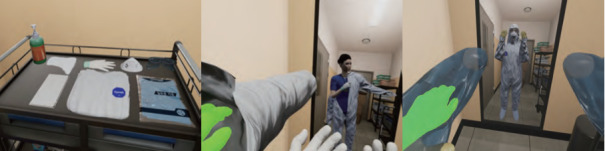
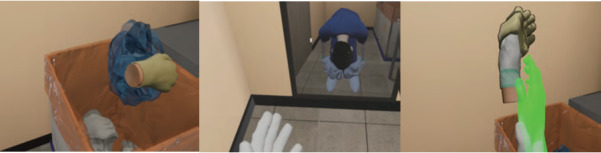
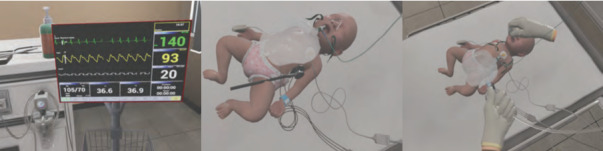
This was a quasi-experimental study based on a controlled pretest-posttest design. Third- and fourth-year nursing students were divided into an experimental group (n=25) who participated in a VRICS program and a control group (n=25) with no participation. Data were collected from November 13 to December 10, 2021, and analyzed using descriptive statistics and the t test, paired t test, Mann-Whitney U test, and Wilcoxon matched-pair signed-rank test. The VRICS program consisted of a prebriefing, including direct practice of donning and doffing PPE, VR simulation, and debriefing. The VR simulation comprised 3 sessions: donning and inspection of PPE in the dressing room before entering the negative-pressure isolation unit; assessing for suction care, nasopharyngeal suctioning, and checking of COVID-19 patients in the negative-pressure isolation unit; and doffing PPE in the dressing room. The total execution time for the program was 180 min.
Compared with the control group, the experimental group showed significantly greater improvements in PPE knowledge (z=-3.28, P<.001), infection control performance (t=4.89, P<.001), and self-efficacy (t=4.93, P<.001). The experimental group's mean scores for realistic immersion and learner satisfaction were 4.49 (SD 0.50) points and 4.75 (SD 0.38) points (on a 5-point Likert scale), respectively.
The VR simulation training program involving pediatric COVID-19 patients combined skills training effectively and enhanced theoretical knowledge, respiratory care skills, and infectious disease preparedness. Thus, it could be applied to training nurses to respond more effectively to public health situations involving infectious diseases, including the COVID-19 pandemic.
在新冠疫情期间,护士必须迅速掌握预防和控制医院感染以及管理重症监护患者的正确方法,包括个人防护装备(PPE)的穿脱。虚拟现实(VR)模拟具有在安全环境中学习的优势,其逼真感类似于实际临床环境,据报道可提高学生在感染控制、安全操作方面的自我效能感以及学习满意度。
本研究旨在开发一个关于为入住新冠隔离病房的儿科患者穿脱PPE及呼吸道护理的虚拟现实感染控制模拟(VRICS)程序,并确定该程序对护生PPE知识、感染控制操作及自我效能感的影响。此外,还评估了VRICS程序的逼真度以及学生对该程序的满意度。
这是一项基于对照前后测设计的准实验研究。将大三和大四护理专业学生分为参与VRICS程序的实验组(n = 25)和未参与的对照组(n = 25)。于2021年11月13日至12月10日收集数据,并使用描述性统计以及t检验、配对t检验、曼 - 惠特尼U检验和威尔科克森配对符号秩检验进行分析。VRICS程序包括预 briefing,包括PPE穿脱的直接练习、VR模拟和汇报总结。VR模拟包括3个环节:在进入负压隔离病房前在更衣室穿脱和检查PPE;在负压隔离病房评估吸痰护理、鼻咽部吸痰并检查新冠患者;在更衣室脱卸PPE。该程序的总执行时间为180分钟。
与对照组相比,实验组在PPE知识(z = -3.28,P <.001)、感染控制操作(t = 4.89,P <.001)和自我效能感(t = 4.93,P <.001)方面有显著更大的改善。实验组在逼真沉浸感和学习者满意度方面的平均得分分别为4.49(标准差0.50)分和4.75(标准差0.38)分(5分李克特量表)。
涉及儿科新冠患者的VR模拟培训程序有效地结合了技能培训,增强了理论知识、呼吸道护理技能和传染病应对能力。因此,它可应用于培训护士,使其更有效地应对包括新冠疫情在内的涉及传染病的公共卫生情况。