The AIDS Support Organization (TASO), Kampala, Uganda.
Makerere University School of Medicine, Kampala, Uganda.
PLoS One. 2022 May 16;17(5):e0266285. doi: 10.1371/journal.pone.0266285. eCollection 2022.
Isoniazid preventive therapy (IPT) is effective in treating tuberculosis (TB) infection and hence limiting progression to active disease. However, the durability of protection, associated factors and cost-effectiveness of IPT remain uncertain in low-and-middle income countries, Uganda inclusive. The Uganda Ministry of health recommends a single standard-dose IPT course for eligible people living with HIV (PLHIV). In this study we determined the incidence, associated factors and median time to TB diagnosis among PLHIV on Antiretroviral therapy (ART) who initiated IPT.
We conducted a retrospective cohort study at eleven The AIDS Support Organization (TASO) centers in Uganda. We reviewed medical records of 2634 PLHIV on ART who initiated IPT from 1st January 2016 to 30th June 2018, with 30th June 2021 as end of follow up date. We analyzed study data using STATA v.16. Incidence rate was computed as the number of new TB cases divided by the total person months. A Frailty model was used to determine factors associated with TB incidence.
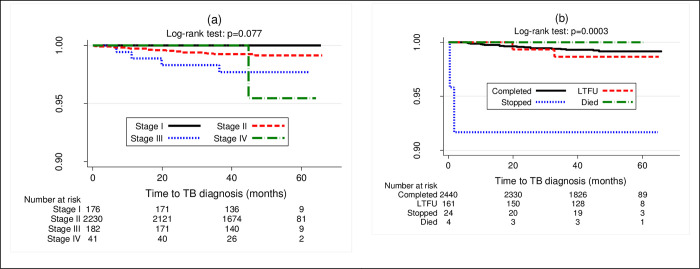
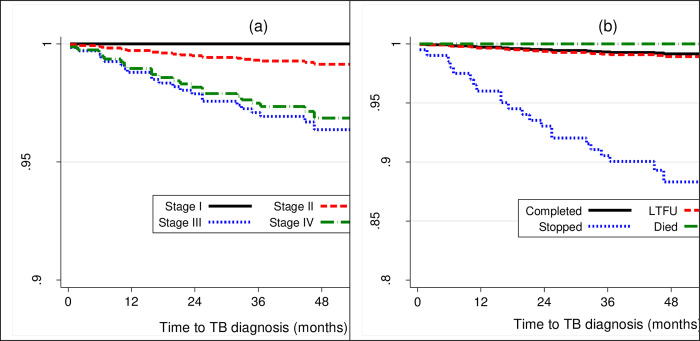
The 2634 individuals were observed for 116,360.7 person months. IPT completion rate was 92.8%. Cumulative proportion of patients who developed TB in this cohort was 0.83% (22/2634), an incidence rate of 18.9 per 100,000 person months. The median time to TB diagnosis was 18.5 months (minimum- 0.47; maximum- 47.3, IQR: 10.1-32.4). World Health Organization (WHO) HIV clinical stage III (adjusted hazard ratio (aHR) 95%CI: 3.66 (1.08, 12.42) (P = 0.037) and discontinuing IPT (aHR 95%CI: 25.96(4.12, 169.48) (p = 0.001)), were associated with higher odds of TB diagnosis compared with WHO clinical stage II and IPT completion respectively.
Incidence rates of TB were low overtime after one course of IPT, and this was mainly attributed to high completion rates.
异烟肼预防治疗(IPT)可有效治疗结核感染,从而限制其发展为活动性疾病。然而,在包括乌干达在内的中低收入国家,IPT 的保护持久性、相关因素和成本效益仍不确定。乌干达卫生部建议为符合条件的艾滋病毒感染者(PLHIV)提供单一标准剂量的 IPT 疗程。在这项研究中,我们确定了开始 IPT 的接受抗逆转录病毒治疗(ART)的 PLHIV 中结核的发病率、相关因素和中位诊断时间。
我们在乌干达的 11 个艾滋病支持组织(TASO)中心进行了一项回顾性队列研究。我们回顾了 2016 年 1 月 1 日至 2018 年 6 月 30 日期间开始 IPT 的 2634 名接受 ART 的 PLHIV 的医疗记录,截至 2021 年 6 月 30 日为随访结束日期。我们使用 STATA v.16 分析研究数据。发病率计算为新结核病例数除以总人月数。使用脆弱性模型确定与结核发病率相关的因素。
2634 人观察了 116360.7 人月。IPT 完成率为 92.8%。该队列中发展为结核的患者累积比例为 0.83%(22/2634),发病率为 18.9/100000 人月。结核诊断的中位时间为 18.5 个月(最小-0.47;最大-47.3,IQR:10.1-32.4)。世界卫生组织(WHO)艾滋病毒临床分期 III(调整后的危险比(aHR)95%CI:3.66(1.08,12.42)(P=0.037)和停止 IPT(aHR 95%CI:25.96(4.12,169.48)(p=0.001))与 WHO 临床分期 II 和 IPT 完成率分别与较高的结核诊断几率相关。
IPT 疗程后,TB 的发病率随着时间的推移呈下降趋势,这主要归因于高完成率。