Cho Jaewon, Tae Nara, Ahn Jae-Hee, Chang Sun-Young, Ko Hyun-Jeong, Kim Dae Hee
Department of Pharmacy, Kangwon National University, Chuncheon 24341, Republic of Korea.
Kangwon Institute of Inclusive Technology, Kangwon National University, Chuncheon 24341, Republic of Korea.
Biomol Ther (Seoul). 2022 Sep 1;30(5):418-426. doi: 10.4062/biomolther.2022.015. Epub 2022 May 17.
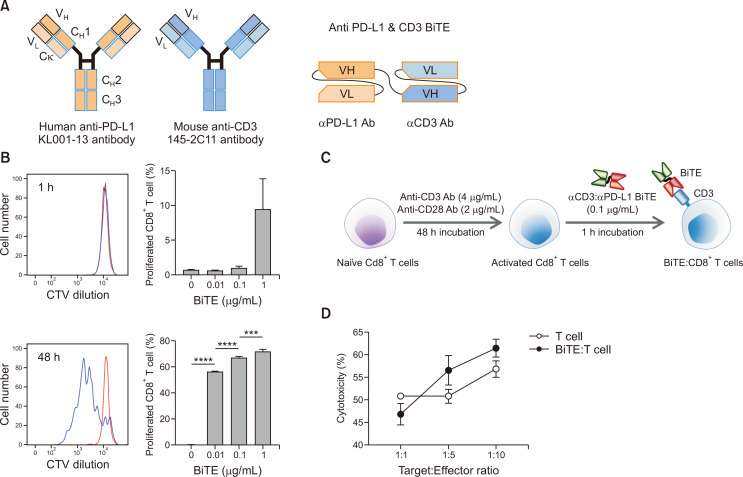
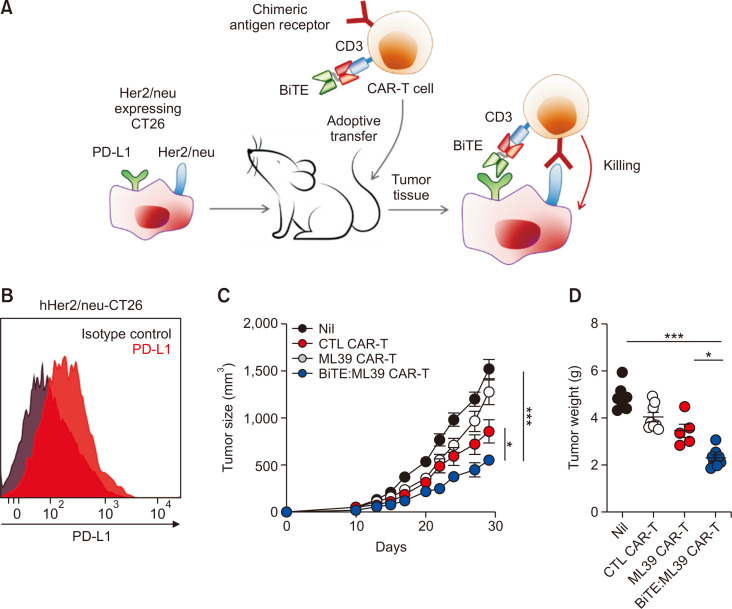
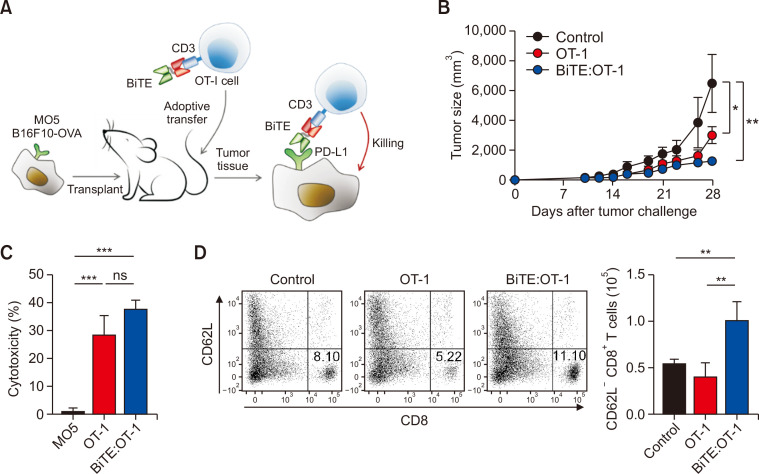
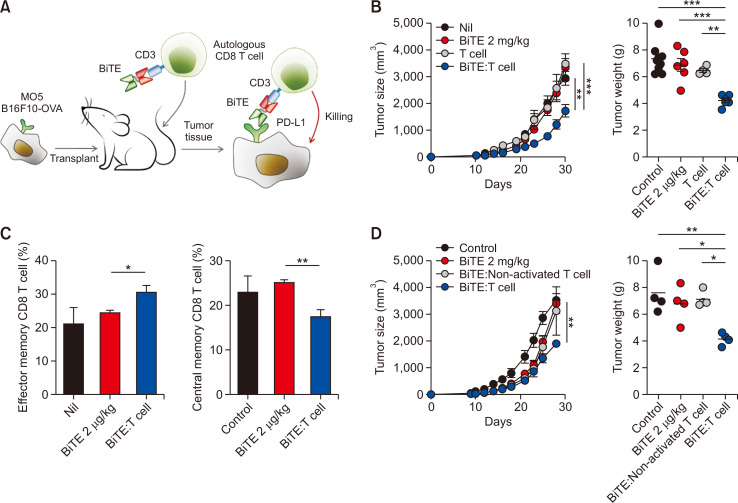
Chimeric antigen receptor T (CAR-T) cell therapy is one of the promising anticancer treatments. It shows a high overall response rate with complete response to blood cancer. However, there is a limitation to solid tumor treatment. Additionally, this currently approved therapy exhibits side effects such as cytokine release syndrome and neurotoxicity. Alternatively, bispecific antibody is an innovative therapeutic tool that simultaneously engages specific immune cells to disease-related target cells. Since programmed death ligand 1 (PD-L1) is an immune checkpoint molecule highly expressed in some cancer cells, in the current study, we generated αCD3xαPD-L1 bispecific antibody (BiTE) which can engage T cells to PD-L1 cancer cells. We observed that the BiTE-bound OT-1 T cells effectively killed cancer cells and . They substantially increased the recruitment of effector memory CD8 T cells having CD8CD44CD62L phenotype in tumor. Interestingly, we also observed that BiTE-bound polyclonal T cells showed highly efficacious tumor killing activity in comparison with the direct intravenous treatment of bispecific antibody, suggesting that PD-L1-directed migration and engagement of activated T cells might increase cancer cell killing. Additionally, BiTE-bound CAR-T cells which targets human Her-2/neu exhibited enhanced killing effect on Her-2-expressing cancer cells , suggesting that this could be a novel therapeutic regimen. Collectively, our results suggested that engaging activated T cells with cancer cells using αCD3xαPD-L1 BiTE could be an innovative next generation anticancer therapy which exerts simultaneous inhibitory functions on PD-L1 as well as increasing the infiltration of activated T cells having effector memory phenotype in tumor site.
嵌合抗原受体T(CAR-T)细胞疗法是一种很有前景的抗癌治疗方法。它对血癌的总体缓解率很高,完全缓解率也很高。然而,实体瘤治疗存在局限性。此外,这种目前已获批的疗法会出现细胞因子释放综合征和神经毒性等副作用。相比之下,双特异性抗体是一种创新的治疗工具,可同时使特定免疫细胞与疾病相关靶细胞结合。由于程序性死亡配体1(PD-L1)是一种在某些癌细胞中高度表达的免疫检查点分子,在本研究中,我们制备了αCD3xαPD-L1双特异性抗体(BiTE),它可以使T细胞与PD-L1癌细胞结合。我们观察到,与BiTE结合的OT-1 T细胞有效地杀死了癌细胞。它们显著增加了肿瘤中具有CD8CD44CD62L表型的效应记忆CD8 T细胞的募集。有趣的是,我们还观察到,与双特异性抗体直接静脉注射治疗相比,与BiTE结合的多克隆T细胞表现出高效的肿瘤杀伤活性,这表明PD-L1导向的活化T细胞迁移和结合可能会增强癌细胞杀伤作用。此外,靶向人Her-2/neu的与BiTE结合的CAR-T细胞对表达Her-2的癌细胞表现出增强的杀伤作用,这表明这可能是一种新的治疗方案。总的来说,我们的结果表明,使用αCD3xαPD-L1 BiTE使活化T细胞与癌细胞结合可能是一种创新的下一代抗癌疗法,它对PD-L1具有同时抑制作用,并增加具有效应记忆表型的活化T细胞在肿瘤部位的浸润。