Division of Adolescent/Young Adult Medicine, Boston Children's Hospital, Boston, Massachusetts, USA.
Computational Health Informatics Program, Boston Children's Hospital, Boston, Massachusetts, USA.
Clin Infect Dis. 2022 Aug 15;75(Suppl 1):S98-S109. doi: 10.1093/cid/ciac344.
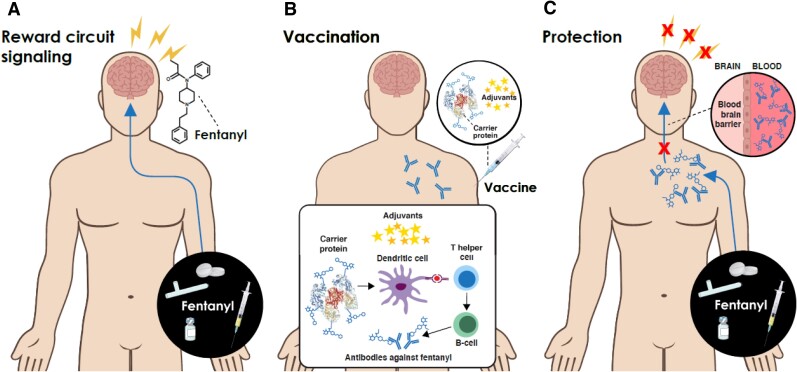
The opioid epidemic worsened during the coronavirus disease 2019 (COVID-19) pandemic. Synthetic opioids (primarily fentanyl) comprise the most common drugs involved in overdose (OD) death. A vaccine that blocks fentanyl from reaching the brain to prevent OD is under development, and insight is needed into its acceptability.
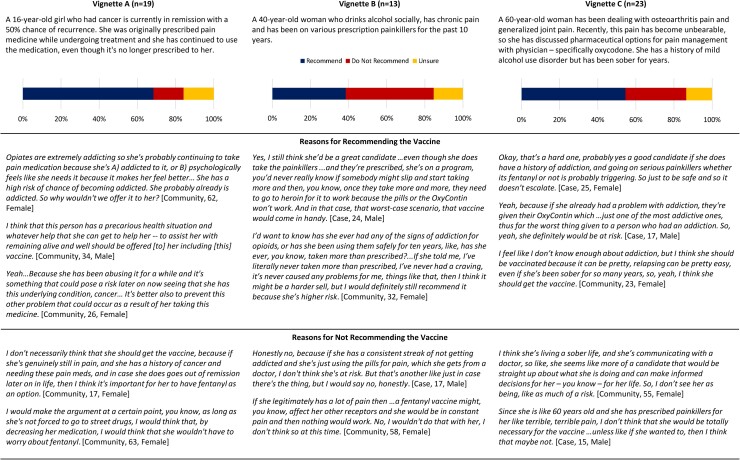
Using a semi-structured interview guide, persons with opioid use disorder (OUD), family, professionals, and the public were interviewed about attitudes and concerns regarding a fentanyl vaccine. Reactions to fictional clinical vignettes of persons at risk of OUD because of pain and/or substance use histories were collected, analyzed, and quantified for favorability. Interviews were transcribed, coded, and analyzed thematically.
Among N = 64 participants, (70.3% female, average age 32.4 years), attitudes were favorable toward a fentanyl vaccine, with preference for lifelong durability (76% of n = 55 asked). Perceived benefits centered on the potential for a life-saving intervention, suffering averted, healthcare dollars saved, and the utility of a passive harm reduction strategy. Concerns centered on uncertainty regarding vaccine safety, questions about efficacy, worry about implications for future pain management, stigma, and need for supportive counseling and guidance to personalize decision making. Reactions to vignettes revealed complex attitudes toward fentanyl vaccination when considering recipient age, health history, and future risks for addiction and pain.
Positive responses to a fentanyl vaccine were found along with appreciation for the complexity of a vaccine strategy to prevent OD in the setting of pain and uncertain durability. Further research is needed to elucidate operational, ethical, and communications strategies to advance the model.
在 2019 年冠状病毒病(COVID-19)大流行期间,阿片类药物泛滥问题恶化。合成阿片类药物(主要是芬太尼)是最常见的与过量用药(OD)死亡相关的药物。一种能阻止芬太尼进入大脑以预防 OD 的疫苗正在研发中,因此需要深入了解其可接受性。
使用半结构式访谈指南,对患有阿片类药物使用障碍(OUD)的个体、其家属、专业人员和公众进行了关于对芬太尼疫苗的态度和关注点的访谈。收集并分析了对因疼痛和/或药物使用史而有 OUD 风险的虚构临床病例的反应,并对其有利程度进行量化。访谈内容被转录、编码,并进行了主题分析。
在 N = 64 名参与者中(70.3%为女性,平均年龄为 32.4 岁),对芬太尼疫苗的态度是积极的,他们更倾向于终身耐用性(76%的 n = 55 被问到)。人们认为潜在的拯救生命的干预措施、避免痛苦、节省医疗保健费用和被动减少伤害的策略是疫苗的潜在好处。关注的焦点是疫苗安全性的不确定性、对疗效的疑问、对未来疼痛管理的担忧、耻辱感以及对支持性咨询和指导的需求,以个性化决策。考虑到接受者的年龄、健康史以及未来成瘾和疼痛的风险,对芬太尼疫苗接种的病例反应揭示了对其复杂的态度。
发现对芬太尼疫苗有积极的反应,同时也对在疼痛和不确定耐用性的情况下,预防 OD 的疫苗策略的复杂性表示赞赏。需要进一步研究以阐明推进该模型的操作性、伦理和沟通策略。