Cancer Epidemiology Unit, Nuffield Department of Population Health, University of Oxford, Oxford, UK.
Genomic Epidemiology Branch, International Agency for Research on Cancer, Lyon, France.
Int J Cancer. 2022 Oct 1;151(7):1033-1046. doi: 10.1002/ijc.34116. Epub 2022 Jun 7.
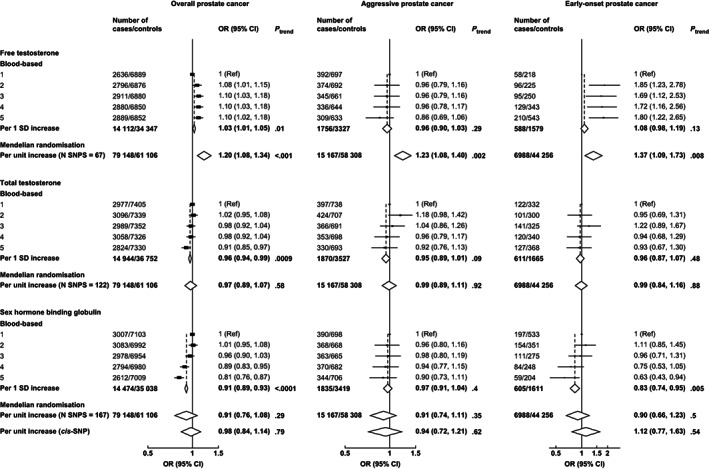
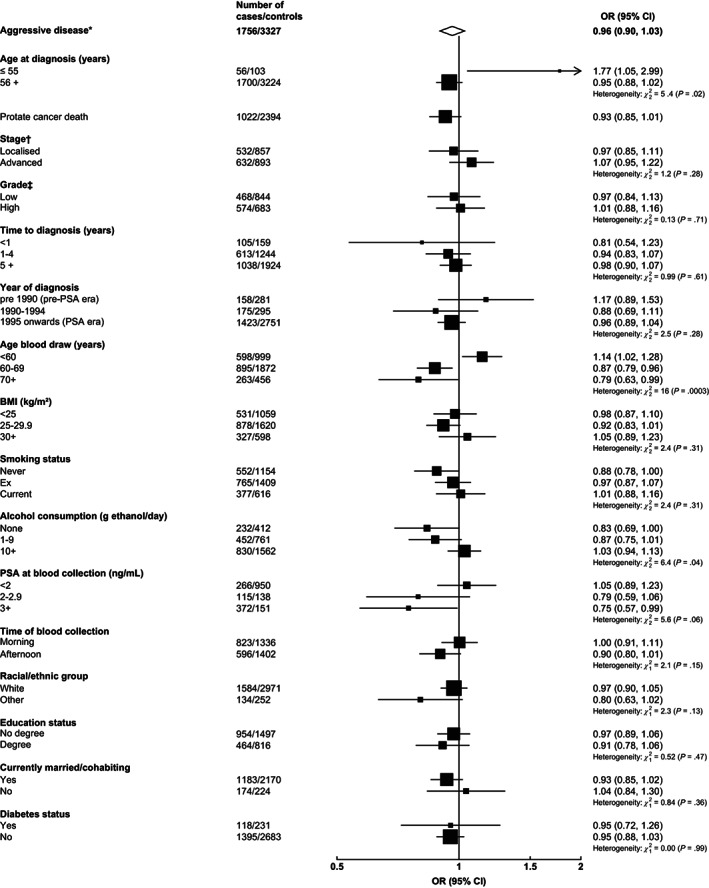
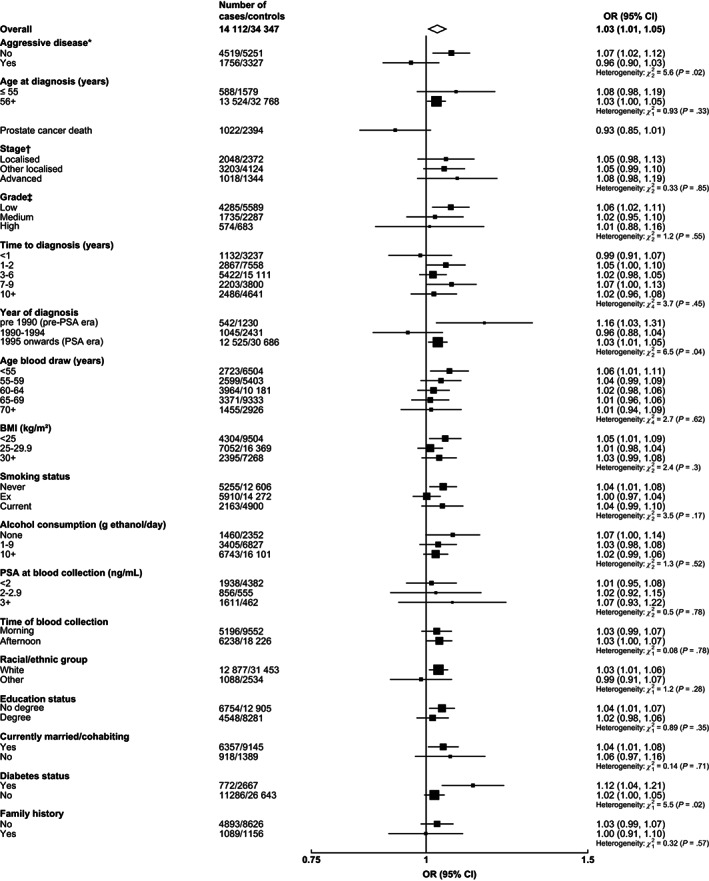
Previous studies had limited power to assess the associations of testosterone with aggressive disease as a primary endpoint. Further, the association of genetically predicted testosterone with aggressive disease is not known. We investigated the associations of calculated free and measured total testosterone and sex hormone-binding globulin (SHBG) with aggressive, overall and early-onset prostate cancer. In blood-based analyses, odds ratios (OR) and 95% confidence intervals (CI) for prostate cancer were estimated using conditional logistic regression from prospective analysis of biomarker concentrations in the Endogenous Hormones, Nutritional Biomarkers and Prostate Cancer Collaborative Group (up to 25 studies, 14 944 cases and 36 752 controls, including 1870 aggressive prostate cancers). In Mendelian randomisation (MR) analyses, using instruments identified using UK Biobank (up to 194 453 men) and outcome data from PRACTICAL (up to 79 148 cases and 61 106 controls, including 15 167 aggressive cancers), ORs were estimated using the inverse-variance weighted method. Free testosterone was associated with aggressive disease in MR analyses (OR per 1 SD = 1.23, 95% CI = 1.08-1.40). In blood-based analyses there was no association with aggressive disease overall, but there was heterogeneity by age at blood collection (OR for men aged <60 years 1.14, CI = 1.02-1.28; P = .0003: inverse association for older ages). Associations for free testosterone were positive for overall prostate cancer (MR: 1.20, 1.08-1.34; blood-based: 1.03, 1.01-1.05) and early-onset prostate cancer (MR: 1.37, 1.09-1.73; blood-based: 1.08, 0.98-1.19). SHBG and total testosterone were inversely associated with overall prostate cancer in blood-based analyses, with null associations in MR analysis. Our results support free testosterone, rather than total testosterone, in the development of prostate cancer, including aggressive subgroups.
先前的研究在评估睾酮与侵袭性疾病(主要终点)的关联方面的效力有限。此外,遗传预测的睾酮与侵袭性疾病的关联尚不清楚。我们研究了计算的游离和测量的总睾酮和性激素结合球蛋白(SHBG)与侵袭性、总体和早期发病的前列腺癌之间的关联。在基于血液的分析中,使用前瞻性分析生物标志物浓度的条件逻辑回归(来自内源性激素、营养生物标志物和前列腺癌合作组的多达 25 项研究,包括 14944 例病例和 36752 例对照,其中包括 1870 例侵袭性前列腺癌),估计了前列腺癌的比值比(OR)和 95%置信区间(CI)。在孟德尔随机分析中,使用 UK Biobank 中鉴定的工具(多达 194453 名男性)和 PRACTICAL 中的结果数据(多达 79148 例病例和 61106 例对照,其中包括 15167 例侵袭性癌症),使用逆方差加权法估计了 OR。游离睾酮与 MR 分析中的侵袭性疾病相关(每 SD 增加 1 个单位的 OR=1.23,95%CI=1.08-1.40)。在基于血液的分析中,与侵袭性疾病总体无关联,但与血液采集时的年龄存在异质性(年龄<60 岁的男性 OR=1.14,CI=1.02-1.28;P=0.0003:年龄较大时呈负相关)。游离睾酮与总体前列腺癌(MR:1.20,1.08-1.34;基于血液:1.03,1.01-1.05)和早期发病的前列腺癌(MR:1.37,1.09-1.73;基于血液:1.08,0.98-1.19)的相关性呈阳性。在基于血液的分析中,SHBG 和总睾酮与总体前列腺癌呈负相关,而在 MR 分析中呈零关联。我们的结果支持游离睾酮而非总睾酮在前列腺癌的发展中起作用,包括侵袭性亚组。