Moreira Marco, Pobel Cedric, Epaillard Nicolas, Simonaggio Audrey, Oudard Stéphane, Vano Yann-Alexandre
Centre de Recherche des Cordeliers, INSERM, Université de Paris, Sorbonne Université, Paris F-75006, France.
Both authors contributed equally.
Cancer Drug Resist. 2020 Jul 2;3(3):454-471. doi: 10.20517/cdr.2020.16. eCollection 2020.
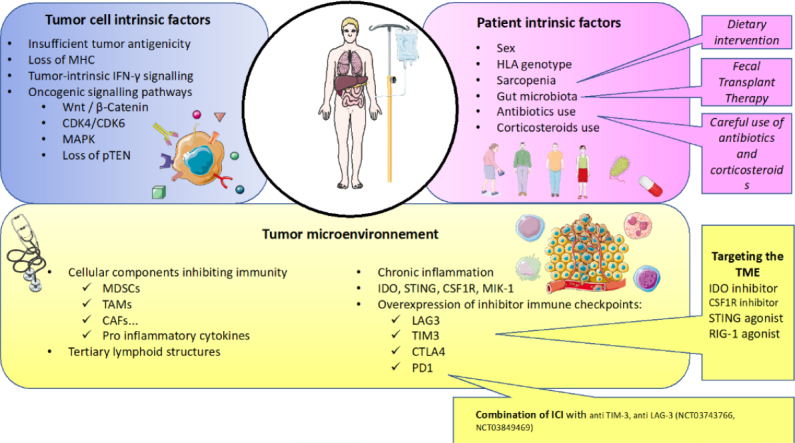
The prognosis of metastatic clear cell renal cell carcinoma (mccRCC) has changed dramatically over the years with the emergence of immune checkpoint inhibitors (ICI) used alone, or in combination with another ICI, or with vascular endothelial growth factor receptor tyrosine kinase inhibitor. Although major response rates have been observed with ICI, many patients do not respond, reflecting primary resistance, and durable responses remain exceptional, reflecting secondary resistance. Factors contributing to primary and acquired resistance are manifold, including patient-intrinsic factors, tumor cell-intrinsic factors and factors associated with the tumoral microenvironment (TME). While some mechanisms of resistance are common to several tumor types, others are specific to mccRCC. Predictive biomarkers and alternative strategies are needed to overcome this resistance. This review provides an overview of the major ICI resistance mechanisms, highlights the potential of the TME to induce resistance to ICI, and discusses the predictive biomarkers available to guide therapeutic choice.
近年来,随着单独使用免疫检查点抑制剂(ICI)、或与另一种ICI联合使用、或与血管内皮生长因子受体酪氨酸激酶抑制剂联合使用,转移性透明细胞肾细胞癌(mccRCC)的预后发生了巨大变化。尽管使用ICI观察到了较高的缓解率,但许多患者无反应,这反映了原发性耐药,而持久反应仍然少见,这反映了继发性耐药。导致原发性和获得性耐药的因素多种多样,包括患者内在因素、肿瘤细胞内在因素以及与肿瘤微环境(TME)相关的因素。虽然一些耐药机制在几种肿瘤类型中是常见的,但其他机制则是mccRCC特有的。需要预测性生物标志物和替代策略来克服这种耐药性。本综述概述了主要的ICI耐药机制,强调了TME诱导ICI耐药的可能性,并讨论了可用于指导治疗选择的预测性生物标志物。