Roy Arya Mariam, George Saby
Division of Hematology and Oncology, Department of Internal Medicine, Roswell Park Comprehensive Cancer Center, Buffalo, NY 14203, USA.
Cancer Drug Resist. 2023 Sep 20;6(3):642-655. doi: 10.20517/cdr.2023.47. eCollection 2023.
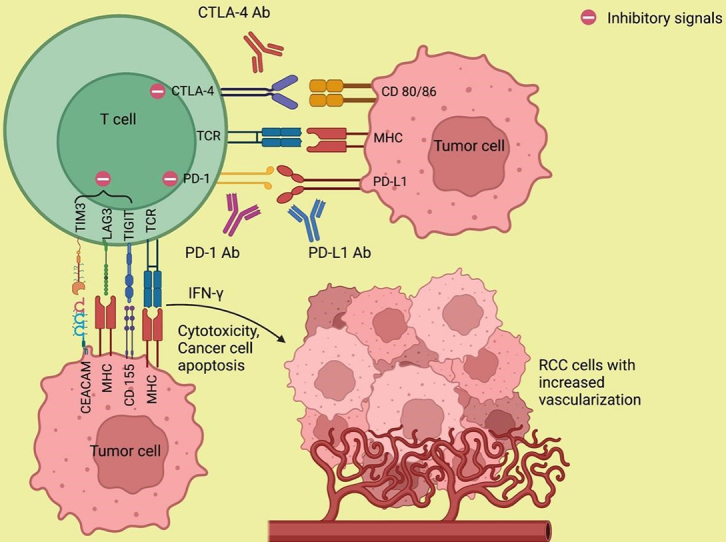
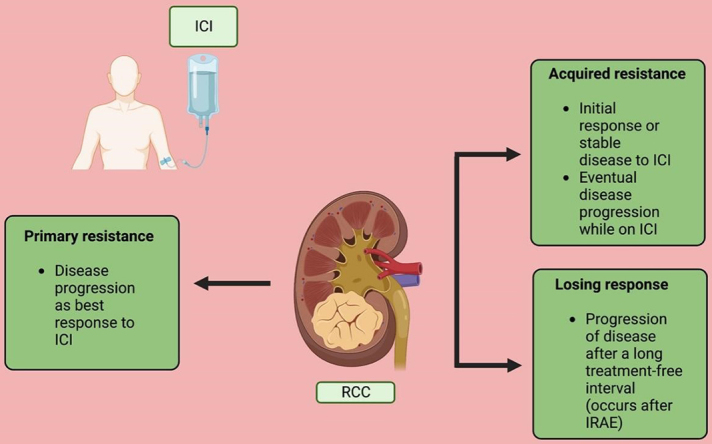
The introduction of immune checkpoint inhibitor (ICI) has revolutionized the treatment of metastatic renal cell carcinoma (mRCC) and has dramatically improved the outcomes of patients. The use of monotherapy or combinations of ICIs targeting PD-1/PD-L1 and CTLA-4, as well as the addition of ICIs with tyrosine kinase inhibitors, has significantly enhanced the overall survival of mRCC patients. Despite these promising results, there remains a subset of patients who either do not respond to treatment (primary resistance) or develop resistance to therapy over time (acquired resistance). Understanding the mechanisms underlying the development of resistance to ICI treatment is crucial in the management of mRCC, as they can be used to identify new targets for innovative therapeutic strategies. Currently, there is an unmet need to develop new predictive and prognostic biomarkers that can aid in the development of personalized treatment options for mRCC patients. In this review, we summarize several mechanisms of ICI resistance in RCC, including alterations in tumor microenvironment, upregulation of alternative immune checkpoint pathways, and genetic and epigenetic changes. Additionally, we highlight potential strategies that can be used to overcome resistance, such as combination therapy, targeted therapy, and immune modulation.
免疫检查点抑制剂(ICI)的引入彻底改变了转移性肾细胞癌(mRCC)的治疗方式,并显著改善了患者的治疗效果。使用针对PD-1/PD-L1和CTLA-4的ICI单药治疗或联合治疗,以及将ICI与酪氨酸激酶抑制剂联合使用,已显著提高了mRCC患者的总生存期。尽管取得了这些令人鼓舞的结果,但仍有一部分患者对治疗无反应(原发性耐药)或随着时间的推移对治疗产生耐药性(获得性耐药)。了解ICI治疗耐药性产生的潜在机制对于mRCC的管理至关重要,因为这些机制可用于识别创新治疗策略的新靶点。目前,迫切需要开发新的预测性和预后性生物标志物,以帮助为mRCC患者制定个性化的治疗方案。在这篇综述中,我们总结了RCC中ICI耐药的几种机制,包括肿瘤微环境的改变、替代免疫检查点途径的上调以及基因和表观遗传变化。此外,我们强调了可用于克服耐药性的潜在策略,如联合治疗、靶向治疗和免疫调节。