Department of Gastroenterology and Hepatology, Nagasaki University Graduate School of Biomedical Sciences, 1-7-1 Sakamoto, Nagasaki City, Nagasaki, Japan.
Medicine (Baltimore). 2022 May 13;101(19):e29289. doi: 10.1097/MD.0000000000029289.
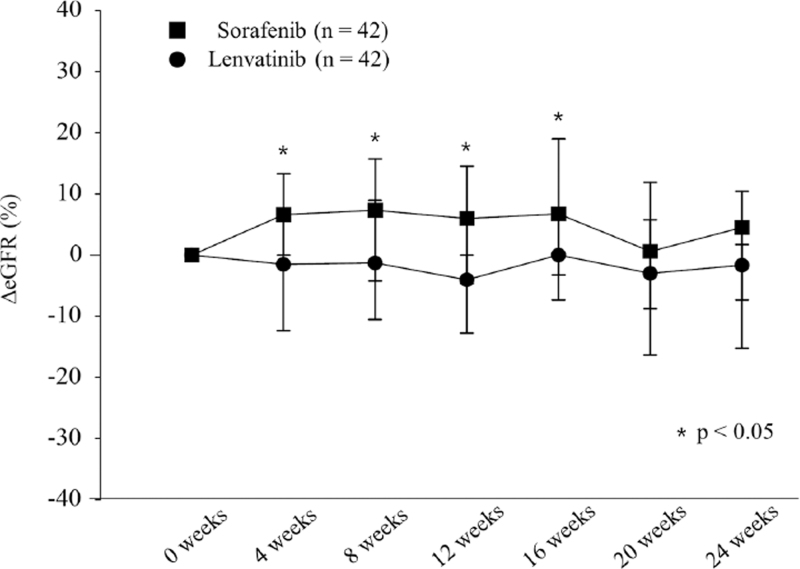
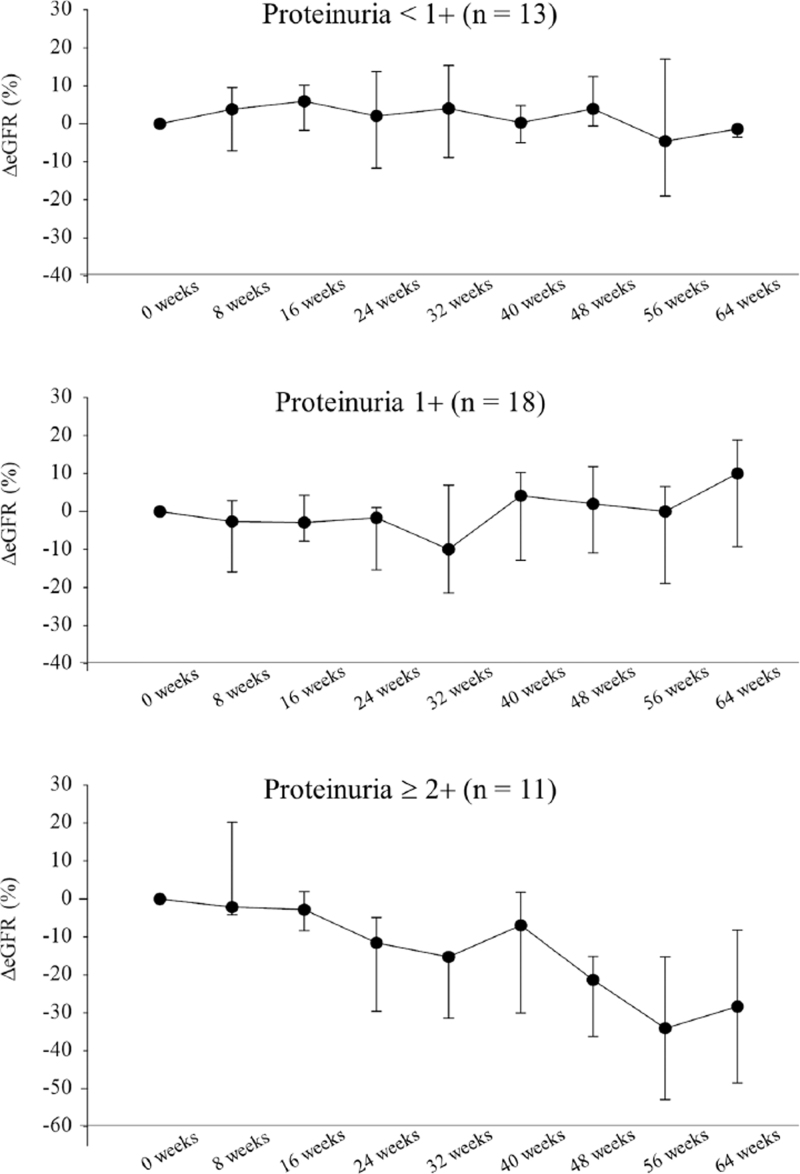
Anti-VEGF drugs, such as tyrosine kinase inhibitors, play an important role in systemic therapy for unresectable hepatocellular carcinoma (uHCC). We examined the effects of sorafenib and lenvatinib on proteinuria and renal function.Patients who were administered sorafenib (n = 85) or lenvatinib (n = 52) as first line treatment for uHCC from July 2009 to October 2020, were enrolled in this retrospective observational study. A propensity score analysis including 13 baseline characteristics was performed. Eighty four patients were selected (sorafenib, n = 42; lenvatinib, n = 42) by propensity score matching (one-to-one nearest neighbor matching within a caliper of 0.2). We analyzed changes in estimated glomerular filtration rate (eGFR) during tyrosine kinase inhibitor treatment, as well as the development of proteinuria in both groups. A multivariate analysis was performed to identify predictors of a deterioration of eGFR.At 4, 8, 12, and 16 weeks, ΔeGFR was significantly lower in the lenvatinib group than in the sorafenib group (P < .05). The lenvatinib group showed a significantly higher frequency of proteinuria than the sorafenib group (30.9% vs 7.1%, P = .005) and had a higher rate of decrease in eGFR than the sorafenib group (P < .05). Multivariate analysis revealed that lenvatinib use was the only predictive factor of eGFR deterioration (odds ratio 2.547 [95% CI 1.028-6.315], P = .043). In cases of proteinuria ≤1+ during lenvatinib treatment, eGFR did not decrease. However, eGFR decreased in the long term (>24 weeks) in patients who have proteinuria ≥2+.Lenvatinib has a greater effect on proteinuria and renal function than sorafenib. In performing multi-molecular targeted agent sequential therapy for uHCC, proteinuria and renal function are important factors associated with drug selection after atezolizumab-bevacizumab combination therapy currently used as the first-line treatment.
抗血管内皮生长因子药物(如酪氨酸激酶抑制剂)在不可切除肝细胞癌(uHCC)的系统治疗中发挥着重要作用。我们研究了索拉非尼和仑伐替尼对蛋白尿和肾功能的影响。
本回顾性观察性研究纳入了 2009 年 7 月至 2020 年 10 月期间接受索拉非尼(n=85)或仑伐替尼(n=52)一线治疗 uHCC 的患者。对包括 13 项基线特征的倾向评分进行了分析。通过倾向评分匹配(在 0.2 卡尺内进行一对一最近邻匹配)选择了 84 名患者(索拉非尼组,n=42;仑伐替尼组,n=42)。我们分析了酪氨酸激酶抑制剂治疗期间估算肾小球滤过率(eGFR)的变化,以及两组蛋白尿的发生情况。采用多变量分析确定 eGFR 恶化的预测因素。
在第 4、8、12 和 16 周,仑伐替尼组的 ΔeGFR 明显低于索拉非尼组(P<0.05)。仑伐替尼组蛋白尿的发生率明显高于索拉非尼组(30.9%比 7.1%,P=0.005),eGFR 下降率也明显高于索拉非尼组(P<0.05)。多变量分析显示,仑伐替尼的使用是 eGFR 恶化的唯一预测因素(比值比 2.547[95%CI 1.028-6.315],P=0.043)。在仑伐替尼治疗期间蛋白尿≤1+的情况下,eGFR 没有下降。然而,在蛋白尿≥2+的患者中,eGFR 在长期(>24 周)下降。
仑伐替尼对蛋白尿和肾功能的影响大于索拉非尼。在对 uHCC 进行多分子靶向药物序贯治疗时,蛋白尿和肾功能是目前作为一线治疗药物使用的阿替利珠单抗联合贝伐珠单抗治疗后药物选择的重要因素。