Suthakar Kirupa, Liberman M Charles
Eaton-Peabody Laboratories, Massachusetts Eye and Ear, Boston, MA, United States.
Department of Otolaryngology, Harvard Medical School, Boston, MA, United States.
J Neurophysiol. 2022 May 18;127(6):1574-85. doi: 10.1152/jn.00402.2021.
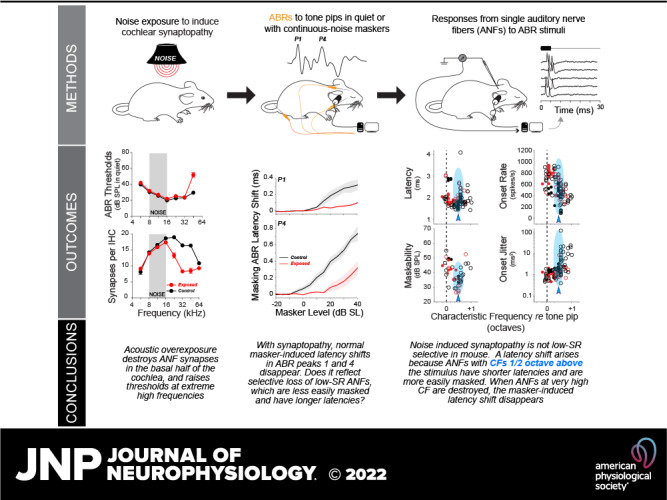
After acoustic overexposure, many auditory-nerve fiber (ANF) synapses permanently retract from surviving cochlear hair cells. This synaptopathy is hard to diagnose, since it does not elevate audiometric thresholds until almost no synapses remain, nevertheless it may degrade discrimination of complex stimuli especially in noisy environments. Here, we study an assay based on masking the auditory brainstem responses (ABRs) to a moderate-level probe tone with continuous noise of varied sound levels, and we investigate the underlying ANF responses at the single-fiber level. Synaptopathy was induced by overexposure to octave-band noise, resulting in a permanent synaptic loss of ~50%, without permanent threshold elevation except at the highest frequencies. The normal progressive delay of ABR peaks with increasing masker level is diminished in synaptopathic ears; however, the single-fiber analysis suggests that this normal latency shift does not arise because contributing ANFs shift from low-threshold fibers (with high spontaneous rates) to high-threshold fibers (with low spontaneous rates). Rather, it may arise because of a shift in the cochlear region dominating the response. Surprisingly, the dynamic range of masking, i.e. the difference between the lowest masker level that attenuates the ABR to a fixed-level probe and the lowest masker level that eliminates the ABR, is enhanced in the synaptopathic ears. This ABR behavior mirrors the single-fiber data showing a paradoxical enhancement of onset-response synchrony and resistance to masking in responses of ANFs in the synaptopathic regions. An assay based on the dynamic range of masking could be useful in diagnosing synaptic damage in human populations.
在听觉过度暴露后,许多听神经纤维(ANF)突触会从存活的耳蜗毛细胞上永久性回缩。这种突触病变很难诊断,因为在几乎没有突触残留之前,它不会提高听力阈值,不过它可能会降低对复杂刺激的辨别能力,尤其是在嘈杂环境中。在此,我们研究了一种基于用不同声级的连续噪声掩盖对中等强度探测音的听觉脑干反应(ABR)的检测方法,并在单纤维水平上研究了潜在的听神经纤维反应。通过过度暴露于倍频程带噪声诱导突触病变,导致约50%的永久性突触损失,除了在最高频率外,没有永久性阈值升高。在突触病变的耳朵中,随着掩蔽声级增加,ABR波峰正常的渐进延迟减小;然而,单纤维分析表明,这种正常的潜伏期变化并非由于起作用的听神经纤维从低阈值纤维(自发率高)转变为高阈值纤维(自发率低)所致。相反,它可能是由于主导反应的耳蜗区域发生了变化。令人惊讶的是,突触病变的耳朵中掩蔽的动态范围,即把ABR衰减到固定水平探测音的最低掩蔽声级与消除ABR的最低掩蔽声级之间的差值,有所增加。这种ABR行为反映了单纤维数据,显示出突触病变区域听神经纤维反应中起始反应同步性和抗掩蔽能力的反常增强。基于掩蔽动态范围的检测方法可能有助于诊断人群中的突触损伤。