Faculdade de Medicina de Marília, Department of Gynecology and Obstetrics - Marília (SP), Brazil.
Universidade de São Paulo, Ribeirão Preto Medical School, Department of Gynecology and Obstetrics - São Paulo (SP), Brazil.
Rev Assoc Med Bras (1992). 2022 May 13;68(6):842-846. doi: 10.1590/1806-9282.20220182. eCollection 2022.
The coronavirus disease 2019 pandemic has disrupted cancer screening worldwide. This study aims to analyze the changes in the rates of screening mammograms and BIRADS 4 or 5 mammograms during the coronavirus disease 2019 pandemic in the opportunistic scenario.
We integrated three different public databases from the state of São Paulo, Brazil, to obtain the rate of screening mammograms per 1,000, and the rate of BIRADS 4 or 5 mammograms per 100,000 women aged from 50 to 69 years in the years from January 2017 to December 2020.
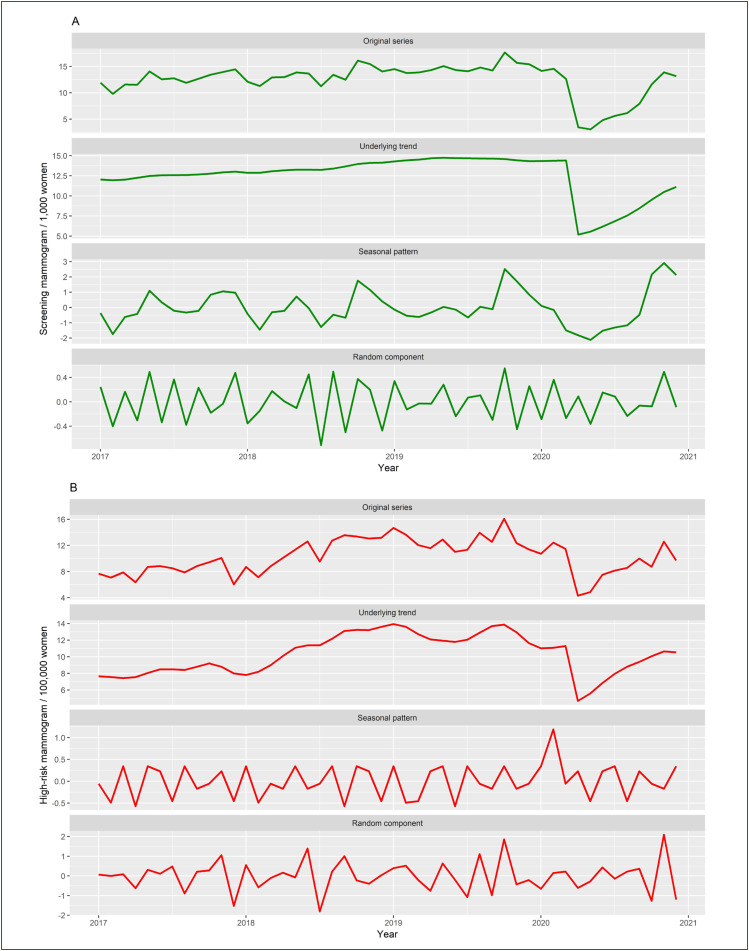
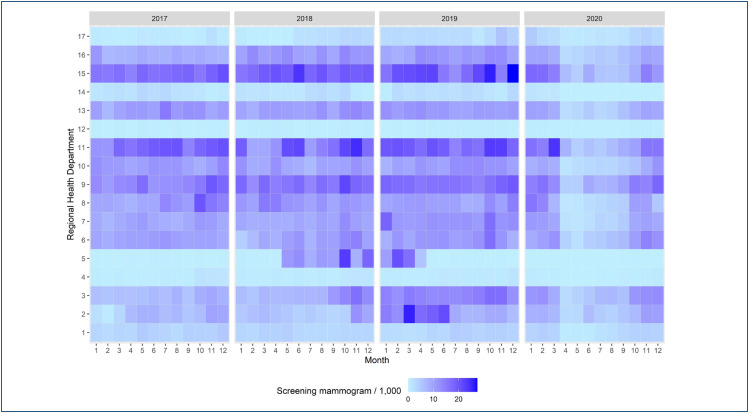
The mean monthly screening mammograms decreased from 14.8/1,000 in 2019 to 9.25/1,000 in 2020, with the lowest rates being recorded in May 2020 (3.1/1,000). The mean monthly high-risk mammograms decreased from 12.8/100,000 in 2019 to 9.1/100,000 in 2020, with the lowest rates being recorded in April 2020 (4.3/100,000).
Coronavirus disease 2019 pandemic significantly decreased mammography screening in an opportunistic scenario, a warning sign for decreasing diagnosis of breast cancer in early stages, and increasing advanced stage diagnosis and mortality in the future.
2019 年冠状病毒病大流行在全球范围内扰乱了癌症筛查。本研究旨在分析在 2019 年冠状病毒病大流行期间,机会性筛查方案中,筛查性乳房 X 光检查和 BI-RADS 4 或 5 乳房 X 光检查的比率变化。
我们整合了来自巴西圣保罗州的三个不同的公共数据库,以获得 2017 年 1 月至 2020 年 12 月期间,年龄在 50 至 69 岁的女性每 1000 人筛查性乳房 X 光检查率和每 100000 人 BI-RADS 4 或 5 乳房 X 光检查率。
平均每月筛查性乳房 X 光检查从 2019 年的 14.8/1000 下降到 2020 年的 9.25/1000,最低的出现在 2020 年 5 月(3.1/1000)。平均每月高危乳房 X 光检查从 2019 年的 12.8/100000 下降到 2020 年的 9.1/100000,最低的出现在 2020 年 4 月(4.3/100000)。
2019 年冠状病毒病大流行显著减少了机会性筛查中的乳房 X 光检查,这是早期乳腺癌诊断减少、未来晚期诊断和死亡率增加的警告信号。