Johns Hopkins University Bloomberg School of Public Health, Center for American Indian Health, Baltimore, USA.
Oklahoma State University, Stillwater, USA.
BMC Public Health. 2022 May 18;22(1):1002. doi: 10.1186/s12889-022-13395-3.
Research on associations between social integration and wellbeing holds promise to inform policy and practice targets for health promotion. Yet, studies of social connection too frequently rely on overly simplistic measures and give inadequate attention to manifestation and meanings of social integration across diverse groups. We use the term socio-cultural integration to describe expanded assessment of both social and cultural aspects of belonging and connection.
We examined 7 distinct indicators of socio-cultural integration, identified heterogeneous patterns of responses across these indicators using latent profile analysis, and determined their relevance for wellbeing using survey data from a study with Indigenous communities in the U.S. and Canada. Wellbeing was measured using holistic ratings of self-rated physical, emotional, and spiritual health.
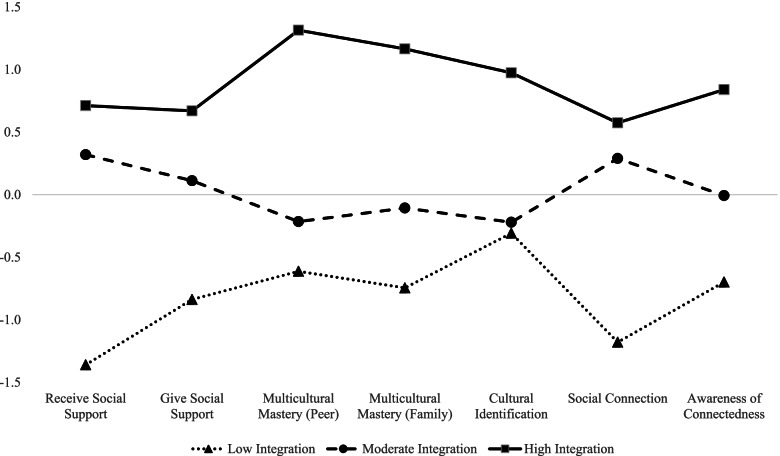
Latent profile analysis (LPA) of responses to the 7 socio-cultural integration variables yielded a 3-class model, which we labeled low, moderate, and high integration. Mean scores on self-rated physical, mental and spiritual health were significantly associated with LPA profiles, such that those in the low integration group had the lowest self-rated health scores and those in the high integration group had the highest health scores. With the exception of similar ratings of cultural identification between low and moderate integration profiles, patterns of responses to the diverse socio-cultural integration measures varied significantly across the 3 latent profiles.
Results underscore the importance of expanding our assessment of social integration with attention to the interrelationships of family, community, culture, and our environment. Such concepts align with Indigenous conceptions of wellbeing, and have relevance for health across cultures. More concretely, the indicators of socio-cultural integration used in this study (e.g., cultural identity, having a sense of connectedness to nature or family, giving or receiving social support) represent malleable targets for inclusion in health promotion initiatives.
社会融合与幸福感之间的关联研究有望为健康促进政策和实践目标提供信息。然而,关于社会联系的研究往往过于依赖过于简单的衡量标准,对不同群体中社会融合的表现和意义关注不足。我们使用社会文化融合一词来描述对归属感和联系的社会和文化方面的扩展评估。
我们研究了 7 种不同的社会文化融合指标,使用潜在剖面分析(LPA)来识别这些指标的异质反应模式,并使用来自美国和加拿大的土著社区研究中的调查数据来确定它们对幸福感的相关性。幸福感是通过对自我评估的身体、情感和精神健康的整体评分来衡量的。
对 7 种社会文化融合变量的反应进行潜在剖面分析(LPA)得出了一个 3 类模型,我们将其标记为低、中、高融合。自我评估的身体、心理和精神健康的平均得分与 LPA 剖面显著相关,即低融合组的自我评估健康得分最低,高融合组的自我评估健康得分最高。除了低和中融合剖面之间对文化认同的相似评分外,对各种社会文化融合措施的反应模式在 3 个潜在剖面中差异显著。
研究结果强调了扩大对社会融合评估的重要性,同时关注家庭、社区、文化和环境之间的相互关系。这些概念与土著人民的幸福感概念一致,对跨文化的健康具有相关性。更具体地说,本研究中使用的社会文化融合指标(例如,文化认同、与自然或家庭有联系的感觉、给予或接受社会支持)代表了可纳入健康促进计划的可塑目标。