Cardiovascular department, Tanta University, EG.
Glob Heart. 2022 Mar 29;17(1):23. doi: 10.5334/gh.1111. eCollection 2022.
Stress hyperglycemia is a common finding during acute myocardial infarction and associated with poor prognosis. To reduce the occurrence of no-reflow, prognostic factors must be identified before primary percutaneous coronary intervention (PPCI). Our objective was to investigate the impact of stress hyperglycemia in non-diabetic and diabetic patients on no-reflow phenomenon after PPCI.
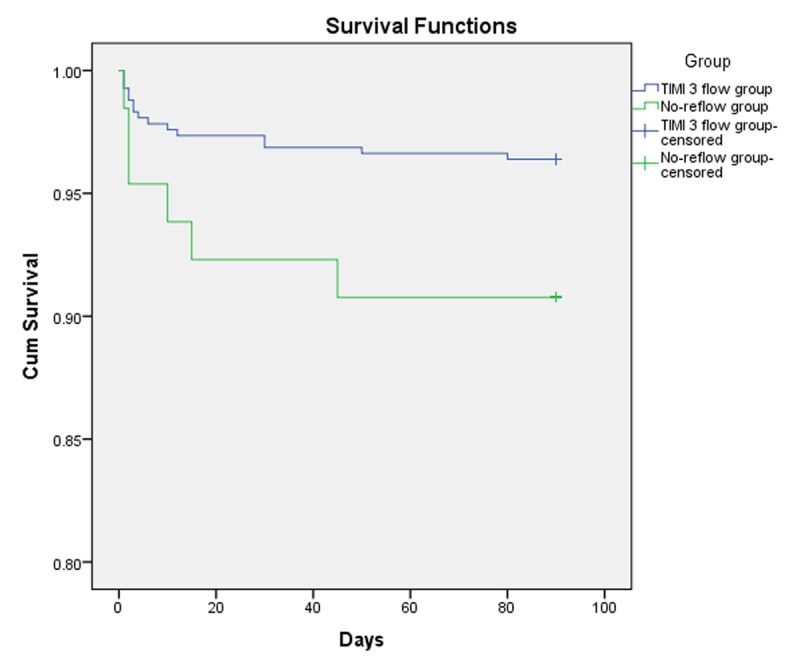
The study comprised 480 patients with ST elevation myocardial infarction (STEMI) who were managed by PPCI. Patients were classified into two groups according to thrombolysis in myocardial infarction (TIMI) flow grade: Group I (Patients with normal flow, TIMI 3 flow) and Group II (Patients with no-reflow, TIMI 0-2 flow). Patients were analyzed for clinical outcomes including mortality and major adverse cardiac events.
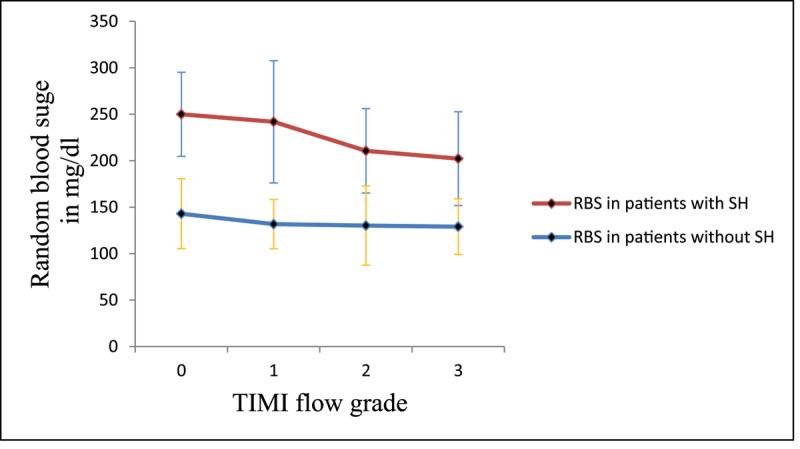
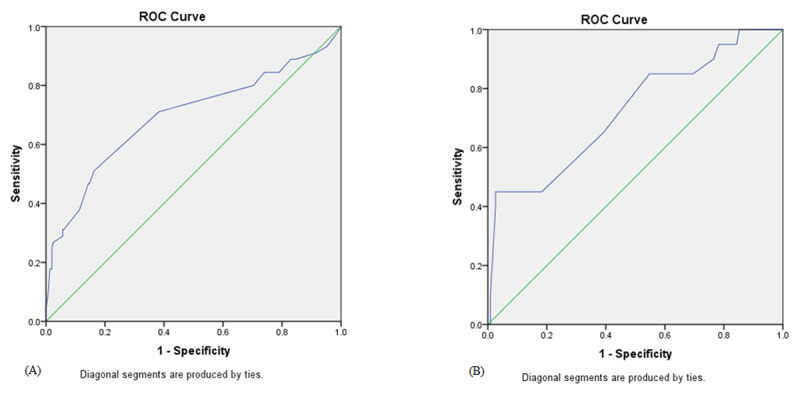
Incidence of stress hyperglycemia was 14.8% in non-diabetic patients and 22.2% in diabetic patients; the incidence of no-reflow phenomenon was 13.5% and no-reflow was significantly higher in patients with stress hyperglycemia. Multivariate regression analysis identified the independent predictors of no-reflow phenomenon: stress hyperglycemia OR 3.247 (CI95% 1.656-6.368, P = 0.001), Killip class >1 OR 1.893 (CI95% 1.004-3.570, P = 0.049) and cardiogenic shock OR 3.778 (CI95% 1.458-9.790, P = 0.006).
Stress hyperglycemia was associated with higher incidence of no-reflow phenomenon. The independent predictors of no-reflow were stress hyperglycemia, Killip class >1 and cardiogenic shock.
应激性高血糖在急性心肌梗死中很常见,与预后不良有关。为了减少无复流的发生,必须在经皮冠状动脉介入治疗(PPCI)前确定预后因素。我们的目的是研究非糖尿病和糖尿病患者应激性高血糖对 PPCI 后无复流现象的影响。
本研究纳入了 480 例接受 PPCI 治疗的 ST 段抬高型心肌梗死(STEMI)患者。根据心肌梗死溶栓治疗(TIMI)血流分级将患者分为两组:组 I(血流正常,TIMI 3 级血流)和组 II(无复流,TIMI 0-2 级血流)。分析患者的临床结局,包括死亡率和主要不良心脏事件。
非糖尿病患者应激性高血糖发生率为 14.8%,糖尿病患者为 22.2%;无复流现象的发生率为 13.5%,应激性高血糖患者的无复流发生率明显更高。多变量回归分析确定了无复流现象的独立预测因素:应激性高血糖 OR 3.247(95%CI 1.656-6.368,P = 0.001),Killip 分级>1 OR 1.893(95%CI 1.004-3.570,P = 0.049)和心源性休克 OR 3.778(95%CI 1.458-9.790,P = 0.006)。
应激性高血糖与无复流现象发生率升高相关。无复流的独立预测因素是应激性高血糖、Killip 分级>1 和心源性休克。