Department of Biochemistry, Indian Institute of Science, Bengaluru, Karnataka, India.
mBio. 2022 Jun 28;13(3):e0040122. doi: 10.1128/mbio.00401-22. Epub 2022 May 19.
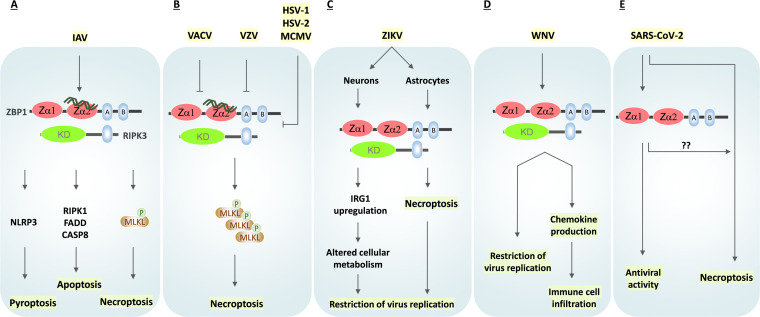
Influenza viruses cause respiratory tract infections, which lead to human disease outbreaks and pandemics. Influenza A virus (IAV) circulates in diverse animal species, predominantly aquatic birds. This often results in the emergence of novel viral strains causing severe human disease upon zoonotic transmission. Innate immune sensing of the IAV infection promotes host cell death and inflammatory responses to confer antiviral host defense. Dysregulated respiratory epithelial cell death and excessive proinflammatory responses drive immunopathology in highly pathogenic influenza infections. Here, we discuss the critical mechanisms regulating IAV-induced cell death and proinflammatory responses. We further describe the essential role of the Z-form nucleic acid sensor ZBP1/DAI and RIPK3 in triggering apoptosis, necroptosis, and pyroptosis during IAV infection and their impact on host defense and pathogenicity . We also discuss the functional importance of ZBP1-RIPK3 signaling in recent severe acute respiratory syndrome coronavirus 2 (SARS-CoV-2) and other viral infections. Understanding these mechanisms of RNA virus-induced cytopathic and pathogenic inflammatory responses is crucial for targeting pathogenic lung infections and human respiratory illness.
流感病毒引起呼吸道感染,导致人类疾病爆发和大流行。甲型流感病毒(IAV)在多种动物物种中传播,主要是水生鸟类。这常常导致新的病毒株通过动物源性传播引起严重的人类疾病。IAV 感染的先天免疫感应促进宿主细胞死亡和炎症反应,从而赋予抗病毒宿主防御。调节不良的呼吸道上皮细胞死亡和过度的促炎反应导致高致病性流感感染中的免疫病理学。在这里,我们讨论了调节 IAV 诱导的细胞死亡和促炎反应的关键机制。我们还描述了 Z 型核酸传感器 ZBP1/DAI 和 RIPK3 在触发凋亡、坏死和焦亡中的重要作用,以及它们在 IAV 感染过程中对宿主防御和致病性的影响。我们还讨论了 ZBP1-RIPK3 信号在最近的严重急性呼吸综合征冠状病毒 2(SARS-CoV-2)和其他病毒感染中的功能重要性。了解这些 RNA 病毒诱导的细胞病变和致病炎症反应的机制对于靶向致病性肺部感染和人类呼吸道疾病至关重要。