Moludi Jalal, Tandorost Arash, Kamari Negin, Abdollahzad Hadi, Pakzad Reza, Najafi Farid, Pasdar Yahya
Research Center for Environmental Determinants of Health (RCEDH) Kermanshah University of Medical Sciences Kermanshah Iran.
School of Nutritional Sciences and Food Technology Kermanshah University of Medical Sciences Kermanshah Iran.
Food Sci Nutr. 2022 Apr 19;10(5):1442-1450. doi: 10.1002/fsn3.2753. eCollection 2022 May.
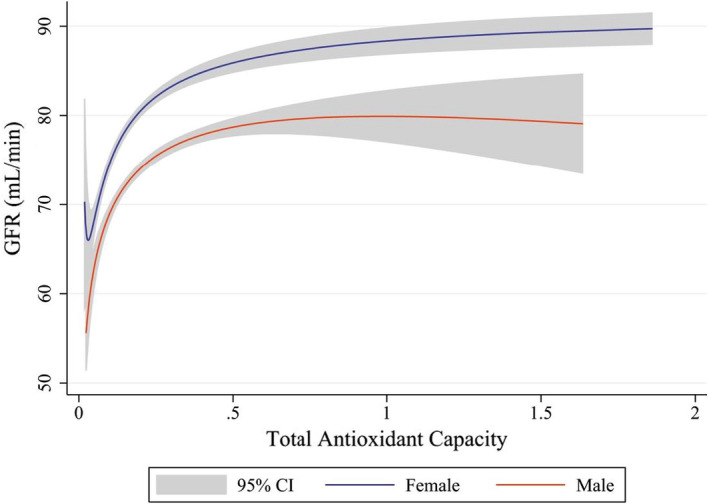
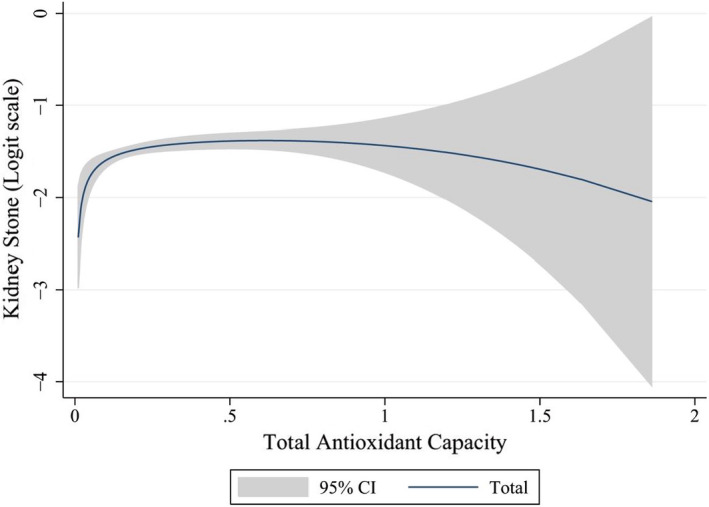
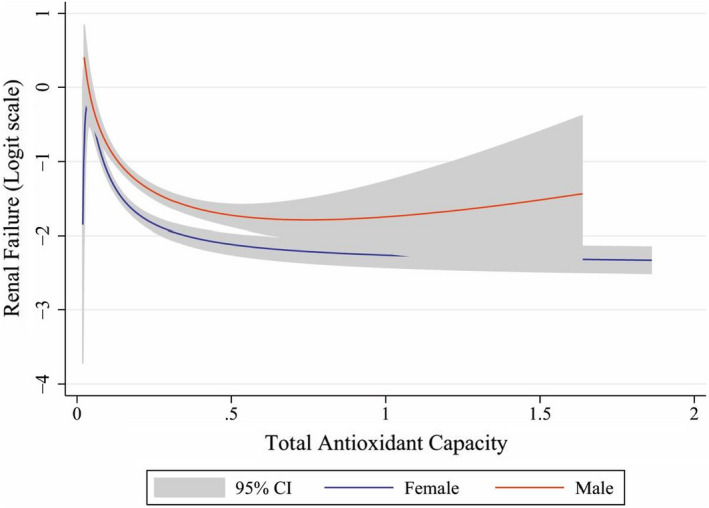
There is evidence to support the hypothesis that dietary antioxidants have shown protective effects against chronic kidney disease (CKD). The purpose of this study was to determine the association between the dietary total antioxidant capacity (DTAC), renal function, and development of CKD and kidney stones in Ravansar Non-Communicable Diseases (RaNCD) cohort study, Kermanshah, Iran. This cross-sectional study was conducted using the recruitment baseline data of the RaNCD cohort study on 9,777 individuals aged 35-65 years. Food frequency questionnaire (FFQ) was performed to assess diet. DTAC scores were calculated using the ferric reducing antioxidant power (FRAP) of selected foods. Renal function was assessed by the estimated glomerular filtration rate (eGFR), blood urea nitrogen, and serum creatinine concentration. Prevalent CKD was based on an eGFR less than <60 ml/min per 1.73 m. Incidence of kidney stones was also assessed by self-reporting. Out of 9,777 participants, 1,747 subjects (eGFR: 18.50 ml/min per 1.73 m; 95% confidence interval (CI): 17.72-19.30) had CKD. The mean DTAC score in this study was 0.24 ± 0.16 µmol TE/100 g (micromole of Trolox Equivalents). We showed a significant trend for eGFR across quartiles of DTAC, i.e., participants in the fourth quartile had a higher glomerular filtration rate (GFR) than those in the first one (DTAC = 82.20 versus 72.20 ml/min per 1.73 m, < .001). Another finding is that high DTAC scores were not associated with having kidney stones after adjusting for confounders. We revealed that higher DTAC scores have positive effects on the renal function. Interestingly, our findings showed that a high DTAC score had nonsignificant correlation with odds of kidney stones.
有证据支持膳食抗氧化剂对慢性肾脏病(CKD)具有保护作用这一假说。本研究的目的是在伊朗克尔曼沙赫拉万萨尔非传染性疾病(RaNCD)队列研究中,确定膳食总抗氧化能力(DTAC)、肾功能以及CKD和肾结石发生之间的关联。这项横断面研究使用了RaNCD队列研究中9777名35 - 65岁个体的招募基线数据。通过食物频率问卷(FFQ)评估饮食情况。使用所选食物的铁还原抗氧化能力(FRAP)计算DTAC得分。通过估算肾小球滤过率(eGFR)、血尿素氮和血清肌酐浓度评估肾功能。CKD的患病率基于eGFR低于每1.73平方米<60 ml/分钟。肾结石的发病率也通过自我报告进行评估。在9777名参与者中,有1747名受试者(eGFR:每1.73平方米18.50 ml/分钟;95%置信区间(CI):17.72 - 19.30)患有CKD。本研究中DTAC得分的平均值为0.24±0.16 μmol TE/100 g(特洛克斯当量微摩尔)。我们发现eGFR在DTAC四分位数间存在显著趋势,即第四四分位数的参与者肾小球滤过率(GFR)高于第一四分位数的参与者(DTAC = 82.20对72.20 ml/分钟每1.73平方米,P <.001)。另一项发现是,在调整混杂因素后,高DTAC得分与患肾结石无关。我们揭示了较高的DTAC得分对肾功能有积极影响。有趣的是,我们的研究结果表明,高DTAC得分与患肾结石的几率无显著相关性。