Lan Wei-Fang, Deng Yan, Wei Bin, Huang Kai, Dai Ping, Xie Shan-Shan, Wu Dan-Dan
Department of Ultrasound, First Affiliated Hospital of Guangxi Medical University, Nanning, China.
Department of Cardiology, First Affiliated Hospital of Guangxi Medical University, Nanning, China.
Front Cardiovasc Med. 2022 May 3;9:843606. doi: 10.3389/fcvm.2022.843606. eCollection 2022.
ambrisentan and phosphodiesterase type 5 inhibitor (PDE5i) have been approved for treating patients with pulmonary arterial hypertension (PAH). Echocardiographic right ventricular pulmonary artery coupling (RVPAC) has been shown to be a valid non-invasive and alternative measurement method to assess the predicted outcomes in PAH patients. The aim of this study was to study the effect and clinical correlates of initial ambrisentan plus PDE5i combination therapy on RVPAC in patients with severe PAH.
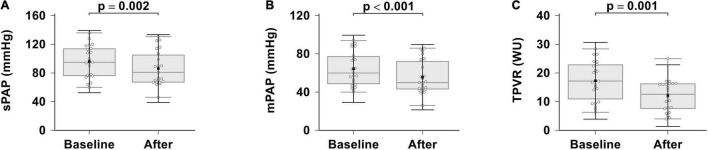
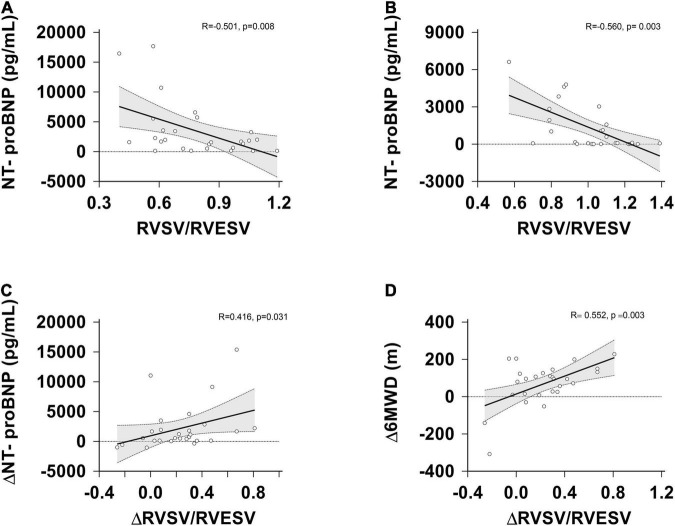
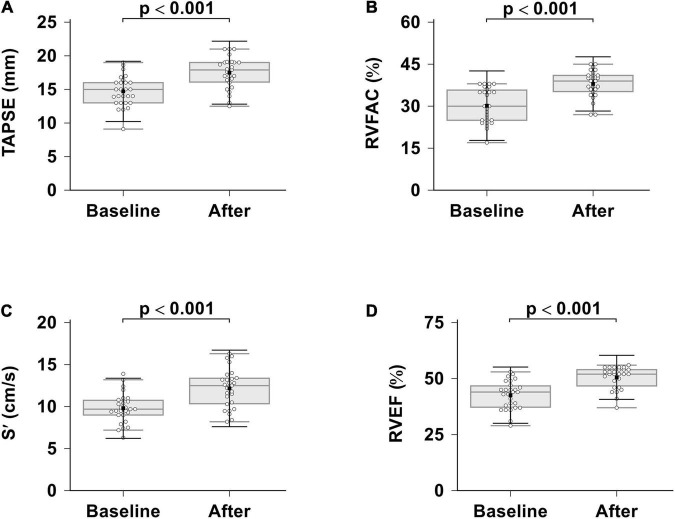
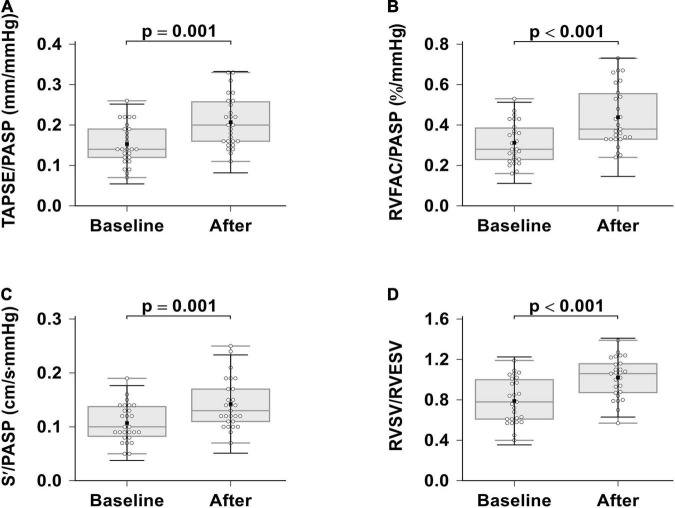
We retrospectively studied and analyzed comprehensive clinical data, hemodynamics, and echocardiography in 27 patients with severe PAH before and after 6 months of initial combination therapy. Compared with the baseline, significant improvements in RVPAC ratios were observed, including RVFAC/PASP (0.31 ± 0.10 vs. 0.44 ± 0.15%/mmHg, < 0.001), TAPSE/PASP (0.15 ± 0.05 vs. 0.21 ± 0.06 mm/mmHg, = 0.001), S'/PASP (0.10 ± 0.03 vs. 0.14 ± 0.05 cm/s∙mmHg, = 0.001), and RVSV/RVESV (0.79 ± 0.22 vs. 1.02 ± 0.20, < 0.001). Functional status indices [World Health Organization functional classifications (WHO-FC) and 6 min walk distance (6MWD) and N-terminal pro B-type natriuretic peptide (NT-proBNP) levels] showed significant improvements. Right heart catheterization (RHC) evaluations for hemodynamic measurements between baseline and the 6-12 month follow-up were sPAP (96 ± 22 vs. 86 ± 24 mmHg, = 0.002), mPAP (64 ± 18 vs. 56 ± 17 mmHg, < 0.001) and TPVR (17.3 ± 6.7 vs. 12.1 ± 5.4 WU, = 0.001). Simultaneously, significant associations between RVPAC ratios and NT-proBNP levels and WHO-FC and 6MWD were observed.
Ambrisentan plus PDE-5i combination therapy resulted in a significant improvement in RVPAC in severe PAH. Importantly, RVPAC parameters correlated with known prognostic markers of PAH.
安立生坦和5型磷酸二酯酶抑制剂(PDE5i)已被批准用于治疗肺动脉高压(PAH)患者。超声心动图右心室肺动脉耦合(RVPAC)已被证明是一种有效的非侵入性替代测量方法,可用于评估PAH患者的预期预后。本研究的目的是探讨初始安立生坦联合PDE5i治疗对重度PAH患者RVPAC的影响及临床相关性。
我们回顾性研究并分析了27例重度PAH患者在初始联合治疗6个月前后的综合临床数据、血流动力学和超声心动图。与基线相比,RVPAC比值有显著改善,包括RVFAC/PASP(0.31±0.10对0.44±0.15%/mmHg,<0.001)、TAPSE/PASP(0.15±0.05对0.21±0.06mm/mmHg,=0.001)、S'/PASP(0.10±0.03对0.14±0.05cm/s∙mmHg,=0.001)和RVSV/RVESV(0.79±0.22对1.02±0.20,<0.001)。功能状态指标[世界卫生组织功能分级(WHO-FC)、6分钟步行距离(6MWD)和N末端B型利钠肽原(NT-proBNP)水平]有显著改善。基线与6-12个月随访期间右心导管检查(RHC)的血流动力学测量结果为sPAP(96±22对86±24mmHg,=0.002)、mPAP(64±18对56±17mmHg,<0.001)和TPVR(17.3±6.7对12.1±5.4WU,=0.001)。同时,观察到RVPAC比值与NT-proBNP水平、WHO-FC和6MWD之间存在显著相关性。
安立生坦联合PDE-5i治疗可使重度PAH患者的RVPAC显著改善。重要的是,RVPAC参数与PAH已知的预后标志物相关。