Barbé Lise, Finkbeiner Steve
Center for Systems and Therapeutics, Gladstone Institutes, San Francisco, CA, United States.
Department of Neurology, University of California, San Francisco, San Francisco, CA, United States.
Front Aging Neurosci. 2022 May 3;14:750629. doi: 10.3389/fnagi.2022.750629. eCollection 2022.
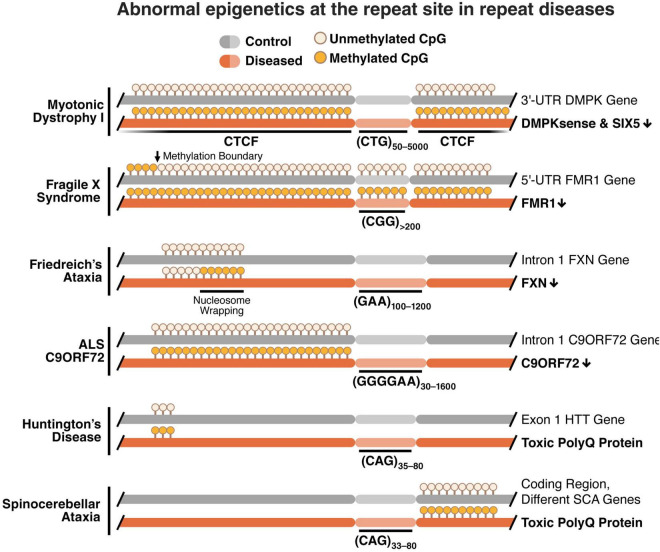
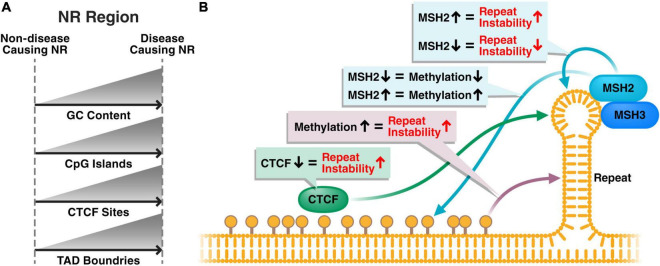
Repeat diseases, such as fragile X syndrome, myotonic dystrophy, Friedreich ataxia, Huntington disease, spinocerebellar ataxias, and some forms of amyotrophic lateral sclerosis, are caused by repetitive DNA sequences that are expanded in affected individuals. The age at which an individual begins to experience symptoms, and the severity of disease, are partially determined by the size of the repeat. However, the epigenetic state of the area in and around the repeat also plays an important role in determining the age of disease onset and the rate of disease progression. Many repeat diseases share a common epigenetic pattern of increased methylation at CpG islands near the repeat region. CpG islands are CG-rich sequences that are tightly regulated by methylation and are often found at gene enhancer or insulator elements in the genome. Methylation of CpG islands can inhibit binding of the transcriptional regulator CTCF, resulting in a closed chromatin state and gene down regulation. The downregulation of these genes leads to some disease-specific symptoms. Additionally, a genetic and epigenetic interplay is suggested by an effect of methylation on repeat instability, a hallmark of large repeat expansions that leads to increasing disease severity in successive generations. In this review, we will discuss the common epigenetic patterns shared across repeat diseases, how the genetics and epigenetics interact, and how this could be involved in disease manifestation. We also discuss the currently available stem cell and mouse models, which frequently do not recapitulate epigenetic patterns observed in human disease, and propose alternative strategies to study the role of epigenetics in repeat diseases.
重复性疾病,如脆性X综合征、强直性肌营养不良症、弗里德赖希共济失调、亨廷顿舞蹈症、脊髓小脑性共济失调以及某些形式的肌萎缩侧索硬化症,是由在受影响个体中扩增的重复性DNA序列引起的。个体开始出现症状的年龄以及疾病的严重程度部分由重复序列的大小决定。然而,重复序列内部及周围区域的表观遗传状态在决定疾病发病年龄和疾病进展速度方面也起着重要作用。许多重复性疾病在重复区域附近的CpG岛处存在甲基化增加的共同表观遗传模式。CpG岛是富含CG的序列,受甲基化严格调控,且常在基因组中的基因增强子或绝缘子元件处发现。CpG岛的甲基化可抑制转录调节因子CTCF的结合,导致染色质处于封闭状态并使基因下调。这些基因的下调会导致一些疾病特异性症状。此外,甲基化对重复序列不稳定性的影响表明了遗传与表观遗传之间的相互作用,重复序列大幅扩增的一个标志是其不稳定性会导致后代疾病严重程度增加。在本综述中,我们将讨论重复性疾病共有的常见表观遗传模式、遗传与表观遗传如何相互作用以及这如何与疾病表现相关。我们还将讨论目前可用的干细胞和小鼠模型,这些模型常常无法重现人类疾病中观察到的表观遗传模式,并提出研究表观遗传学在重复性疾病中作用的替代策略。