IrsiCaixa-AIDS Research Institute and Germans Trias i Pujol Health Research Institute (IGTP), 08916 Badalona, Catalonia, Spain.
Direcció d'Atenció Primària - Metropolitana Nord, 08023 Sabadell, Catalonia, Spain.
Age Ageing. 2022 May 1;51(5). doi: 10.1093/ageing/afac101.
SARS-CoV-2 vaccination is the most effective strategy to protect older residents of long-term care facilities (LTCF) against severe COVID-19, but primary vaccine responses are less effective in older adults. Here, we characterised the humoral responses of institutionalised seniors 3 months after they had received the mRNA/BNT162b2 vaccine.
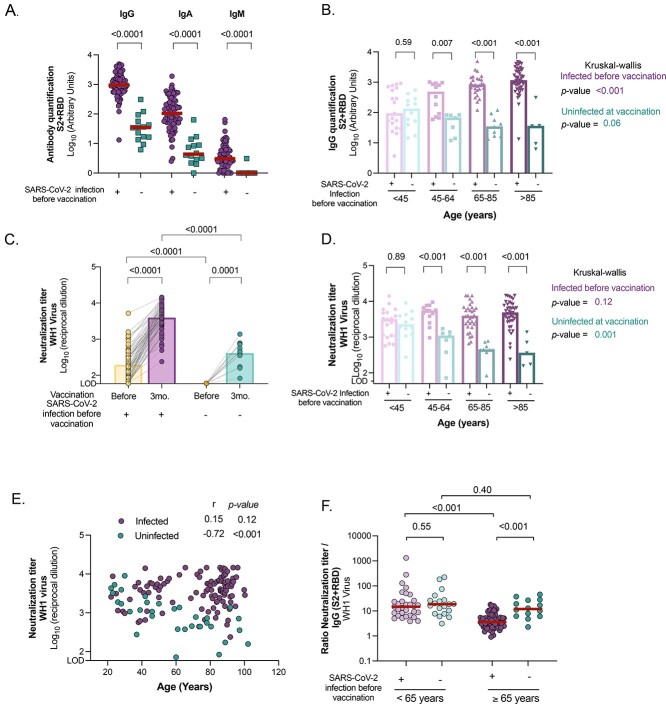
plasma levels of SARS-CoV-2-specific total IgG, IgM and IgA antibodies were measured before and 3 months after vaccination in older residents of LTCF. Neutralisation capacity was assessed in a pseudovirus neutralisation assay against the original WH1 and later B.1.617.2/Delta variants. A group of younger adults was used as a reference group.
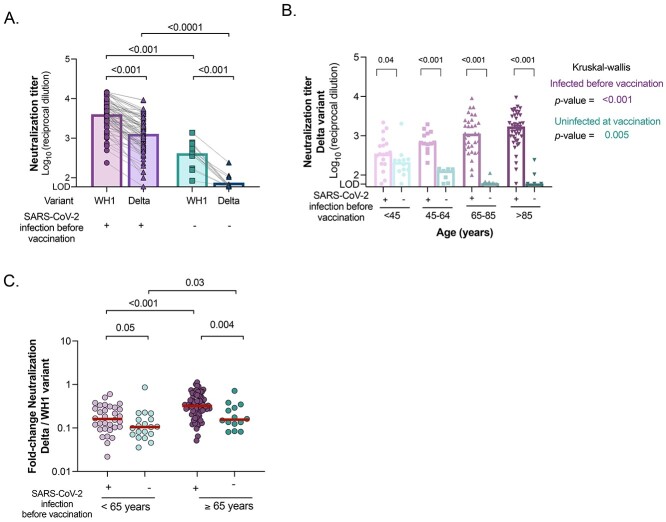
three months after vaccination, uninfected older adults presented reduced SARS-CoV-2-specific IgG levels and a significantly lower neutralisation capacity against the WH1 and Delta variants compared with vaccinated uninfected younger individuals. In contrast, COVID-19-recovered older adults showed significantly higher SARS-CoV-2-specific IgG levels after vaccination than their younger counterparts, whereas showing similar neutralisation activity against the WH1 virus and an increased neutralisation capacity against the Delta variant. Although, similarly to younger individuals, previously infected older adults elicit potent cross-reactive immune responses, higher quantities of SARS-CoV-2-specific IgG antibodies are required to reach the same neutralisation levels.
although hybrid immunity seems to be active in previously infected older adults 3 months after mRNA/BNT162b2 vaccination, humoral immune responses are diminished in COVID-19 uninfected but vaccinated older residents of LTCF. These results suggest that a vaccine booster dose should be prioritised for this particularly vulnerable population.
SARS-CoV-2 疫苗接种是保护长期护理机构(LTCF)中老年人免受严重 COVID-19 的最有效策略,但老年人的初级疫苗反应效果较差。在这里,我们描述了接种 mRNA/BNT162b2 疫苗 3 个月后机构化老年人的体液免疫反应。
在接种疫苗之前和之后 3 个月,测量 LTCF 中老年人的 SARS-CoV-2 特异性总 IgG、IgM 和 IgA 抗体的血浆水平。在针对原始 WH1 和后来的 B.1.617.2/Delta 变体的假病毒中和测定中评估中和能力。使用年轻成年人组作为参考组。
接种疫苗 3 个月后,未感染的老年组与接种疫苗的未感染年轻个体相比,SARS-CoV-2 特异性 IgG 水平降低,对 WH1 和 Delta 变体的中和能力显著降低。相比之下,COVID-19 康复的老年组在接种疫苗后表现出明显更高的 SARS-CoV-2 特异性 IgG 水平,而对 WH1 病毒的中和活性相似,对 Delta 变体的中和能力增加。尽管与年轻个体一样,先前感染的老年人会产生有效的交叉反应性免疫反应,但需要更高数量的 SARS-CoV-2 特异性 IgG 抗体才能达到相同的中和水平。
尽管在接种 mRNA/BNT162b2 疫苗 3 个月后,混合免疫似乎在先前感染的老年人中活跃,但 COVID-19 未感染但接种疫苗的 LTCF 中老年人的体液免疫反应减弱。这些结果表明,应该优先为这一特别脆弱的人群接种疫苗加强针。