Structure of Materials Group, Experiments Division, European Synchrotron and Radiation Facility, Grenoble, France.
Evolutionary Studies Institute, University of Witwatersrand, Johannesburg, South Africa.
Anat Rec (Hoboken). 2022 Oct;305(10):2766-2790. doi: 10.1002/ar.24993. Epub 2022 May 20.
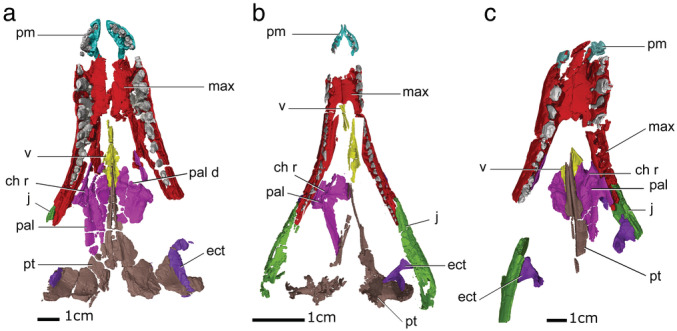
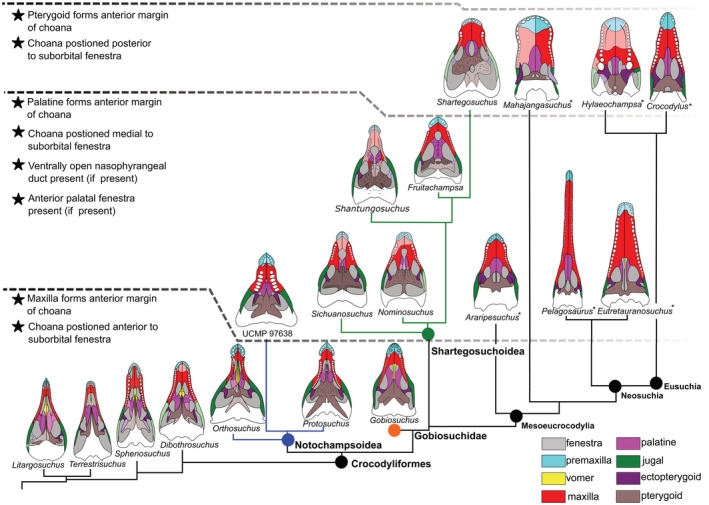
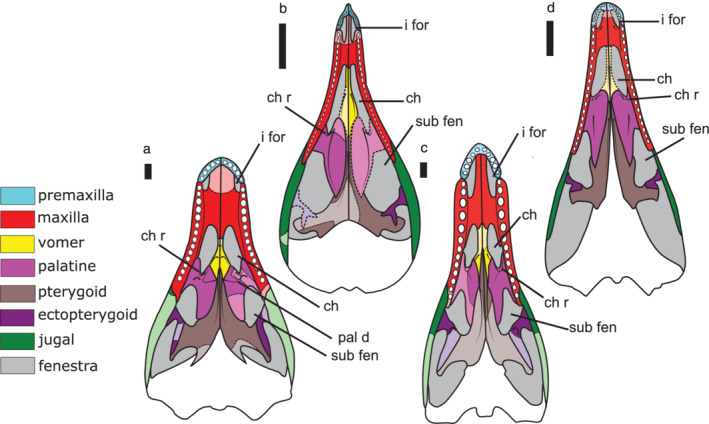
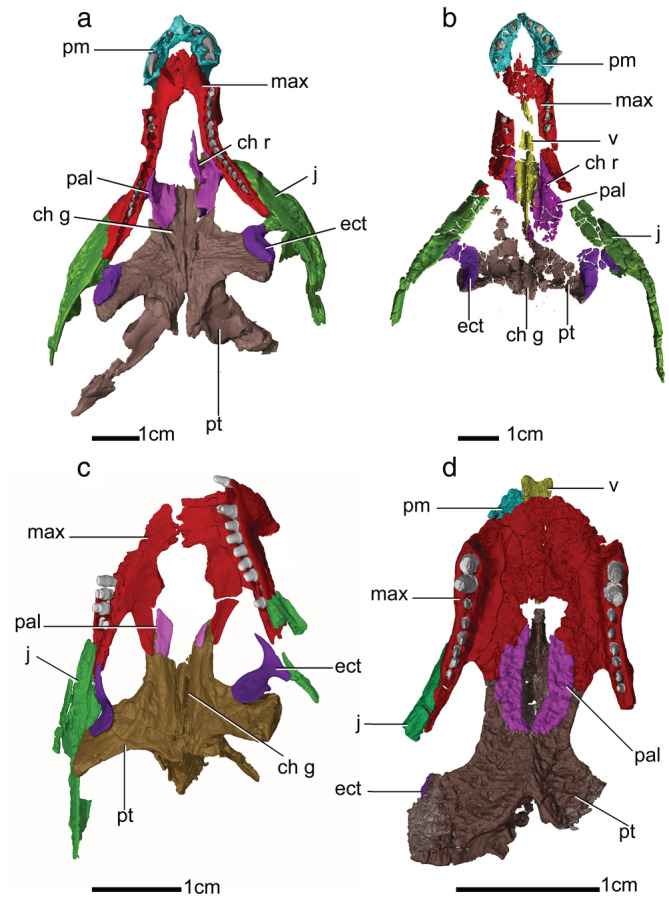
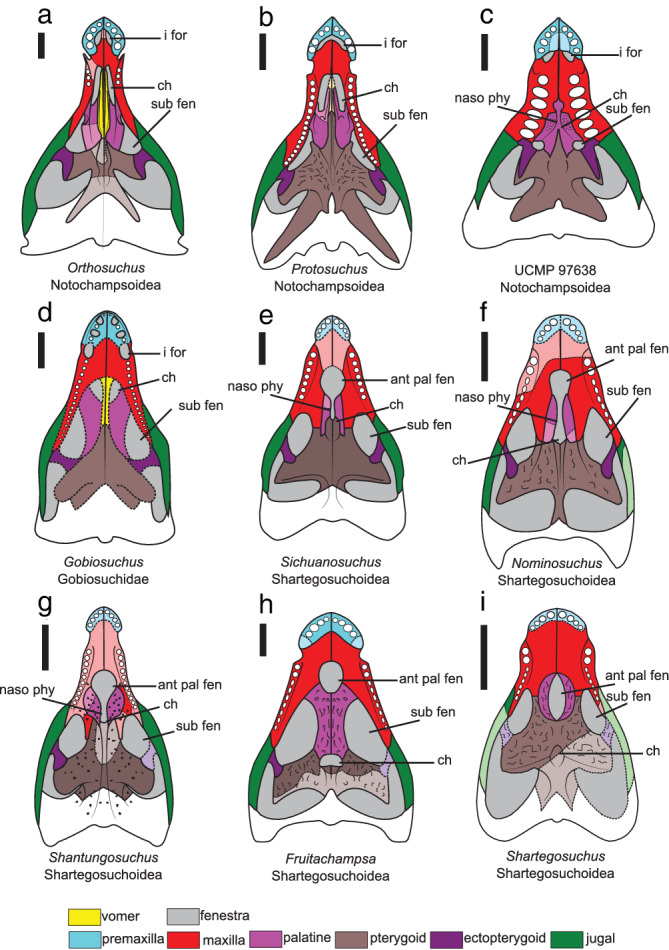
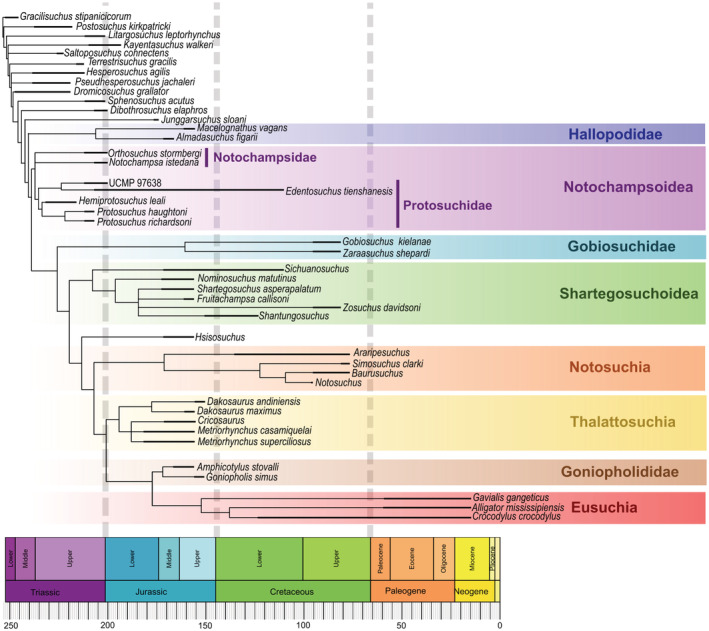
Living crocodylomorphs have an ossified secondary palate with a posteriorly positioned choana that enables their semi-aquatic, predatory ecology. In contrast, the earliest branching members of Crocodylomorpha have an open palate with anteriorly positioned choanae. The evolution of an ossified secondary palate and a posteriorly positioned choana features strongly in hypotheses of broad-scale phylogenetic relationships within Crocodylomorpha. Renewed investigations into palatal morphology among extinct members of the clade show surprising variability in the anatomy of the palate, with at least one and potentially a second independent occurrence of "eusuchian-type" palate outside of Eusuchia. Understanding the trajectory of crocodylomorph palatal evolution is, therefore, a key to inferring crocodylomorph interrelationships and ecomorphology. To document early-branching crocodylomorph palatal anatomy, we developed an anatomical comparative dataset using computed tomography scan data and literature, comprising 12 early-branching crocodylomorph taxa. To understand discrete phenotypic changes in palatal structure, we compiled a phylogenetically broadly sampled character-taxon matrix from the existing literature, and revised its palatal characters, adding 10 new palatal characters. Our comparative anatomical investigations allow us to propose an adapted hypothesis for the closure of the palate and the posterior migration of the choana. Our phylogenetic findings corroborate previous research showing that non-crocodyliform crocodylomorphs ("sphenosuchians") are paraphyletic, with the exclusion of the clade Hallopodidae. Non-mesoeucrocodylian crocodyliforms ("protosuchians") are paraphyletic, but form three monophyletic clades: Notochampsoidea, Shartegosuchoidea, and Gobiosuchidae. We find a potential association between secondary palate development and dietary shifts, particularly with regard to hypothesized origins of herbivory.
现生鳄形超目动物的次生腭骨化,后鼻孔位置后移,这使它们能够适应半水生的掠食生态。相比之下,鳄形超目最早的分支成员具有开放式的腭,前鼻孔位置靠前。次生腭骨化和后鼻孔位置后移的特征在鳄形超目广泛的系统发育关系假说中占有重要地位。对该类群灭绝成员的 palate 形态学的重新研究显示, palate 的解剖结构存在惊人的变异性,至少有一次(而且可能有第二次)“真鳄类型” palate 独立发生于真鳄类之外。因此,理解鳄形超目 palate 进化的轨迹是推断鳄形超目亲缘关系和生态形态的关键。为了记录早期分支鳄形超目 palate 的解剖结构,我们使用计算机断层扫描数据和文献资料开发了一个解剖学比较数据集,其中包含 12 个早期分支鳄形超目分类群。为了了解 palate 结构的离散表型变化,我们从现有文献中编译了一个广泛取样的形态特征-分类群矩阵,并修订了其 palate 特征,增加了 10 个新的 palate 特征。我们的比较解剖学研究使我们能够提出一个适应的假说,即 palate 的关闭和后鼻孔的后移。我们的系统发育学研究结果证实了先前的研究,表明非鳄形类鳄形超目动物(“坚蜥类”)是并系的,排除了 Hallopodidae 科。非中鳄形类鳄形目动物(“原鳄类”)是并系的,但形成了三个单系类群:Notochampsoidea、Shartegosuchoidea 和 Gobiosuchidae。我们发现 secondary palate 发育和饮食变化之间可能存在关联,特别是与假设的食草起源有关。