Burnet Institute, Melbourne, Australia.
Department of Public Health and Primary Care, Ghent University, Ghent, Belgium.
J Glob Health. 2022 May 21;12:04042. doi: 10.7189/jogh.12.04042.
Maternal mental morbidity and low perinatal health service utilisation in resource-constrained settings contribute substantially to the global burden of poor maternal, newborn, and child health. The community-based Mbereko+Men program in rural Zimbabwe engaged women and men in complementary activities to improve men's support for women and babies, coparents' equitable, informed health decision-making, and ultimately, maternal mental health and care-seeking for maternal and newborn health services. The study aimed to test the effectiveness of the Mbereko+Men program on maternal mental health at 0-6 months after childbirth.
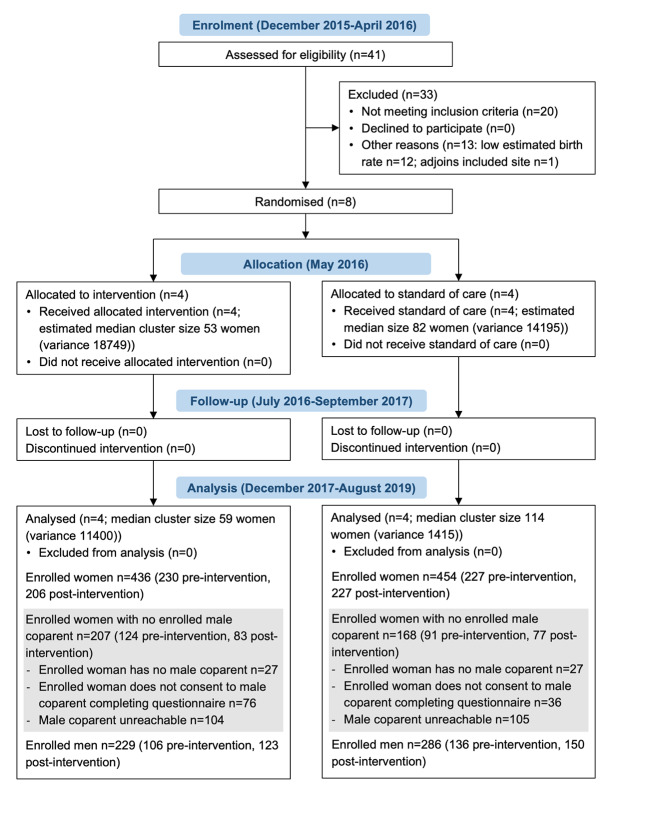
We conducted a cluster-randomised controlled pragmatic trial using a two-arm parallel design with four clusters per arm. Data was data collected through cross-sectional surveys before and after the implementation of the intervention or standard care. Rural health facility catchments in Mutasa District, Zimbabwe, were randomised using a true random number sequence. Survey participants were women who had given birth within 0-6 months and their male coparents. The primary outcome was women's mean Edinburgh Postnatal Depression Scale (EPDS) score. Secondary outcomes captured care-seeking, men's supportive behaviours, and gender dynamics in coparent relationships. Masking was not used. All clusters were included in the analysis. The trial was registered with the Australian New Zealand Clinical Trials Registry (ACTRN12620001014943) in October 2020.
Between April 13 and May 20, 2016, 457 women and 242 men participated in the pre-intervention survey; between October 19 and November 30, 2017, 433 women and 273 men participated in the post-intervention survey. Women's mean EPDS scores declined in both arms. The decline was 34% greater in the intervention arm (adjusted risk ratio = 0.66; 95% confidence interval = 0.48, 0.90, P = 0.008). Improvements in care-seeking, men's support, and coparents' relationships were detected.
A low-intensity gender-synchronised intervention engaged women and men to improve maternal mental health and care-seeking in a setting characterised by gender inequality and demand-side barriers to care.
资源有限环境下产妇精神健康问题和低围产期卫生服务利用率是导致全球产妇、新生儿和儿童健康状况不佳的主要原因。津巴布韦农村的 Mbereko+Men 项目以社区为基础,通过开展互补活动使男女双方参与其中,以改善男性对女性和婴儿的支持、父母共同做出公平知情的健康决策,最终改善产妇心理健康并促进寻求产妇和新生儿卫生服务。本研究旨在检验 Mbereko+Men 项目对产后 0-6 个月产妇心理健康的效果。
我们采用两臂平行设计的聚类随机对照实用试验,每臂有四个簇。数据通过干预前和干预后或标准护理实施的横断面调查收集。津巴布韦穆塔萨区的农村卫生机构采用真随机数字序列进行随机分组。调查对象为产后 0-6 个月内的妇女及其男性伴侣。主要结局是女性爱丁堡产后抑郁量表(EPDS)的平均评分。次要结局包括寻求护理、男性支持性行为以及伴侣关系中的性别动态。没有进行设盲。所有簇均纳入分析。该试验于 2020 年 10 月在澳大利亚和新西兰临床试验注册中心(ACTRN12620001014943)注册。
2016 年 4 月 13 日至 5 月 20 日,457 名妇女和 242 名男子参加了干预前调查;2017 年 10 月 19 日至 11 月 30 日,433 名妇女和 273 名男子参加了干预后调查。两个组中女性的 EPDS 评分均有所下降。干预组下降幅度更大(调整风险比=0.66;95%置信区间=0.48,0.90,P=0.008)。还检测到寻求护理、男性支持和伴侣关系的改善。
一项低强度的性别同步干预使男女双方都参与进来,以改善津巴布韦一个以性别不平等和对护理需求方障碍为特征的环境中的产妇心理健康和寻求护理的情况。