Liu Liang, Liu Junhong, Yang Li, Wen Baohong, Zhang Xiaopan, Cheng Junying, Han Shaoqiang, Zhang Yong, Cheng Jingliang
Department of Magnetic Resonance Imaging, The First Affiliated Hospital of Zhengzhou University, Zhengzhou, China.
Department of Public Health, School of Medicine, Huanghuai University, Zhumadian, China.
Front Psychiatry. 2022 May 6;13:852479. doi: 10.3389/fpsyt.2022.852479. eCollection 2022.
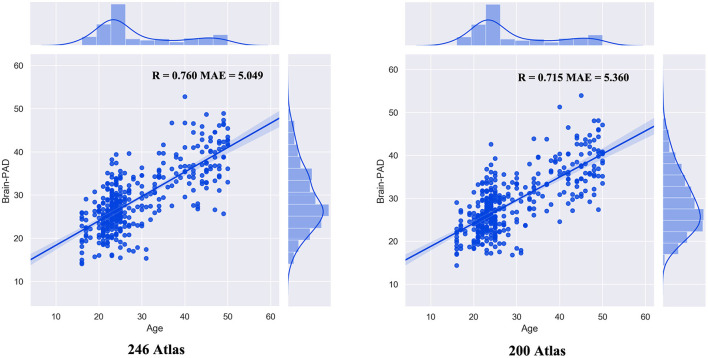
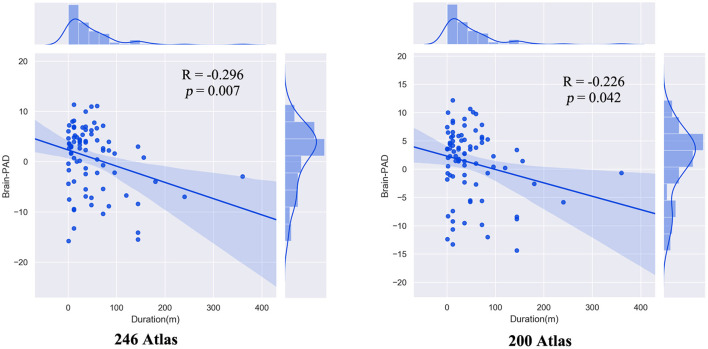
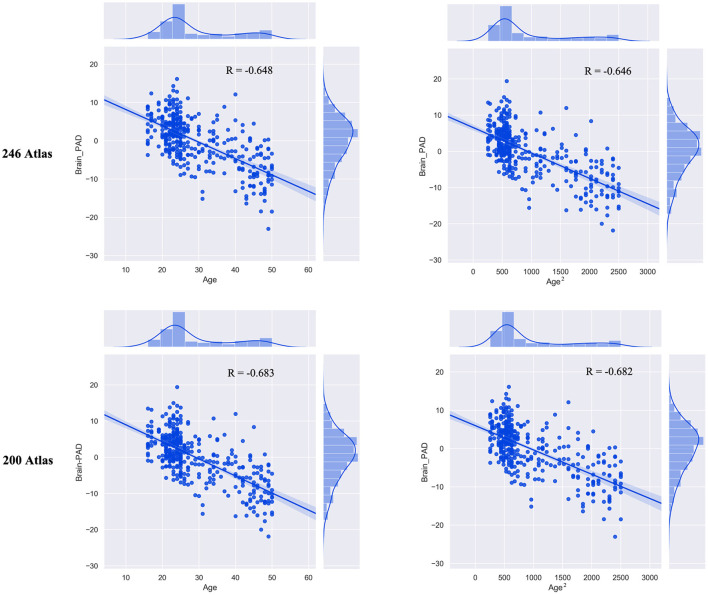
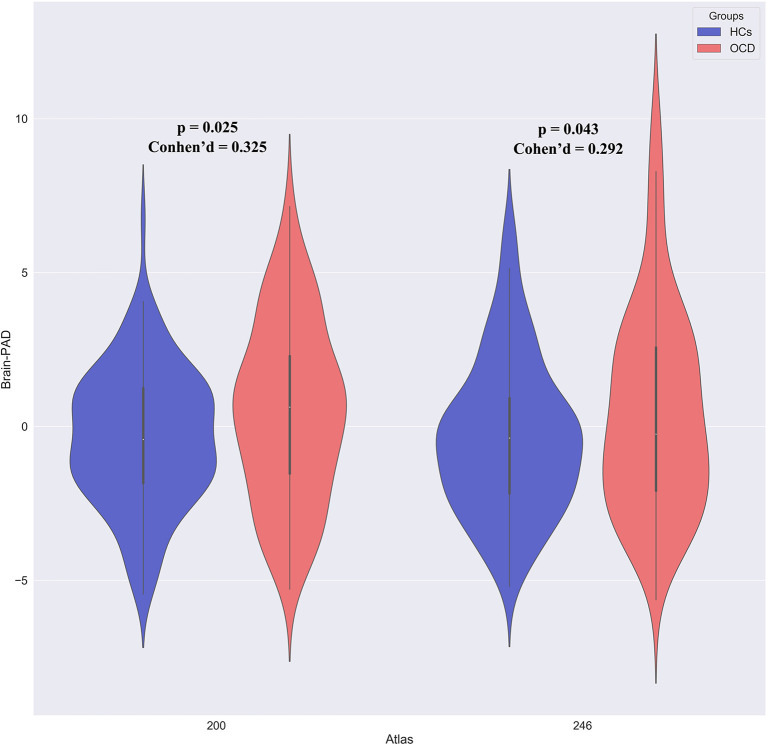
Obsessive-compulsive disorder (OCD) may be accompanied by an accelerated structural decline of the brain with age compared to healthy controls (HCs); however, this has yet to be proven. To answer this question, we built a brain age prediction model using mean gray matter volumes of each brain region as features, which were obtained by voxel-based morphometry derived from T1-weighted MRI scans. The prediction model was built using two Chinese Han datasets (dataset 1, = 106 for HCs and = 90 for patients with OCD; dataset 2, = 270 for HCs) to evaluate its performance. Then, a new prediction model was trained using data for HCs in dataset 1 and applied to patients with OCD to investigate the brain aging trajectory. The brain-predicted age difference (brain-PAD) scores, defined as the difference between predicted brain age and chronological age, were calculated for all participants and compared between patients with matched HCs in dataset 1. It was demonstrated that the prediction model performs consistently across different datasets. Patients with OCD presented higher brain-PAD scores than matched HCs, suggesting that patients with OCD presented accelerated brain aging. In addition, brain-PAD scores were negatively correlated with the duration of illness, suggesting that brain-PAD scores might capture progressive structural brain changes. These results identified accelerated brain aging in patients with OCD for the first time and deepened our understanding of the pathogenesis of OCD.
与健康对照者(HCs)相比,强迫症(OCD)患者可能会随着年龄增长出现大脑结构衰退加速的情况;然而,这一点尚未得到证实。为了回答这个问题,我们构建了一个脑龄预测模型,该模型使用基于体素形态学从T1加权磁共振成像(MRI)扫描中获取的每个脑区平均灰质体积作为特征。该预测模型使用两个中国汉族数据集(数据集1,HCs为106例,OCD患者为90例;数据集2,HCs为270例)进行构建,以评估其性能。然后,使用数据集1中HCs的数据训练一个新的预测模型,并将其应用于OCD患者,以研究大脑衰老轨迹。为所有参与者计算脑预测年龄差(brain-PAD)分数,即预测脑龄与实际年龄之间的差值,并在数据集1中对OCD患者与匹配的HCs进行比较。结果表明,该预测模型在不同数据集上表现一致。OCD患者的brain-PAD分数高于匹配的HCs,这表明OCD患者存在加速的大脑衰老。此外,brain-PAD分数与病程呈负相关,这表明brain-PAD分数可能反映了大脑结构的渐进性变化。这些结果首次确定了OCD患者存在加速的大脑衰老,并加深了我们对OCD发病机制的理解。