Zhang Qiyu, Wang Bin, Hu Nianzhi, Bao Nan, Pan Li, Zhao Yuan, Qin Guixin
Key Laboratory of Animal Production, Product Quality and Security, Ministry of Education, Jilin Provincial Key Laboratory of Animal Nutrition and Feed Science, College of Animal Science and Technology, Jilin Agricultural University, Changchun, 130118, China.
Anim Nutr. 2022 Jan 27;9:233-239. doi: 10.1016/j.aninu.2022.01.001. eCollection 2022 Jun.
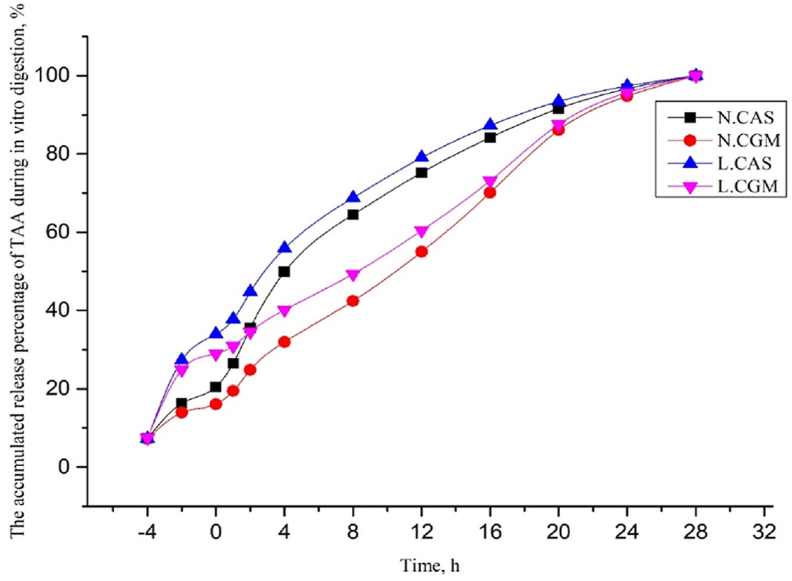
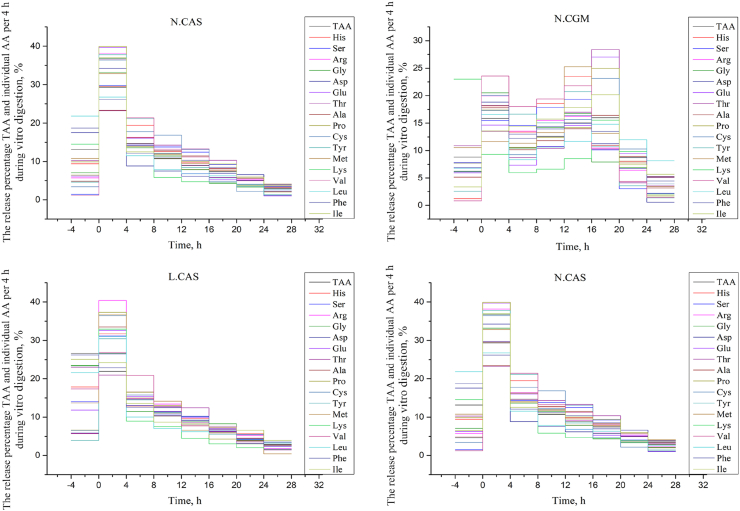
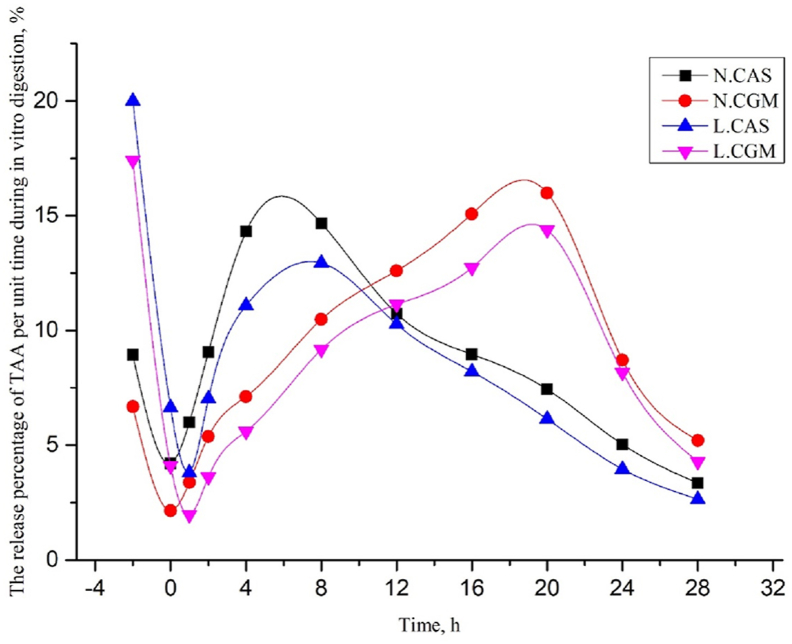
Although the protein content of swine diets is formulated based on the ileal digestibility of protein and amino acids (AA) under current nutrition requirements, the nitrogen utilization efficiency of swine varies based on protein source, which may be related to AA release kinetics. In this experiment, a 2 × 2 factorial arrangement with casein (CAS)-enriched or corn gluten meal (CGM)-enriched protein sources at different digestible crude protein levels (normal [N], 13%; and low [L], 11%) were applied to 24 crossbred (Duroc × Landrace × Yorkshire) growing pigs (average body weight = 43.3 ± 3.5 kg) in 4 treatments (N.CAS, L.CAS, N.CGM, L.CGM, respectively) to investigate the effects of AA release kinetics on nitrogen deposition in growing pigs. Standardized ileal digestible AA in all diets were balanced by adding individual AA to meet the nutrient requirements. The AA release kinetics were detected in vitro by measuring the hydrolysis of various protein diets under pepsin and trypsin conditions. The results demonstrated that the time of AA release peak in the CGM diet was 12 h later than that in the CAS diet. The synchronization indices of dietary AA release in N.CAS, N.CGM, L.CAS, and L.CGM were 23.73%, 29.37%, 23.40%, and 26.07%, respectively. The N.CGM had the poorest AA release synchronism while the N.CAS had the greatest among the 4 diets. However, within the pigs, L.CAS and N.CGM showed the highest (81.08%) and lowest (73.54%) nitrogen biological values, respectively, despite the standard ileal digestible AA levels being equal for all diets. These results indicate that the release kinetics of dietary AA had great effect on nitrogen deposition. To optimize nitrogen deposition, AA release kinetics and composition should be taken into consideration when formulating diets for growing pigs.
尽管在当前营养需求下,猪日粮的蛋白质含量是根据蛋白质和氨基酸(AA)的回肠消化率来配制的,但猪对氮的利用效率会因蛋白质来源而异,这可能与氨基酸释放动力学有关。在本试验中,采用2×2析因设计,将不同可消化粗蛋白水平(正常[N],13%;低[L],11%)的富含酪蛋白(CAS)或玉米蛋白粉(CGM)的蛋白质来源应用于24头杂交(杜洛克×长白×约克夏)生长猪(平均体重 = 43.3 ± 3.5 kg),分为4种处理(分别为N.CAS、L.CAS、N.CGM、L.CGM),以研究氨基酸释放动力学对生长猪氮沉积的影响。通过添加单个氨基酸使所有日粮中的标准化回肠可消化氨基酸达到平衡,以满足营养需求。通过测定各种蛋白质日粮在胃蛋白酶和胰蛋白酶条件下的水解情况,在体外检测氨基酸释放动力学。结果表明,CGM日粮中氨基酸释放峰值时间比CAS日粮晚12小时。N.CAS、N.CGM、L.CAS和L.CGM日粮中氨基酸释放的同步指数分别为23.73%、29.37%、23.40%和26.0%。在这4种日粮中,N.CGM的氨基酸释放同步性最差,而N.CAS的同步性最好。然而,在猪体内,尽管所有日粮的标准回肠可消化氨基酸水平相同,但L.CAS和N.CGM的氮生物学价值分别最高(81.08%)和最低(73.54%)。这些结果表明,日粮氨基酸释放动力学对氮沉积有很大影响。为优化氮沉积,在为生长猪配制日粮时应考虑氨基酸释放动力学和组成。