Majumder Md Anwarul Azim, Lutfor Afzalunnessa Binte, Rabbi Ahbab Mohammad Fazle, Alam A B M Muksudul, Rahman Mizanur, Saha Narayan, Campbell Michael H, Haque Mainul, Nessa Kamrun, Khondoker Mohib Ullah, Das Tapas Ranjan, Rahman Sayeeda, Jahan Fauzia, Mashreky Saidur Rahman, Wahab Abrar, Siddiqui Md Tosaddeque Hossain, Hinkson-Lacorbiniere Karisha, Ivy Roksana, Islam Rezaul, Haider Yusuf, Omar Eliza, Ahmed S M Moslehuddin, Reza A M Selim, Daud A K M, Choudhury Muiz Uddin Ahmed, Hossain Md Abed, Pappu Abdul Matin, Jahan Nusrat, Razzaque Mohammed S
Public Health Foundation of Bangladesh Dhaka Bangladesh.
The University of the West Indies Bridgetown Barbados.
FASEB Bioadv. 2022 Mar 24;4(6):379-390. doi: 10.1096/fba.2021-00158. eCollection 2022 Jun.
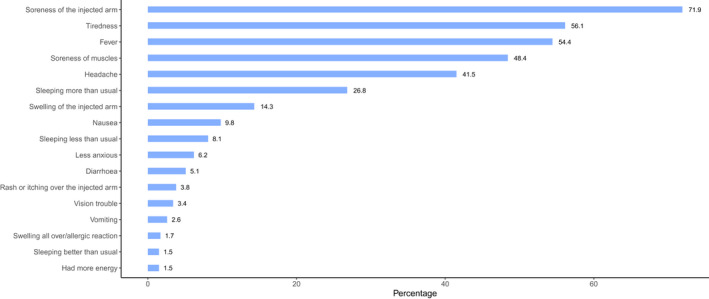
Increased COVID-19 vaccine hesitancy presents a major hurdle in global efforts to contain the COVID-19 pandemic. This study was designed to estimate the prevalence of adverse events after the first dose of the Covishield (AstraZeneca) vaccine among physicians in Bangladesh. A cross-sectional study was conducted using an online questionnaire for physicians ( = 916) in Bangladesh. Physicians who received at least one dose of the COVID-19 vaccine were included. The study was carried out from April 12 to May 31, 2021. More than 58% of respondents ( = 533) reported one or more adverse events. Soreness of the injected arm (71.9%), tiredness (56.1%), fever (54.4%), soreness of muscles (48.4%), headache (41.5%) and sleeping more than usual (26.8%) were the most commonly reported adverse events. Most vaccine-related reactogenicities were reported by the younger cohorts (<45 years). The majority of respondents reported severity of reactogenicity as "mild," experienced on the day of vaccination, and lasting for 1-3 days. The most common reactogenicity was pain at the injection site; the second most common was tiredness. Almost half (49.2%) of the physicians took acetaminophen (paracetamol) to minimize the effects of vaccine reactogenicity. Multivariate logistic regression analyses showed that physicians with diabetes and hypertension (OR = 2.729 95% CI: 1.282-5.089) and asthma with other comorbidities (OR = 1.885 95% CI: 1.001-3.551) had a significantly higher risk of vaccine-related reactogenicities than physicians without comorbidities. Further safety studies with larger cohorts are required to monitor vaccine safety and provide assurance to potential vaccine recipients.
对新冠疫苗接种的犹豫情绪增加是全球遏制新冠疫情努力中的一个主要障碍。本研究旨在估计孟加拉国医生接种第一剂Covishield(阿斯利康)疫苗后不良事件的发生率。采用在线问卷对孟加拉国916名医生进行了一项横断面研究。纳入至少接种一剂新冠疫苗的医生。研究于2021年4月12日至5月31日进行。超过58%的受访者(n = 533)报告了一种或多种不良事件。注射部位疼痛(71.9%)、疲劳(56.1%)、发热(54.4%)、肌肉酸痛(48.4%)、头痛(41.5%)和睡眠时间比平时增多(26.8%)是最常报告的不良事件。大多数与疫苗相关的反应原性是由较年轻的队列(<45岁)报告的。大多数受访者报告反应原性的严重程度为“轻度”,在接种当天出现,持续1至3天。最常见的反应原性是注射部位疼痛;第二常见的是疲劳。几乎一半(49.2%)的医生服用对乙酰氨基酚(扑热息痛)以减轻疫苗反应原性的影响。多因素逻辑回归分析显示,患有糖尿病和高血压的医生(OR = 2.729,95%CI:1.282 - 5.089)以及患有哮喘和其他合并症的医生(OR = 1.885,95%CI:1.001 - 3.551)与无合并症的医生相比,发生疫苗相关反应原性的风险显著更高。需要对更大队列进行进一步的安全性研究,以监测疫苗安全性并向潜在的疫苗接种者提供保证。