Lu Shuai, Yang Zhenpeng, Tang Huazhen, Sun Xibo, Wang Bing, Qu Jinxiu, Wang Yuying, Yang Penghui, Rao Benqiang
Department of General Surgery, Beijing Shijitan Hospital Affiliated Capital Medical University, Beijing 100038, China.
Key Laboratory of Cancer Foods for Special Medical Purpose (FSMP) for State Market Regulation, Beijing 100038, China.
Food Chem (Oxf). 2022 Mar 12;4:100099. doi: 10.1016/j.fochms.2022.100099. eCollection 2022 Jul 30.
Surgical resection remains the primary treatment for gastrointestinal (GI) cancer, omega-3 polyunsaturated fatty acids (n-3 PUFAs) have been reported to improve the prognosis of patients undergoing gastrointestinal tumor surgery. This meta-analysis aims to explore the efficacy of n-3 PUFAs on GI cancer patients undergoing surgery.
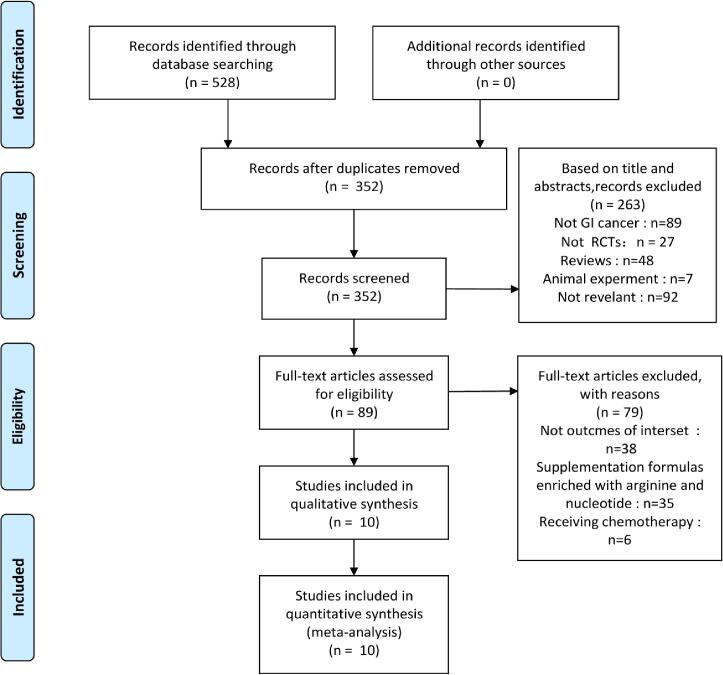
A systematic search of PubMed, Cochrane Library databases, EMBASE (until December 2021) was conducted. PRISMA checklist was followed. The data were analyzed by RevMan v5.3.0.
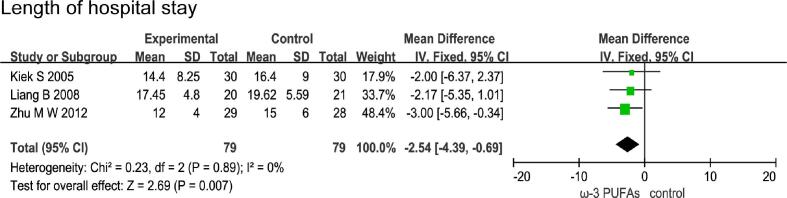
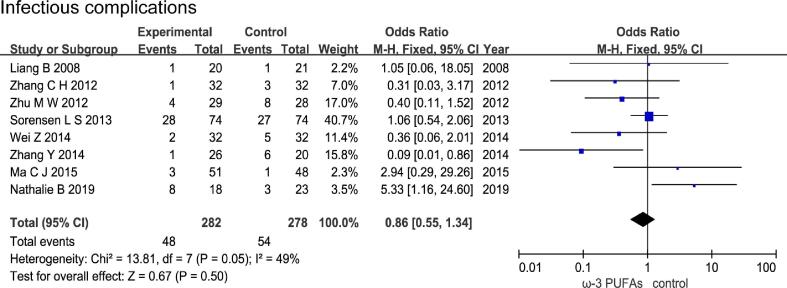
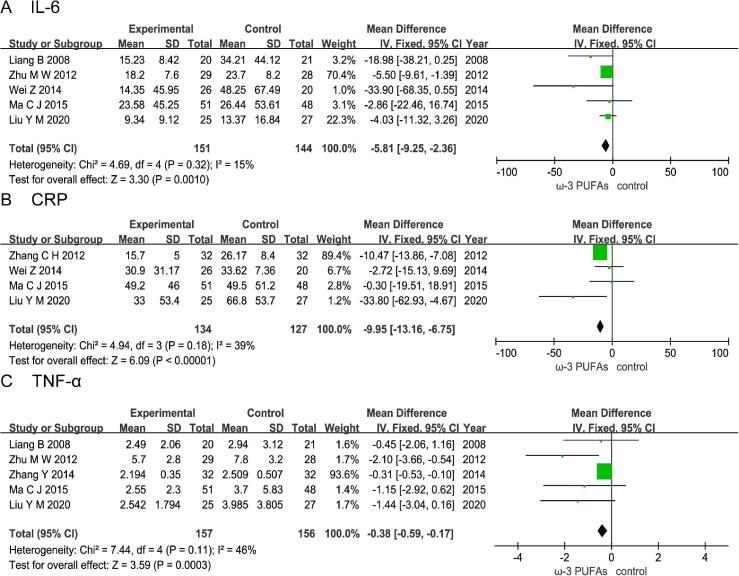
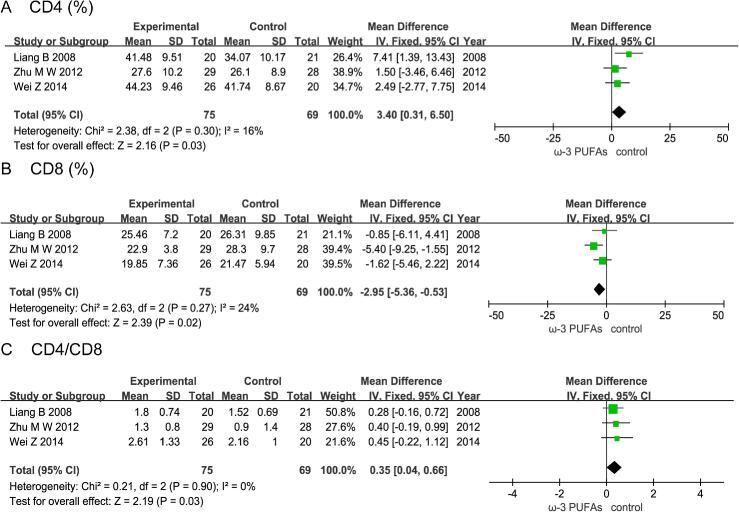
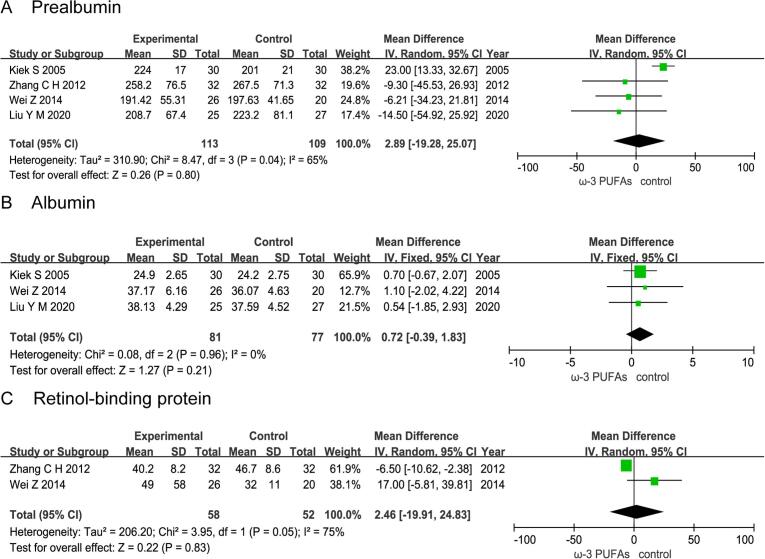
A total of ten RCTs articles including 663 patients were studied. The analysis demonstrated that the n-3 PUFAs group significantly reduced levels of interleukin-6 (IL-6) (P = 0.001), C-reactive protein (CRP) (P < 0.00001), tumor necrosis factor-ɑ (TNF-α) (P = 0.0003) compared with the control group. and higher levels of CD4T cells (P = 0.03), CD8T cells (P = 0.02) and CD4/CD8ratio (P = 0.03) compared with the control group. but there was no significant difference in infection complications rate (P = 0.50) and the level of prealbumin (P = 0.80), albumin (P = 0.21), retinol-binding protein(P = 0.80) between the two groups. In addition, the n-3 PUFAs group significantly reduced the length of hospital stay (P = 0.007).
Our meta-analysis shows that n-3 PUFAs can effectively improve the immune function of patients undergoing gastrointestinal cancer surgery, reduce inflammatory response and reduce the length of hospital stay, But it has no significant impact on the incidence of infectious-related complications and the level of nutrient protein.
手术切除仍然是胃肠道(GI)癌的主要治疗方法,据报道,ω-3多不饱和脂肪酸(n-3 PUFAs)可改善接受胃肠道肿瘤手术患者的预后。本荟萃分析旨在探讨n-3 PUFAs对接受手术的GI癌患者的疗效。
对PubMed、Cochrane图书馆数据库、EMBASE(截至2021年12月)进行系统检索。遵循PRISMA清单。数据采用RevMan v5.3.0进行分析。
共研究了10篇随机对照试验文章,包括663例患者。分析表明,与对照组相比,n-3 PUFAs组显著降低了白细胞介素-6(IL-6)水平(P = 0.001)、C反应蛋白(CRP)水平(P < 0.00001)、肿瘤坏死因子-α(TNF-α)水平(P = 0.0003)。与对照组相比,CD4T细胞水平(P = 0.03)、CD8T细胞水平(P = 0.02)和CD4/CD8比值(P = 0.03)更高。但两组在感染并发症发生率(P = 0.50)以及前白蛋白水平(P = 0.80)、白蛋白水平(P = 0.21)、视黄醇结合蛋白水平(P = 0.80)方面无显著差异。此外,n-3 PUFAs组显著缩短了住院时间(P = 0.007)。
我们的荟萃分析表明,n-3 PUFAs可有效改善胃肠道癌手术患者的免疫功能,减轻炎症反应,缩短住院时间,但对感染相关并发症的发生率和营养蛋白水平无显著影响。