Department of Livestock and Pasture Sciences, Faculty of Science and Agriculture, University of Fort Hare, P/Bag X1314, Alice 5700, South Africa.
Department of Agriculture and Animal Health, University of South Africa, Johannesburg, South Africa.
Open Vet J. 2022 Mar-Apr;12(2):204-211. doi: 10.5455/OVJ.2022.v12.i2.8. Epub 2022 Mar 28.
Parasites contribute significantly to the decline of livestock production and productivity and consequently hamper the availability of protein food resources.
This study aims to report the prevalence of parasitic diseases in the Eastern Cape Province (ECP), South Africa.
Retrospective data of animal diseases in the ECP from 2013 to 2018 was obtained from the veterinary unit of the Department of Rural and Agrarian Reform database, decoded analyzed, and interpreted.
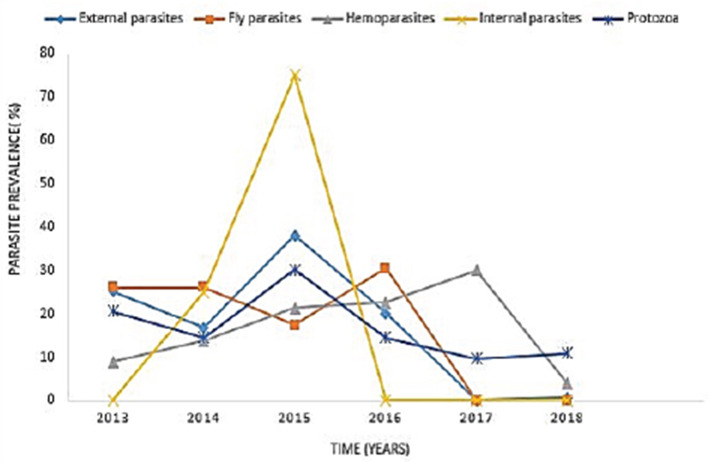
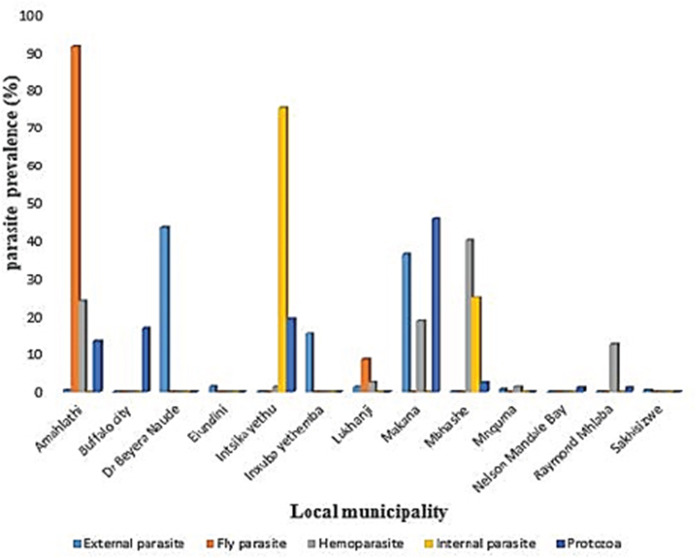
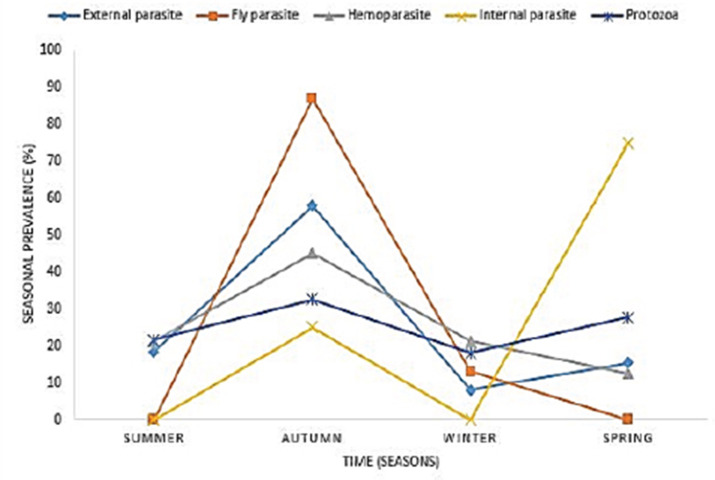
The results reveal a significant association ( < 0.05) between local municipality, seasons, year, and livestock species. Endoparasites (75%) were the highest reported in the year 2015, whereas ectoparasites (38.1%) and fly parasites (30.4%) were mostly reported in the year 2016. The highest prevalence of fly parasites and endoparasites was found in autumn (87%) and spring (75%). The local municipalities with the highest prevalence were Amahlathi (fly parasite, 91.3%), Dr Beyers Naude (ectoparasite, 43.6%), Intsika Yethu (endoparasite, 75%), Makana (protozoa, 45.8%), Mbhashe (hemoparasite, 40%), Raymond Mhlaba municipality (hemoparasite, 12.5%), and Lukhanji (fly parasite, 8.7%). Parasitic diseases diagnosed in the province between 2013 and 2018 were babesiosis (1.7%), anaplasmosis (2.1%), distomatosis (0.1%), goat mange (0.2%), and sheep scab (94%).
The prevalence of parasitic diseases was found unevenly distributed in the local municipalities of the ECP and mostly diagnosed in autumn and spring compared to summer and winter. This study provides baseline information to guide policy-making on disease preventative actions. The recommended action would include appropriate and timely use of acaricide to mitigate problems associated with parasitic diseases.
寄生虫对牲畜生产和生产力的下降有重大影响,从而阻碍了蛋白质食物资源的供应。
本研究旨在报告南非东开普省(ECP)寄生虫病的流行情况。
从农村和农业改革部兽医股数据库中获取 ECP 2013 年至 2018 年动物疾病的回顾性数据,对其进行解码分析和解释。
结果显示,地方直辖市、季节、年份和牲畜种类之间存在显著关联(<0.05)。2015 年报告的内寄生虫(75%)最高,而 2016 年报告的外寄生虫(38.1%)和蝇类寄生虫(30.4%)最多。蝇类寄生虫和内寄生虫的最高流行率出现在秋季(87%)和春季(75%)。流行率最高的地方直辖市是阿玛哈蒂(蝇类寄生虫,91.3%)、拜尔斯诺德(外寄生虫,43.6%)、因茨卡耶图(内寄生虫,75%)、马卡纳(原生动物,45.8%)、姆巴谢(血液寄生虫,40%)、雷蒙德·姆赫拉巴市(血液寄生虫,12.5%)和卢汉吉(蝇类寄生虫,8.7%)。2013 年至 2018 年在该省诊断出的寄生虫病有巴贝斯虫病(1.7%)、无形体病(2.1%)、双腔吸虫病(0.1%)、山羊螨病(0.2%)和绵羊疥癣(94%)。
ECP 地方直辖市的寄生虫病流行情况分布不均,与夏季和冬季相比,秋季和春季寄生虫病的诊断率较高。本研究提供了基线信息,以指导疾病预防行动的决策。建议采取适当和及时使用杀螨剂的行动,以减轻与寄生虫病相关的问题。