From the Comprehensive Stroke Center (S.R.), Department of Neuroscience, Hospital Clinic, University of Barcelona; August Pi i Sunyer Biomedical Research Institute (IDIBAPS)(S.R.), Barcelona, Spain; Centre for Clinical Brain Sciences (E.C., M.S.S., M.T., F.C., G.B., D.J.G., F.D., I.H., J.M.W.), UK Dementia Research Institute, University of Edinburgh, United Kingdom; Institute for Stroke and Dementia Research (A.K., M. Dichgans), University Hospital, LMU Munich; Department of Radiology (M.I.),Ludwig-Maximilians-University Hospital Munich, Germany; Department of Neurology (D.K., J.S., R.v.O.), CARIM-School for Cardiovascular Diseases Maastricht University Medical Center+, Maastricht,; Department of Radiology & Nuclear Medicine (W.H.B.), School for Mental Health & Neuroscience and School for Cardiovascular Diseases, Maastricht University Medical Centre, Netherlands; Institute for Stroke and Dementia Research (ISD) (M. Duering), University Hospital, LMU Munich, Germany; Medical Image Analysis Center (MIAC AG) and Department of Biomedical Engineering (M. Duering), University of Basel, Switzerland; Munich Cluster for Systems Neurology (SyNergy) (M. Dichgans); and German Center for Neurodegenerative Diseases (DZNE) (M. Dichgans), Munich, Germany.
Neurology. 2022 Aug 1;99(5):e440-e452. doi: 10.1212/WNL.0000000000200614.
Magnetic resonance susceptibility-weighted imaging (SWI) can identify small brain blood vessels that contain deoxygenated blood due to its induced magnetic field disturbance. We observed focal clusters of possible dilated small vessels on SWI in white matter in severe small vessel disease (SVD). We assessed their prevalence, associations with SVD lesions, and vascular reactivity in patients with sporadic SVD and in patients with cerebral autosomal dominant arteriopathy with subcortical infarcts and leukoencephalopathy (CADASIL).
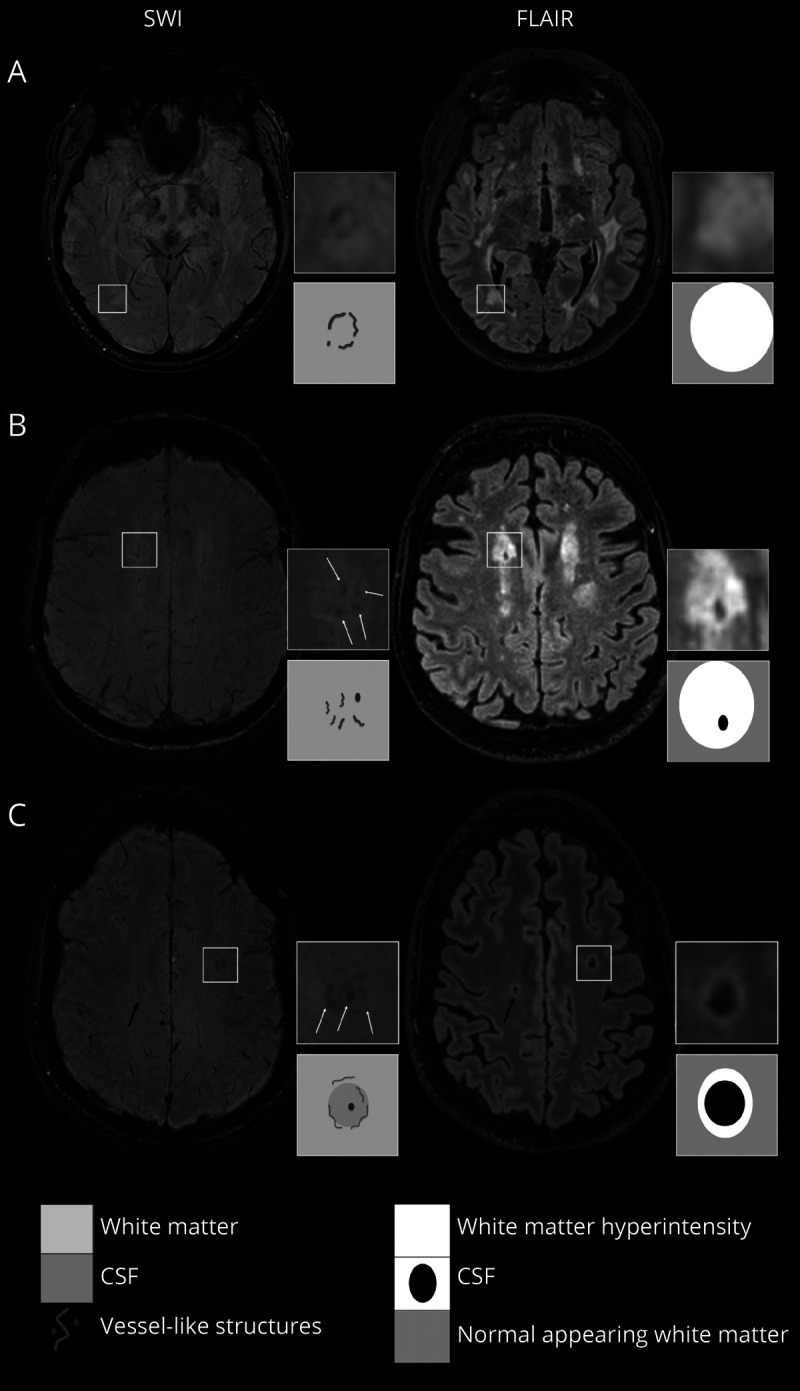
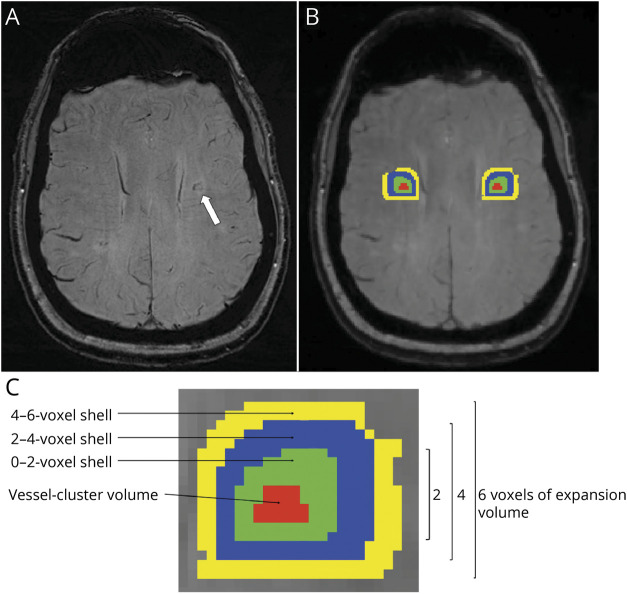
Secondary cross-sectional analysis of a prospective multicenter observational study of patients with either sporadic SVD or CADASIL (INVESTIGATE-SVD) studied with 3 Tesla MRI including blood-oxygen-level-dependent MRI cerebrovascular reactivity (CVR). Two independent raters evaluated SWI sequences to identify "vessel-clusters" in white matter as focal low-signal dots/lines with small vessel appearance (interrater agreement, kappa statistic = 0.66). We assessed per-patient and per-cluster associations with SVD lesion type and severity on structural MRI sequences. We also assessed CVR within and at 2-voxel concentric intervals around the vessel-clusters using contralateral volumes as a reference.
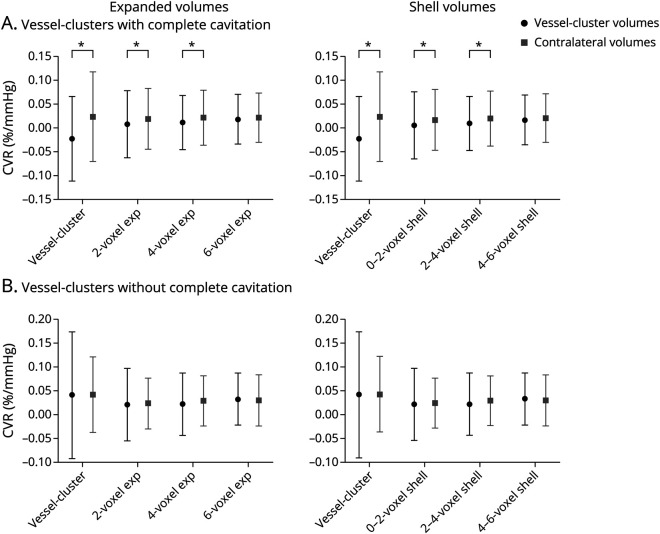
Among the 77 patients enrolled, 76 had usable SWI sequences, 45 with sporadic SVD (mean age 64 years [SD 11], 26 men [58%]) and 31 with CADASIL (53 years [11], 15 men [48%]). We identified 94 vessel-clusters in 36 of the 76 patients (15/45 sporadic SVD, 21/31 CADASIL). In covariate-adjusted analysis, patients with vessel-clusters had more lacunes (OR, 95% CI) (1.30, 1.05-1.62), higher white matter hyperintensity (WMH) volume (per-log10 increase, 1.92, 1.04-3.56), and lower CVR in normal appearing white matter (per %/mm Hg, 0.77, 0.60-0.99), compared with patients without vessel-clusters. Fifty-seven of the 94 vessel-clusters (61%) corresponded to noncavitated or partially cavitated WMH on fluid-attenuated inversion recovery, and 37 of 94 (39%) to complete cavities. CVR magnitude was lower than in the corresponding contralateral volumes (mean difference [SD], , ) within vessel-cluster volumes (-0.00046 [0.00088], -3.021, 0.005) and in the surrounding volume expansion shells up to 4 voxels (-0.00011 [0.00031], -2.140, 0.039; -0.00010 [0.00027], -2.295, 0.028) in vessel-clusters with complete cavities, but not in vessel-clusters without complete cavitation.
Vessel-clusters might correspond to maximally dilated vessels in white matter that are approaching complete tissue injury and cavitation. The pathophysiologic significance of this new feature warrants further longitudinal investigation.
磁共振磁敏感加权成像(SWI)可以识别因磁场干扰而含有脱氧血液的小脑血管。我们在严重小血管疾病(SVD)的脑白质中观察到 SWI 上可能存在的扩张小血管焦点簇。我们评估了它们的患病率,与 SVD 病变的相关性,以及散发性 SVD 患者和伴有皮质下梗死和白质脑病的常染色体显性脑动脉病(CADASIL)患者的血管反应性。
对一项前瞻性多中心观察性研究的二级横断面分析,该研究纳入了 SVD 或 CADASIL 患者(INVESTIGATE-SVD),使用 3T MRI 进行研究,包括血氧水平依赖性 MRI 脑血管反应性(CVR)。两名独立的评分者评估 SWI 序列,以识别白质中的“血管簇”,即具有小血管外观的局灶性低信号点/线(组内一致性,kappa 统计量=0.66)。我们评估了每个患者和每个簇与结构 MRI 序列上 SVD 病变类型和严重程度的相关性。我们还使用对侧体积作为参考,在血管簇内和 2 个体素同心间隔内评估 CVR。
在纳入的 77 名患者中,有 76 名患者的 SWI 序列可用,其中 45 名患有散发性 SVD(平均年龄 64 岁[标准差 11],26 名男性[58%]),31 名患有 CADASIL(53 岁[11],15 名男性[48%])。我们在 36 名患者中的 76 名患者中发现了 94 个血管簇(15/45 名散发性 SVD,21/31 名 CADASIL)。在调整协变量的分析中,有血管簇的患者腔隙数量更多(OR,95%CI)(1.30,1.05-1.62),脑白质高信号(WMH)体积更高(每对数增加 1.92,1.04-3.56),正常表现白质的 CVR 更低(每%/mmHg,0.77,0.60-0.99),与无血管簇的患者相比。94 个血管簇中的 57 个(61%)与液体衰减反转恢复的非空洞或部分空洞性 WMH 相对应,94 个中的 37 个(39%)与完全空洞相对应。与相应的对侧体积相比,血管簇内体积(平均差值[标准差],)内的 CVR 幅度较低(0.00046 [0.00088],-3.021,0.005),在 4 个体素的血管簇体积扩张壳内至 4 个体素(0.00011 [0.00031],-2.140,0.039;0.00010 [0.00027],-2.295,0.028)内,血管簇内存在完全空洞,但不存在不完全空洞。
血管簇可能对应于脑白质中最大扩张的血管,这些血管接近完全组织损伤和空洞化。这一新特征的病理生理意义值得进一步进行纵向研究。